

Last updated:
Estimated reading time: 12 minutes
An educational robot is a physical, interactive device designed to support teaching and learning, and for English Learner programs the most valuable kind is a social robot that gives students speaking practice a screen cannot. This guide explains what educational robots are, what the research actually shows, how schools use them, what they cost and how to fund them, and where an AI robot fits, honestly, in a district’s instructional strategy.
Table of contents
Executive Summary
Educational robots range from coding kits to telepresence devices to social robots that interact through speech. The research is cautiously positive: a major review in Science Robotics found social robots can improve both cognitive and affective learning outcomes, with effects largest for elementary-aged learners and for language learning, largely because of the robot’s physical presence, which traditional screens lack.
For district leaders, the honest framing is this: a robot is not magic, and most consumer “home robots” are irrelevant to schools. The case for an educational robot in a K-12 program rests on one job it does well, giving students engaging, individual speaking practice at a scale teachers cannot, which is exactly the gap English Learner programs struggle with most.
Key Takeaways
- An educational robot is a physical, interactive learning device, not a consumer home robot.
- Types include coding kits, telepresence, and social robots; social robots fit language learning best.
- Evidence is cautiously positive: physical presence boosts engagement and learning, especially for young learners.
- The strongest K-12 use is individual speaking practice at a scale teachers cannot provide.
- Title III can fund a language-focused robot; general STEM robots are a separate budget question.
What Is an Educational Robot?
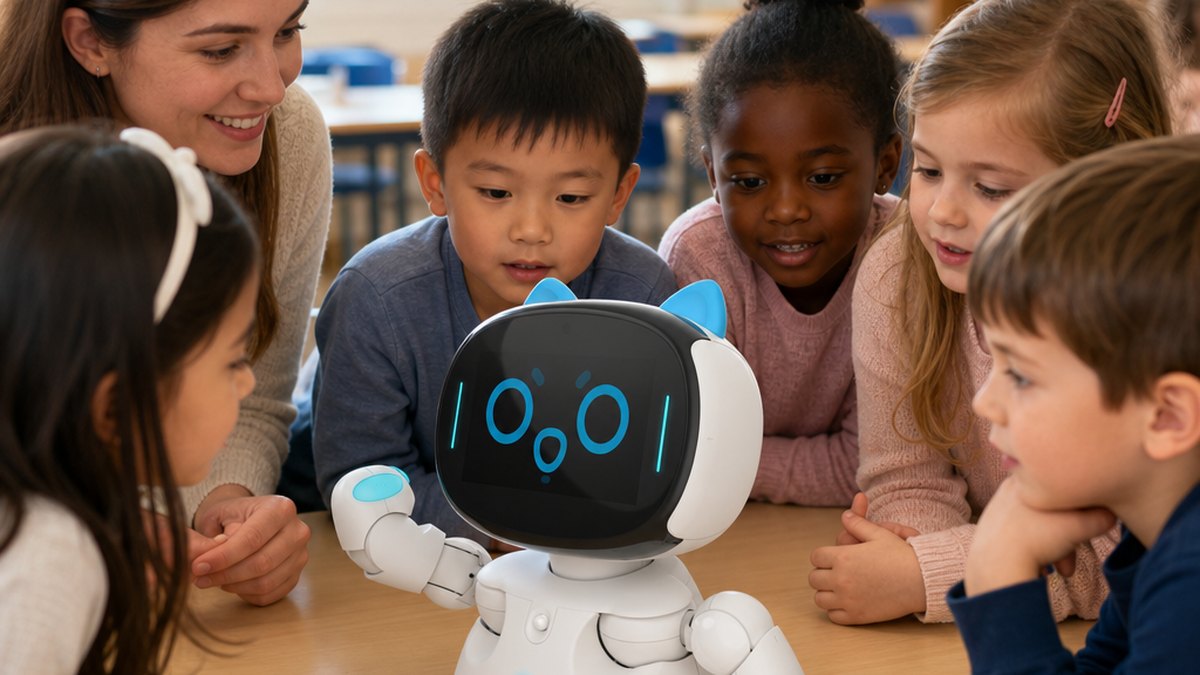
An educational robot is a physical device built to support learning through interaction. Unlike software alone, it has a presence in the room, which research links to stronger engagement. Educational robots fall into a few broad categories. For a fuller definition, see what is an educational robot.
| Type | What It Does | Best Fit |
|---|---|---|
| Coding / STEM kits | Teach programming and engineering | STEM classes (not language) |
| Telepresence robots | Let a remote student or teacher attend | Access and inclusion |
| Social / AI robots | Interact through speech and expression | Language practice, engagement |
What the Evidence Shows
The most cited synthesis, a 2018 review of social robots for education in Science Robotics, concluded that social robots can produce learning gains comparable to human tutoring on focused tasks, and that their physical presence is a key advantage over screen-based tools. Meta-analyses have found positive overall effects on learning, particularly in language learning, with the largest effects for elementary-aged students. The evidence is promising but not unlimited: effects depend on how the robot is used, and robots complement rather than replace teachers. For more, see robots in education and social robots in education.
Classroom Use Cases
In K-12, educational robots are used for guided speaking practice, vocabulary and pronunciation work, station rotations, and engagement for reluctant learners. The clearest EL use case is a speaking-practice station where each student converses with the robot while the teacher works with a small group. For more, see robots in the classroom and robots for language learning.
Cost and Funding
Educational robot pricing varies widely by type and whether software and content are included. The more useful question for districts is funding. A robot that supports English Learners’ language development can be a supplemental, allowable Title III purchase; a general STEM robot is not an EL expense.
| Funding Source | Fit for a Language Robot | How to Access |
|---|---|---|
| Title III, Part A | Yes, if supplemental and EL-focused | Formula grant via state education agency |
| State EL / bilingual funding | Often, for EL supports | State formula |
| TIPS / Region 19 cooperatives | Faster purchasing | Cooperative contract, often no RFP |
For the rules, see can Title III pay for robotics and educational robot cost.
District Benchmark
Translate it. A district piloting one educational robot per EL classroom is really buying one thing: additional individual speaking practice. If a robot gives each student in a rotation several extra minutes of guided conversation a day, across a class of 25 that is practice the single teacher could never deliver one-to-one. The robot’s value is judged not by novelty but by the speaking minutes per student it adds, and whether those minutes show up in proficiency growth.
The Gap a Robot Can Help Close
The reason a language robot earns its place is the Speaking Time Gap: the shortfall between the speaking practice a student needs and what one teacher can provide across a full class.
The math: a teacher with 25 students in a 45-minute block has 1,125 student-minutes and can hold a responsive conversation with one student at a time, leaving each learner only minutes of individual speaking practice per day. A social robot can converse with students the teacher cannot reach at that moment, adding individual practice with the engagement of physical presence. That is the structural case for an educational robot in an EL program.
Common Mistakes District Leaders Make
- Buying novelty. Choosing a robot for the wow factor rather than measurable practice.
- Confusing consumer and educational robots. Home robots are not classroom tools.
- Expecting replacement. Robots augment teachers; they do not replace them.
- Ignoring funding rules. Charging a general STEM robot to EL funds.
- Skipping outcomes. Not measuring whether the robot adds practice and growth.
Recommended Actions
Immediate (this month): Define the single job a robot must do in your program, most often, add individual speaking practice.
Medium-term (this year): Pilot a language-focused robot in a few EL classrooms, funded through Title III where eligible, and measure speaking minutes and growth.
Long-term (strategy): Scale only what demonstrably adds practice and outcomes, and integrate the robot with your broader EL technology.
Questions District Leaders Should Ask
- What specific job will the robot do, and is it language-focused?
- How many speaking minutes per student will it add?
- Is there evidence behind it, and is it FERPA-aligned and COPPA-compliant?
- Can we fund it through Title III or state EL funds?
- How will we measure its effect on proficiency?
Frequently Asked Questions
What is an educational robot?
An educational robot is a physical, interactive device designed to support teaching and learning. Types include coding/STEM kits, telepresence robots, and social robots that interact through speech. For language learning, social robots are the best fit because their physical presence boosts engagement.
Do educational robots actually work?
The research is cautiously positive. A 2018 Science Robotics review found social robots can improve cognitive and affective learning outcomes, with the largest effects for elementary learners and language learning, thanks to physical presence. Effects depend on how the robot is used, and robots complement teachers rather than replacing them.
How much do educational robots cost?
It varies widely by type and whether software and content are included. The more important question is funding: a language-focused robot for English Learners can be a supplemental Title III purchase, while a general STEM robot is a separate budget question.
How do educational robots help English Learners?
The strongest use is individual speaking practice: a social robot gives each student engaging conversation a single teacher cannot provide across a full class, directly addressing the speaking gap that limits EL proficiency.
Related Resources
- AI Robot vs Tablet Learning
- AI Robots for Elementary Schools
- Future of Educational Robotics
- Robots in Education: Benefits and Evidence
- Robots for Language Learning
- Robot Teacher: Can a Robot Teach?
- Can Title III Pay for Robotics?
- AI for English Learners
Conclusion
An educational robot is worth a district’s attention not because it is futuristic but because of one practical job: adding the individual, engaging speaking practice that English Learners need and teachers cannot scale. The evidence supports that role, especially for young learners and language learning, when the robot is chosen for outcomes rather than novelty and funded as the EL tool it is. Judge it by the practice it adds and the growth it produces, and an educational robot becomes a real lever rather than a gadget.
Sources: Belpaeme et al., “Social robots for education: A review,” Science Robotics (2018); U.S. Department of Education, Title III, Part A.
Buying for the One Job That Matters
Set the categories, the studies, and the funding tables aside, and a district decision comes down to a single classroom fact. A teacher with twenty-five students can hold a real conversation with one child at a time, which leaves each English Learner only a couple of minutes of genuine speaking practice a day.
That shortfall is structural, not a matter of effort or skill. It is fixed by the ratio of one adult to a full class, and it is the exact place a well-chosen robot earns its keep, taking the individual, patient speaking practice the schedule cannot otherwise supply.
This is why the guidance throughout points to one job rather than a wish list: pick the robot for the speaking practice it adds, fund it as the EL tool it is, and measure it in minutes and growth. Telo AI is one example built for that job, in English plus Spanish and French.
See how a robot turns that one job into daily practice: https://mytelo.ai/how-telo-works/
Bought for wow, a robot ends up in a corner. Bought for the narrow, high-value work a teacher cannot scale, it becomes a lever, and the difference is entirely in what you asked it to do before you signed the purchase order.
Found this guide useful?
Preferred sources show up more often in your Google results, including AI Overviews.