

Last updated:
Estimated reading time: 5 minutes
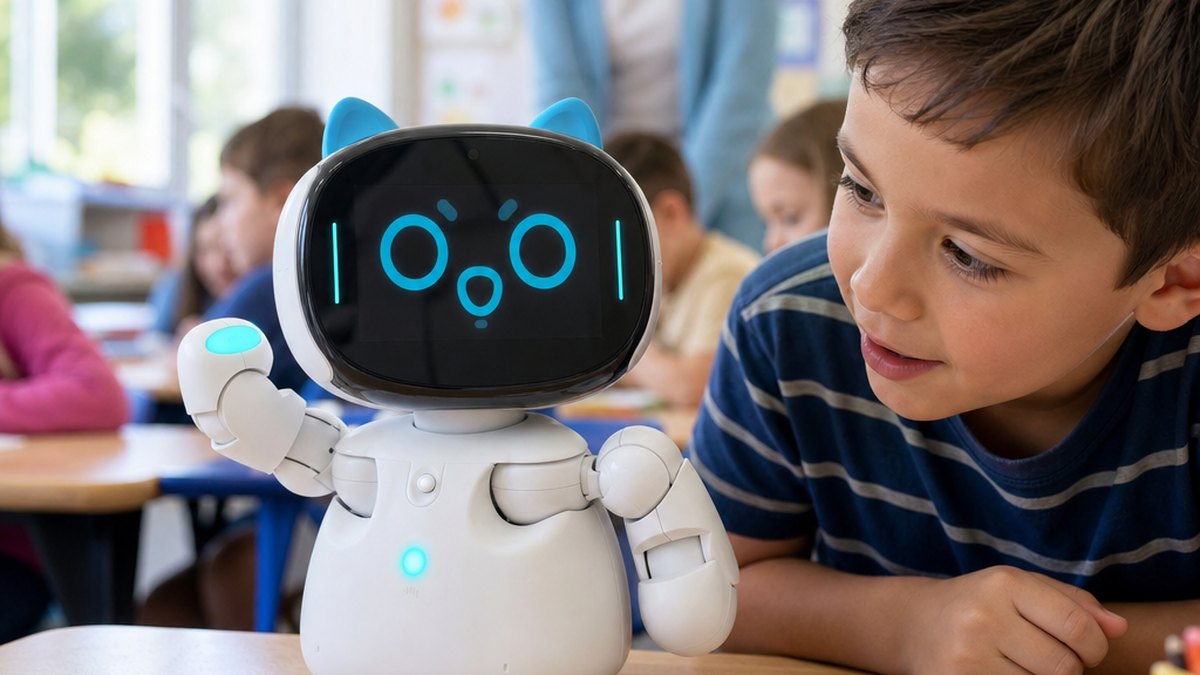
What is an educational robot? It is a physical, interactive device designed to support teaching and learning, distinct from consumer home robots and from software alone. The defining feature is presence: a robot occupies the room and interacts, which research links to higher engagement. This short guide defines the educational robot, outlines the main types, and explains how schools use them.
Table of contents
Executive Summary
An educational robot is a physical device built for learning, used as a tool, tutor, or peer learner. The main types are coding/STEM kits, telepresence robots, and social or AI robots that interact through speech. For language learning, social robots fit best because their presence boosts engagement and they can provide individual speaking practice. The term excludes consumer home robots, which are not classroom tools.
Key Takeaways
- An educational robot is a physical, interactive learning device.
- Three main types: coding/STEM, telepresence, and social/AI robots.
- Social robots fit language learning best.
- Presence drives engagement, the key advantage over screens.
- Not the same as a consumer home robot.
Definition
An educational robot is a physical, programmable or interactive device used to support instruction and learning. It may teach (as a tutor), be taught (as a peer learner the student instructs), or serve as a tool students operate. What sets it apart from other edtech is embodiment: a presence in the classroom that students respond to.
Quick answer: an educational robot is a physical, interactive device designed to help students learn, used as a tutor, a peer learner, or a tool.
The Main Types
| Type | Purpose | Best Fit |
|---|---|---|
| Coding / STEM kits | Teach programming and engineering | STEM classes |
| Telepresence robots | Enable remote presence | Access, inclusion |
| Social / AI robots | Interact through speech and expression | Language practice, engagement |
How Schools Use Them
Schools use educational robots for coding instruction, remote attendance, engagement, and, most relevant to EL programs, individual speaking and skills practice in a station rotation. For the EL angle, see robots for language learning and robots in the classroom.
Why the Social Robot Matters for EL
The social robot matters because it addresses the Speaking Time Gap: the shortfall between the speaking practice a student needs and what one teacher can provide across a full class. A teacher with 25 students can speak with one at a time; a social robot adds individual conversation for the others, with the engagement of presence.
Common Mistakes District Leaders Make
- Confusing types. Treating a coding kit and a social robot as interchangeable.
- Including consumer robots. Home robots are not educational robots.
- Ignoring fit. Choosing a type that does not match the goal.
A Short History of the Educational Robot
The idea of a robot as a learning device is older than most people assume. Its intellectual roots reach back to the work of Seymour Papert at MIT, whose Logo programming language in the late 1960s and 1970s let children direct a small floor robot, the Logo turtle, and learn mathematical and computational thinking by doing. Papert’s argument was that children learn deeply by building and controlling things, and the turtle made abstract ideas physical. That principle still underlies the coding and STEM robots in classrooms today.
The next milestone was the arrival of affordable, buildable robotics kits in schools, which spread programming and engineering education to a much wider set of students. More recently the field has extended in a new direction: instead of robots that children build and program, social and AI robots that children interact with through speech. This shift, driven by advances in conversational AI, moved educational robotics beyond the STEM lab and into areas like language learning, where the value is not in constructing the robot but in talking with it. Understanding this history clarifies why the term educational robot now covers such different machines, from a plastic coding kit to a conversational social robot, and why choosing the right one depends entirely on the learning goal.
What Makes a Robot Educational Rather Than a Toy
Not every robot marketed to families or schools is genuinely educational, and the difference is worth naming. A true educational robot is built around a learning purpose rather than entertainment. That shows up in several ways. It aligns to a curriculum or a set of standards, so its activities reinforce what students are meant to learn rather than simply amuse them. It adapts to the learner, adjusting difficulty or content based on how the student responds, instead of running the same fixed routine for everyone. It produces information a teacher can use, reporting on what a student practiced and how they did, so the robot supports instruction rather than sitting apart from it. And, especially in a school context, it is designed with student safety and data privacy in mind. A toy robot may talk, move, and delight a child, but without a learning purpose, adaptation, and teacher-facing data, it does not do the instructional work that justifies a place in a classroom. For a district evaluating options, these four traits, purpose, adaptation, teacher data, and safety, are a practical test of whether a device is educational in substance or only in marketing.
Frequently Asked Questions
What is an educational robot?
A physical, interactive device designed to support teaching and learning, used as a tutor, a peer learner, or a tool. Its defining feature is presence in the classroom, which boosts engagement compared with screens.
What are the types of educational robots?
Coding/STEM kits, telepresence robots, and social or AI robots. Social robots fit language learning best because of their interactive presence.
Is a home robot an educational robot?
No. Consumer home robots are not designed for instruction. Educational robots are built specifically to support learning.
Which type helps English Learners?
The social/AI robot, because it can provide engaging individual speaking practice that a single teacher cannot scale.
When did educational robots first appear?
The concept traces to Seymour Papert’s work at MIT in the late 1960s and 1970s, where the Logo programming language let children direct a small floor robot, the turtle, to learn computational thinking. Buildable robotics kits later spread the idea, and social or AI robots are the most recent development.
What makes a robot educational rather than a toy?
Four traits: it aligns to a curriculum or standards, it adapts to the learner, it produces data a teacher can use, and it is designed for student safety and privacy. A toy robot may talk and move, but without these it does not do instructional work.
How is an educational robot different from a learning app?
The key difference is embodiment. An app runs on a screen, while a robot has a physical presence students respond to, which research links to higher engagement, particularly for young learners and speaking practice. Some tools, like Telo AI, offer the same practice on both a robot and the web.
Which type should a district choose?
It depends on the goal. For coding and engineering, a STEM kit fits; for remote access, a telepresence robot; for language practice and engagement, a social or AI robot. Match the type to the learning objective rather than buying by category name.
Related Resources
- AI Robot vs Tablet Learning
- Educational Robots for Schools
- Robots for Language Learning
- Social Robots in Education
- Robots in Education
- AI for English Learners
Conclusion
An educational robot is a physical, interactive learning device, and the type that matters for English Learner programs is the social or AI robot, whose presence drives engagement and whose interaction can add individual speaking practice. Knowing the types, and which fits the goal, is the first step to using an educational robot well rather than buying the wrong one.
Sources: Belpaeme et al., “Social robots for education: A review,” Science Robotics (2018).
Which Kind Actually Helps a Language Program
Definitions are useful, but the practical question a leader asks is simpler: of these categories, which one changes anything for the students in front of us? For an English Learner program, most do not. A coding kit teaches programming; a telepresence unit extends reach; neither adds a word of spoken English.
The category that matters is the social or AI robot, and it matters for a plain reason. In a full class, each learner gets only a couple of minutes of real conversation a day, and that ceiling comes from having one adult and many students, not from any lack of teaching skill.
A social robot can hold the individual, back-and-forth talk the schedule cannot. Telo AI is one example of that category, offering adaptive conversation in English plus Spanish and French.
See what a social robot built for language practice actually does: https://mytelo.ai/how-telo-works/
The label educational robot covers very different machines. For a language program, only the conversational kind earns the name in any way that shows up in student talk, and that is the distinction worth carrying into a purchase.
Found this guide useful?
Preferred sources show up more often in your Google results, including AI Overviews.