

Last updated:
Estimated reading time: 6 minutes
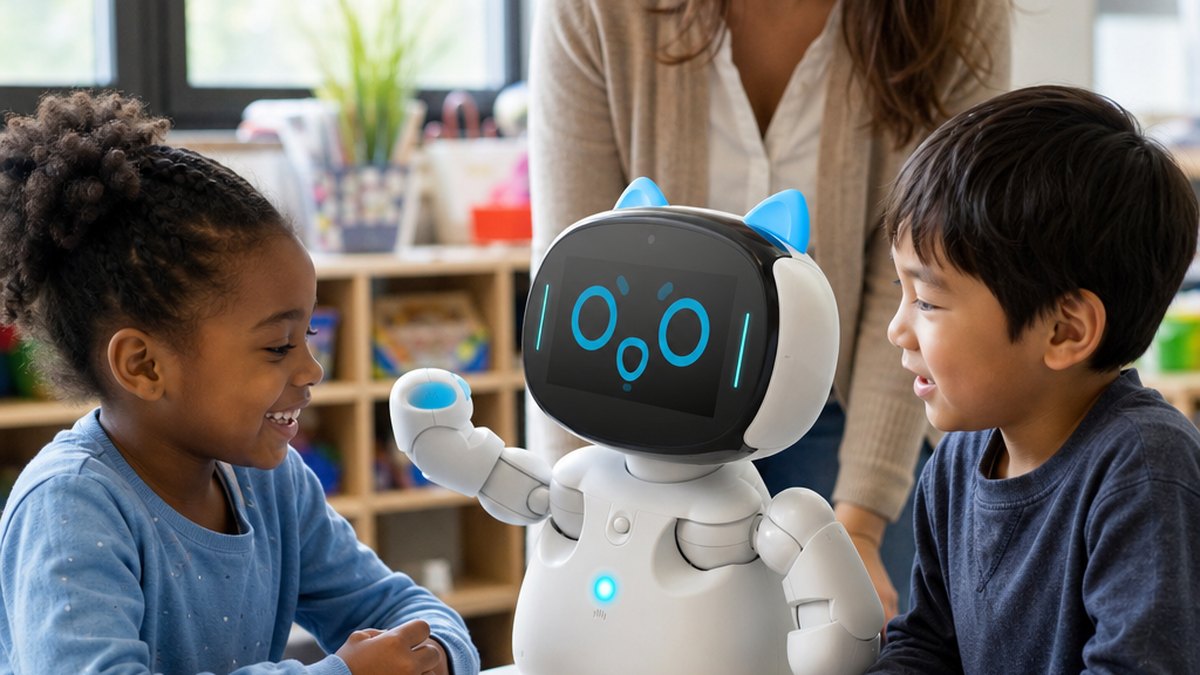
Social robots in education are robots designed to interact with students through speech, expression, and presence, acting as tutors or peer learners rather than coding kits or tools. They are the category with the strongest research support, and the best fit for language learning. This guide explains what social robots are, why their presence improves learning and lowers speaking anxiety, and how schools use them.
Table of contents
Executive Summary
Social robots are interactive robots that engage students socially, through conversation, gestures, and presence. A 2018 review in Science Robotics found they can improve cognitive and affective learning outcomes, achieving results comparable to human tutoring on focused tasks, with the largest effects for elementary learners and language learning. Their distinctive advantage is physical presence, which raises engagement and lowers the anxiety that keeps many students from speaking. For EL programs, that makes social robots the most relevant robot category.
Key Takeaways
- Social robots interact socially, as tutors or peer learners.
- Physical presence is the key advantage over screens.
- Research shows learning and engagement gains, strongest for young learners and language.
- They lower speaking anxiety, increasing participation.
- Best EL use: individual speaking practice in a rotation.
What Are Social Robots?
Social robots are designed for social interaction: they speak, respond, show expression, and maintain a presence students relate to. In education they function as tutors (teaching a skill) or peer learners (which students teach, reinforcing their own learning). What sets them apart from other educational robots is the social, conversational dimension, which is why they suit language practice.
Quick answer: social robots are interactive robots that engage students through conversation and presence, used as tutors or peer learners, and best suited to language learning.
Why Social Robots Work
- Physical presence raises attention and engagement beyond screens.
- Lower anxiety: students often speak more freely to a robot than to peers.
- Patient repetition: consistent, judgment-free practice.
- Adaptation: interaction adjusts to the learner.
The Evidence
The 2018 Science Robotics review concluded social robots can match human tutoring on restricted tasks and improve both cognitive and affective outcomes, with physical presence as the key driver and the largest effects for elementary-aged and language learners. Effects are strongest with sustained use over a few weeks and depend on sound instructional design, social robots support teaching, they do not replace it.
District Benchmark
Translate it. For an EL program, a social robot’s value is concrete: in a speaking station, each English Learner gets engaged, low-anxiety conversation practice the teacher cannot provide one-to-one. Across a school, that is a meaningful, recurring increase in speaking minutes, the input most tied to proficiency. The research supports the approach; the classroom routine delivers it.
Why Presence Matters for the Gap
Social robots help close the Speaking Time Gap: the shortfall between the speaking practice a student needs and what one teacher can provide across a full class. A teacher can speak with one student at a time; a social robot adds engaged conversation for others, and its presence makes that practice more effective than a screen. That combination, more practice, more engagement, is the case for social robots in EL programs.
Common Mistakes District Leaders Make
- Confusing social robots with coding kits. Different category, different fit.
- One-off use. Effects need sustained, integrated use.
- Whole-class demos instead of individual interaction.
- Expecting replacement rather than support.
Recommended Actions
Immediate (this month): Identify where social interaction and speaking practice would help most.
Medium-term (this year): Pilot a social robot in EL speaking stations with sustained use.
Long-term (strategy): Scale what adds engaged speaking practice and outcomes.
Questions District Leaders Should Ask
- Is it a true social robot (conversational), not a coding kit?
- Will it be used for sustained individual practice?
- Does it lower anxiety and engage our youngest learners?
- How will we measure speaking practice and growth?
Tutor or Peer Learner: Two Ways to Use a Social Robot
Social robots play two distinct instructional roles, and the difference matters when a district plans how to use one. In the tutor role, the robot teaches or guides the student, asking questions, prompting practice, and giving feedback. This is the familiar model and the one most directly useful for language practice, where the robot acts as a patient conversation partner. In the peer-learner role, the relationship flips: the student teaches the robot, which plays a less-capable learner that the child helps along. This draws on a well-documented idea in education, sometimes called the protege effect, where explaining a concept to someone else deepens the explainer’s own understanding. A student who coaches a robot through a task or corrects its mistakes has to organize and articulate what they know, which reinforces learning.
For English Learner programs, the tutor role usually carries the most weight because the priority is giving each student more talking time with feedback. But the peer-learner role can be a powerful complement, especially for building confidence, because a student who feels nervous speaking to an adult may feel entirely comfortable helping a robot. Knowing both roles lets a district design activities that fit the specific goal rather than using the robot in only one way.
What Makes a Social Robot Deployment Succeed
The research is clear that results depend on how a robot is used, not simply on having one. Three implementation factors stand out. The first is sustained use: effects show up over weeks of regular interaction, not in a single demonstration, so the robot needs a fixed place in the weekly routine. The second is integration with instruction; the robot’s activities should reinforce what the teacher is already teaching, using the same standards and vocabulary, so practice compounds rather than sitting to one side. The third is honest attention to the novelty effect. Students are naturally excited by a new robot, and some early engagement comes from novelty that fades. A good deployment plans for the point where the novelty wears off, relying on genuinely useful, adaptive content to keep students engaged once the robot is no longer new. Districts that plan for these three factors tend to see the durable gains the research describes, while those that treat the robot as a one-time event usually do not.
Frequently Asked Questions
What are social robots in education?
Interactive robots that engage students through conversation, expression, and presence, used as tutors or peer learners. They are the robot category best suited to language learning because of their social, conversational nature.
Do social robots improve learning?
Research, including a 2018 Science Robotics review, finds they improve cognitive and affective outcomes, matching human tutoring on focused tasks, with the largest effects for elementary and language learners, driven by physical presence.
Why do students speak more to a social robot?
The robot is patient and non-judgmental, and many learners feel less self-conscious than speaking in front of peers, which raises participation, especially for beginning or reluctant speakers.
How are social robots used for English Learners?
Most effectively in a speaking-practice station within a rotation, giving each EL engaged, individual conversation practice while the teacher leads a small group.
What roles can a social robot play in a classroom?
Two main ones. As a tutor, the robot teaches or guides the student and gives feedback, which suits language practice. As a peer learner, the student teaches the robot, drawing on the protege effect where explaining a concept deepens the explainer’s own understanding and builds confidence.
Does the excitement of a robot wear off?
Some of it does. Early engagement partly reflects novelty that fades, which is why sustained gains depend on genuinely useful, adaptive content rather than the robot being new. Plan for the point where novelty passes so the value comes from the practice itself.
What makes a social robot deployment work?
Three factors: sustained use over weeks rather than a one-time demo, integration with what the teacher is already teaching using the same standards, and honest planning for the novelty effect so engagement rests on quality content over time.
Related Resources
- Future of Educational Robotics
- Educational Robots for Schools
- Robots for Language Learning
- Robots in Education
- AI for English Learners
- Oral Language Development for English Learners
Conclusion
Social robots in education are the category with the strongest research and the clearest fit for English Learners. Their physical presence raises engagement and lowers speaking anxiety, and the evidence shows real learning gains for young and language learners when they are used consistently. Deployed in speaking-practice stations, social robots add the engaged individual practice that EL proficiency depends on.
Sources: Belpaeme et al., “Social robots for education: A review,” Science Robotics (2018).
Where Presence Earns Its Keep
The research on social robots is encouraging, but it lands in a very ordinary place: the moment in a classroom when a quiet student needs to talk and there is no one free to talk with. A teacher leading a small group cannot also sit across from every learner waiting to practice.
That is the problem presence is good at. The barrier for many English Learners is not ability but nerve, and a patient, non-judgmental partner lowers it. The teacher’s judgment and relationship stay irreplaceable; what a full class cannot supply is a steady conversation partner for the students not in front of her right now.
Schools that see gains treat the robot as one station in a rotation, used consistently, not as a demo. Telo AI is one example built for that role, offering conversation in English plus Spanish and French.
See how a social robot fits into a speaking-station rotation: https://mytelo.ai/how-telo-works/
Presence is not magic; it is simply another voice a student can practice with when the teacher is occupied. Used that way, week after week, it turns a promising body of research into more speaking minutes on the ground.
Found this guide useful?
Preferred sources show up more often in your Google results, including AI Overviews.