

Last updated:
Estimated reading time: 6 minutes
Robots for language learning are where educational robotics and English Learner instruction meet most powerfully: a social robot can give each student individual speaking practice, the single input EL programs most lack. Research finds language learning is exactly where robots help most. This guide explains how robots for language learning work, what the evidence shows, and how districts should use them.
Table of contents
Executive Summary
Robots for language learning, typically social or AI robots, give students conversational practice with feedback, in a low-anxiety, patient, repeatable way. The research is encouraging: meta-analyses find the largest robot learning effects in language learning and for elementary-aged students, driven by the robot’s physical presence. The practical value for districts is direct: a robot adds the individual speaking practice that one teacher cannot provide across a full class, the core constraint in EL programs. For districts, robots for English language learners are best understood as a speaking-practice layer for ELL and bilingual students in elementary classrooms, not a replacement for the teacher.
Key Takeaways
- Language learning is where robots help most, per the research.
- Robots add individual speaking practice with feedback, at scale.
- Lower anxiety: many students speak more freely to a robot.
- Physical presence drives engagement over screens alone.
- Best used in a station rotation alongside teacher instruction.
How Robots for Language Learning Work
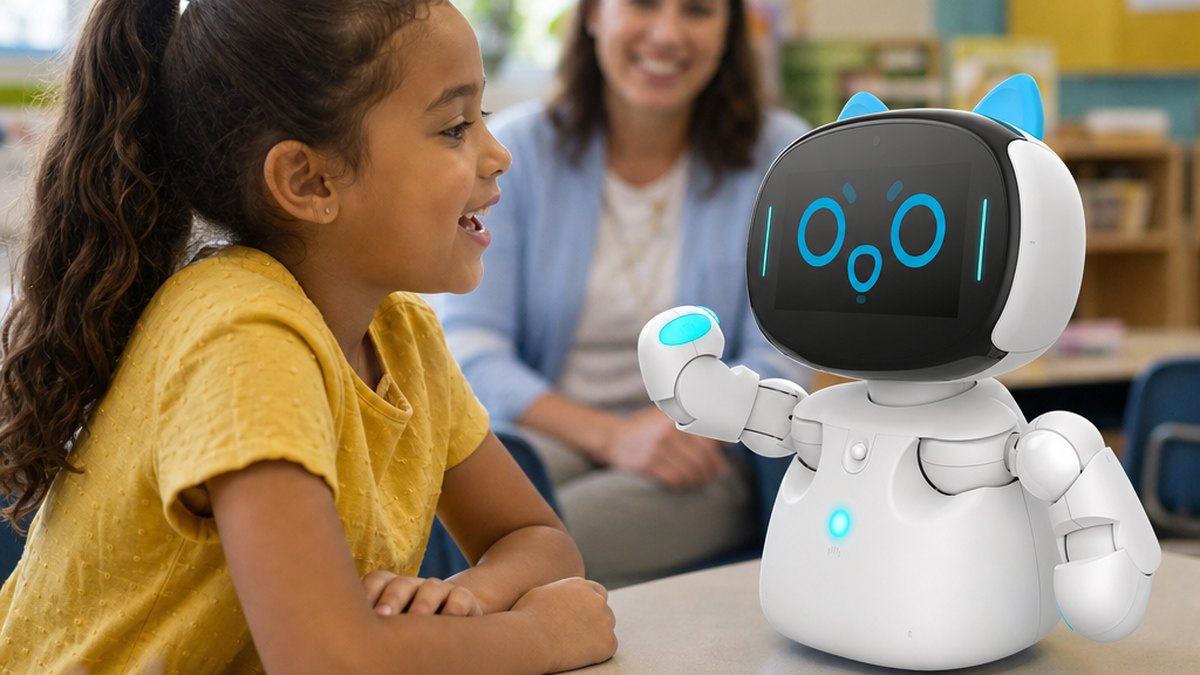
A language-learning robot engages the student in spoken interaction: it prompts, listens, responds, and gives feedback, adapting to the learner’s level. Unlike a worksheet or a screen, it holds a two-way conversation with a physical presence, which keeps young learners engaged and lowers the anxiety that silences many students in front of peers.
Quick answer: robots for language learning give students individual, adaptive speaking practice with feedback, in an engaging, low-anxiety format a teacher cannot scale to a whole class.
What the Evidence Shows
A 2018 review of social robots for education in Science Robotics found that language learning is among the strongest use cases, with effects largest for elementary-aged learners and driven by physical presence. Robots achieve outcomes comparable to human tutoring on focused tasks like vocabulary and pronunciation. As always, robots complement teachers and depend on good instructional use.
How to Use Them
The most effective model is a speaking-practice station in a rotation: each English Learner converses with the robot while the teacher leads a small group. This adds individual practice without adding teacher hours. See robots in the classroom and our guide to EL speaking practice.
District Benchmark
Translate it. In a class of 25 with five English Learners, a language robot in a 15-minute station gives each EL real conversation practice daily, which the teacher could not deliver one-to-one. Across a school serving hundreds of ELs, that is a large, recurring gain in speaking minutes, the input most tied to proficiency growth. The robot’s worth is measured in those minutes and the growth they produce.
Why This Is the Best Robot Use Case
Robots for language learning directly close the Speaking Time Gap: the shortfall between the speaking practice a student needs and what one teacher can provide across a full class.
The math: a teacher with 25 students in a 45-minute block has 1,125 student-minutes and can speak with one student at a time, leaving each EL only minutes of practice per day. A language robot converses with the students the teacher is not with, multiplying individual practice with engagement. That is why language learning is the strongest case for an educational robot.
Common Mistakes District Leaders Make
- Using it as a demo, not for individual practice.
- No rotation, so the robot reaches few students.
- Ignoring level adaptation, using one-size content.
- Skipping measurement of speaking minutes and growth.
Recommended Actions
Immediate (this month): Identify EL classrooms where a speaking station would add the most practice.
Medium-term (this year): Pilot a language robot in a rotation and measure added speaking minutes and proficiency growth.
Long-term (strategy): Scale the use that demonstrably moves speaking outcomes, funded through Title III where eligible.
Questions District Leaders Should Ask
- Does the robot hold real, adaptive conversations?
- Is it used in a rotation so every EL gets practice?
- Does it report progress to teachers?
- Can we fund it through Title III as an EL tool?
Which Language Skills Robots Support Best
Robots for language learning are not equally strong at every part of language, and knowing the difference helps a district set expectations. Their clearest strengths are the oral skills. For vocabulary, a robot can introduce and reinforce words through repeated, contextual use and check recall in conversation. For pronunciation, it offers a patient partner a student can practice sounds and phrasing with as many times as needed without embarrassment. For speaking fluency, it supplies the sheer volume of turns that build automaticity, the ability to produce language without laboring over every word. Listening comprehension improves alongside, since every exchange requires the student to understand a spoken prompt before responding.
The honest limits are worth stating too. Robots are weaker at extended writing, complex grammar instruction, and the nuanced cultural and academic discussion that a skilled teacher leads. That is not a flaw so much as a division of labor. The robot carries the high-volume oral practice, the part that is hardest to scale, while the teacher handles the reading, writing, and higher-order language work that depends on human judgment. A district that understands this uses the robot for what it does best and does not expect it to teach the whole of language.
What Robots for English Language Learners Do Well (and What the Teacher Does)
| Language skill | What the robot does | What the teacher does |
|---|---|---|
| Speaking fluency | High-volume individual conversation turns | Sets goals, models academic discourse |
| Pronunciation | Patient, repeatable practice with feedback | Targets specific sounds, corrects in context |
| Vocabulary | Repeated contextual use and recall checks | Selects academic vocabulary, builds depth |
| Listening | Comprehensible spoken prompts every turn | Scaffolds complex, content-area listening |
| Writing & grammar | Limited | Leads writing, grammar, higher-order work |
Robots and the Value of Pushed Output
Part of why speaking practice matters so much is captured by a well-established idea in second language acquisition: learners advance not only by understanding language they hear but by producing it. When a student has to formulate a response, they notice the gaps in what they can say and stretch to fill them, a process researchers call pushed output. A conversation partner that expects a reply, and gives feedback on it, creates exactly this pressure to produce. A robot in a speaking station does this continuously, prompting each student to respond, then responding back, so the learner is producing language rather than passively receiving it. This is the mechanism behind the speaking-minutes argument: it is not only that students talk more, but that the talking itself, the effort of producing and adjusting language turn after turn, is what drives proficiency. The robot’s job is to keep that productive effort going for every student, not just the one the teacher happens to be sitting with.
Frequently Asked Questions
How do robots help with language learning?
They give students individual, adaptive speaking practice with feedback in an engaging, low-anxiety format. Research finds language learning is where robots help most, especially for elementary learners, because of their physical presence.
Is there evidence robots help language learning?
Yes. A 2018 Science Robotics review found language learning among the strongest robot use cases, with outcomes comparable to human tutoring on focused tasks like vocabulary and pronunciation, and the largest effects for young learners.
Do students speak more to a robot?
Often, yes. Many learners feel less self-conscious practicing with a robot than in front of peers, which increases participation and practice, especially for reluctant or beginning speakers.
How should schools use language robots?
In a speaking-practice station within a rotation, so each English Learner gets individual conversation while the teacher leads a small group, adding practice without adding teacher hours.
Which language skills do robots help most?
The oral skills: vocabulary through repeated contextual use, pronunciation through patient practice, speaking fluency through a high volume of turns, and listening comprehension in every exchange. They are weaker at extended writing, complex grammar, and nuanced discussion, which the teacher leads.
Why is producing language, not just hearing it, important?
Second language acquisition research shows learners advance by producing language, not only understanding it. Formulating a response reveals gaps and pushes the learner to fill them, sometimes called pushed output. A robot that expects a reply and gives feedback creates that productive effort for every student.
Can a language robot replace the teacher?
No. It carries the high-volume oral practice that is hardest to scale, while the teacher handles reading, writing, grammar, and higher-order language work that depends on human judgment. The robot extends practice; it does not deliver the whole of language instruction.
Related Resources
- AI Robots for Elementary Schools
- Educational Robots for Schools
- Robots in the Classroom
- AI for English Learners
- Why English Learners Need More Speaking Time
- Best Strategies for EL Speaking Practice
Conclusion
Robots for language learning are the strongest case in all of educational robotics, because they target the exact gap English Learner programs struggle with: individual speaking practice. The evidence backs it, especially for young learners, and the classroom model is simple, a speaking station in a rotation. Used that way and measured by speaking minutes and growth, a language robot is not a gadget but a direct answer to the Speaking Time Gap.
Sources: Belpaeme et al., “Social robots for education: A review,” Science Robotics (2018).
Closing the Distance Between Need and Hours
Every EL teacher knows the arithmetic without doing the math. A class of twenty-five, one adult, forty-five minutes, and five English Learners who each need far more talk than the period can hold. By the time the group work ends, most of them have spoken aloud for barely a minute or two.
The gap is one of hours, not heart. A teacher can plan brilliant conversation prompts and still not be able to sit with each learner long enough for fluency to build. What a full class cannot supply is a partner who will talk with the students she is not currently beside.
That is the narrow job a language robot does well, and why the strongest classroom model is a speaking station in a rotation. Telo AI is one example built for it, holding adaptive conversation in English plus Spanish and French with feedback on each turn.
See how a language robot runs as a speaking station in the rotation: https://mytelo.ai/how-telo-works/
Measured in speaking minutes, the difference is not subtle. The teacher still drives the instruction; the robot simply makes sure the students waiting their turn are practicing instead of sitting silent.
Found this guide useful?
Preferred sources show up more often in your Google results, including AI Overviews.