

Last updated:
Estimated reading time: 6 minutes
As educational robots reach more classrooms, district leaders ask a direct question: can Title III pay for robotics? The answer is yes, with a condition: Title III can pay for an educational robot when it supplements English Learner language instruction, not when it is general STEM equipment unrelated to EL needs. This guide explains when robotics qualifies, how to justify it, and what to look for so the purchase actually supports language development.
Table of contents
Executive Summary
Title III can fund educational robotics when the robot is a supplemental tool that supports English Learners’ language development, for example, an AI robot that provides conversational speaking practice. The distinction that matters is purpose: a robot used to deliver EL language practice is educational technology in service of Title III’s goal; a general coding or STEM robot with no language-development function is not an allowable Title III use. As always, the spending must be supplemental and documented.
Key Takeaways
- Yes, Title III can fund robotics that supports EL language development.
- Purpose is the test: language-learning robots qualify; general STEM robots do not.
- It must be supplemental and tied to English Learner needs.
- An AI language robot adds engagement and individual speaking practice.
- Document the EL rationale and verify student-data privacy.
When Robotics Qualifies for Title III
| Robot Type | Qualifies for Title III? |
|---|---|
| AI language robot (speaking practice for ELs) | Yes, if supplemental and EL-focused |
| Robot delivering EL language content | Yes, if supplemental and EL-focused |
| General coding / STEM robot | No, not tied to language development |
Quick answer: Title III can pay for robotics that supports English Learners’ language development, as a supplemental tool; it cannot fund general STEM robots unrelated to EL needs.
How to Justify the Purchase
- Document the language purpose. Show how the robot builds English proficiency for identified ELs.
- Confirm it is supplemental. It must add to, not replace, the required core program.
- Verify privacy and safety. Check FERPA alignment and COPPA compliance, plus age-appropriate design.
- Keep records. Retain the EL rationale for audit.
District Benchmark
Translate the value. A 3,000-student district serving roughly 320 English Learners that buys a general STEM robot has bought something Title III cannot fund. The same budget spent on an AI language robot, or a platform plus robot, that gives newcomers engaging daily speaking practice supports the program’s purpose and qualifies. The deciding factor is not the hardware; it is whether the robot delivers language practice English Learners need.
Why a Language Robot Helps
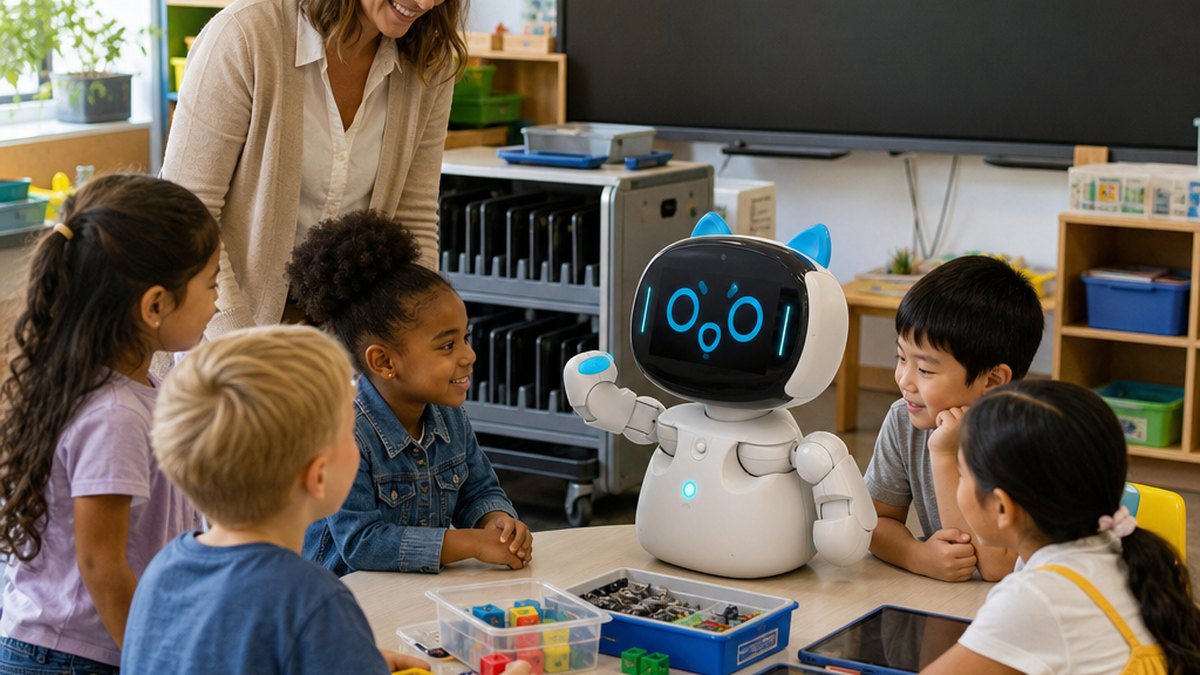
An AI language robot addresses the Speaking Time Gap: the shortfall between the speaking practice an EL needs and what one teacher can provide across a full class.
The math: a teacher with 25 students in a 45-minute block has 1,125 student-minutes and can speak with one student at a time. An embodied AI robot can hold conversations with students the teacher cannot reach, adding individual practice with the engagement of a physical presence. That is the language-development function that makes robotics a legitimate, high-leverage Title III purchase.
Common Mistakes District Leaders Make
- Buying general STEM robots with Title III. No language function means it is not allowable.
- Skipping the supplemental test. Using Title III to cover core equipment.
- Ignoring privacy. Not verifying FERPA and COPPA compliance.
- Engagement over outcomes. Buying novelty rather than measurable language practice.
Recommended Actions
Immediate (this month): Define the language-development purpose any robot must serve to qualify.
Medium-term (this year): Pilot a language-focused AI robot or platform, document its EL purpose, and verify privacy.
Long-term (strategy): Evaluate robotics on per-student speaking practice and outcomes, not novelty.
Questions District Leaders Should Ask
- Does the robot build English proficiency, or is it general STEM?
- Is it supplemental to our required core program?
- Is it FERPA-aligned, COPPA-compliant, and age-appropriate?
- Does it measurably add individual speaking practice?
Frequently Asked Questions
Can Title III pay for robotics?
Yes, when the robot supports English Learners’ language development as a supplemental tool, such as an AI robot that provides speaking practice. General STEM or coding robots unrelated to language development are not allowable Title III uses.
Which robots qualify?
AI language robots and robots that deliver EL language content qualify when supplemental and EL-focused. General-purpose coding robots do not.
How do I justify a robotics purchase?
Document the language-development purpose for identified English Learners, confirm it is supplemental, verify privacy and safety compliance, and keep the rationale for audit.
How can districts buy a language robot efficiently?
Through a cooperative such as TIPS, which offers pre-approved purchasing and can avoid a separate RFP.
Related Resources
- Educational Robot Cost
- Complete Guide to Title III Funding
- Can Title III Pay for Educational Technology?
- Understanding TIPS Cooperative Purchasing
- AI for English Learners
- Technology for English Learners
Conclusion
Title III can pay for robotics, but only when the robot serves English Learners’ language development. An AI language robot that adds engaging individual speaking practice supports the program’s purpose and qualifies; a general STEM robot does not. Define the language purpose first, keep the spending supplemental, and evaluate on practice and outcomes, not novelty.
Sources: U.S. Department of Education, Title III, Part A; U.S. Department of Education, Student Privacy (FERPA).
Funding Follows Purpose, Not the Hardware
The robotics question tends to trip up district budgets because the eligibility test has nothing to do with how impressive the device is. A general STEM robot, however engaging, cannot be charged to Title III; a robot that delivers EL language practice can. Purpose decides, not the price tag.
This is harder than it sounds because the appealing purchase and the fundable one are not always the same, and a modest subgrant leaves no room to buy the wrong thing and hope it counts.
Districts that navigate it well fix the language-development purpose first, then choose hardware and a compliant way to pay. That is where cooperatives help with speed. Telo AI is one example, available as a web platform or an embodied robot, fundable as supplemental EL technology and purchasable through TIPS.
See how an embodied tool delivers individual speaking practice: https://mytelo.ai/how-telo-works/
Anchored to a clear language purpose, robotics becomes a legitimate and high-leverage Title III investment rather than a compliance risk. Whether Title III can pay for a robot always comes back to what the robot is actually for.
Found this guide useful?
Preferred sources show up more often in your Google results, including AI Overviews.