

Last updated:
Estimated reading time: 5 minutes
AI robots for elementary schools are a strong fit on paper, the research shows robot learning effects are largest for young learners, but choosing one for K-5 raises specific questions about safety, privacy, and instructional fit. This guide explains where AI robots help most in elementary settings, what to verify before buying, and how to fund one.
Table of contents
Executive Summary
Elementary grades are where AI robots show the largest learning effects, particularly for language and foundational skills, because young learners respond strongly to a robot’s physical presence. The buying considerations for K-5 are stricter: COPPA compliance for under-13 students, FERPA for data, age-appropriate design, and a clear instructional fit (usually individual speaking or skills practice). The strongest use is a station that adds practice while the teacher instructs.
Key Takeaways
- Effects are largest for elementary learners, per the research.
- Verify COPPA (under-13) and FERPA before buying.
- Age-appropriate design and safety are essential.
- Best use: individual speaking or skills practice in a rotation.
- Fundable through Title III when EL-focused and supplemental.
Where AI Robots Help in Elementary
- Speaking and pronunciation practice for English Learners and early readers.
- Foundational skills through interactive, repeatable practice.
- Engagement for young or reluctant learners.
Quick answer: AI robots help elementary schools most with individual speaking and foundational-skills practice, where young learners’ response to physical presence is strongest.
What to Verify Before Buying
| Check | Why It Matters for K-5 |
|---|---|
| COPPA compliance | Required for students under 13 |
| FERPA alignment | Protects student data |
| Age-appropriate design | Safe, suitable interactions for young children |
| Instructional fit | Adds practice (e.g., speaking), not novelty |
| Evidence | Demonstrated learning impact |
Funding
An AI robot that supports English Learners’ language development can be a supplemental, allowable Title III purchase; a general STEM robot is not an EL expense. See can Title III pay for robotics.
Why Elementary Is the Sweet Spot
Elementary is where an AI robot best closes the Speaking Time Gap: the shortfall between the speaking practice a young learner needs and what one teacher can provide across a full class. Young children need lots of oral practice, and a robot adds it with the engagement of presence, exactly where the research shows the largest effects.
Common Mistakes District Leaders Make
- Skipping COPPA/FERPA review for young students.
- Choosing novelty over instructional fit.
- Ignoring age-appropriate design.
- Funding a general STEM robot with EL money.
Recommended Actions
Immediate (this month): Set COPPA, FERPA, and instructional fit as non-negotiable criteria.
Medium-term (this year): Pilot an AI robot for elementary EL speaking practice and measure the added practice.
Long-term (strategy): Scale what works, funded through Title III where eligible.
Questions District Leaders Should Ask
- Is it COPPA-compliant and FERPA-aligned?
- Is the design age-appropriate for K-5?
- Does it add individual practice, not just novelty?
- Can we fund it through Title III as an EL tool?
Why Physical Presence Works So Well for Young Children
The reason AI robots show their strongest effects in the elementary grades comes down to how young children engage with the world. Early learners are highly responsive to social cues, they attend to a face, follow a gaze, and respond to a voice that seems to be addressing them directly. A physical robot supplies those cues in a way a flat screen cannot, so a young child treats an interaction with a robot as a genuine social exchange rather than a media activity. The widely cited Science Robotics review found that the learning benefits of educational robots are greatest for younger learners, and that the physical presence of the robot, not merely its content, is a key driver of that advantage.
This matters most for language. Foundational oral language develops through a large volume of responsive, back-and-forth exchanges, the kind of turn-taking a caregiver provides at home. In a classroom of twenty-five, a single teacher cannot supply that volume to every child. A robot that holds a child’s attention and responds to their attempts adds turns of practice that would otherwise not happen, and it does so with the engagement that keeps a five- or six-year-old participating. The presence advantage is not a gimmick; it is the mechanism that makes the practice stick for this age group.
Fitting a Robot Into the Elementary Day
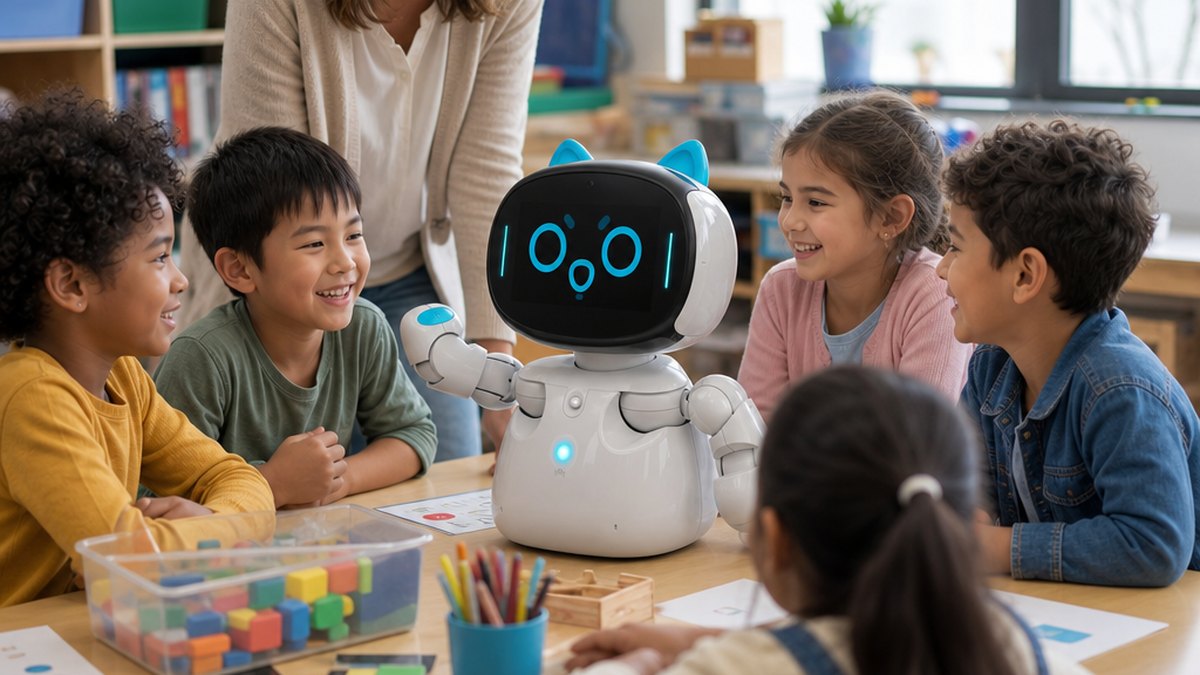
An AI robot delivers value in the elementary grades only when it has a defined place in the daily routine, and the natural fit is the station rotation that most K-5 teachers already use. During a literacy or English language development block, the class breaks into small groups that cycle through activities: one group works directly with the teacher, another reads independently, and another practices at the robot station. Each child rotates through, getting a few minutes of individual speaking or skills practice with the robot while the teacher gives focused attention to a small group. This structure solves the two problems a busy teacher faces at once. It gives every student some individual practice, and it frees the teacher to work intensively with the students who need her most, without leaving the rest idle. Because the rotation is a routine rather than an event, the sustained, repeated use that the research links to real gains happens naturally. A robot dropped into a classroom without this structure tends to become a novelty; a robot built into the rotation becomes part of how the class learns to talk.
Frequently Asked Questions
Do AI robots help elementary students?
Yes, research finds robot learning effects are largest for elementary-aged learners, especially in language and foundational skills, because young children respond strongly to a robot’s physical presence.
Are AI robots safe for young children?
They can be, when built for K-12: verify COPPA compliance (under 13), FERPA alignment, and age-appropriate, safe interaction design before adopting.
What is the best use in elementary schools?
Individual speaking and foundational-skills practice in a station rotation, so each student gets practice the teacher cannot provide one-to-one.
Can Title III fund an AI robot for elementary?
Yes, if the robot supports English Learners’ language development and is supplemental. A general STEM robot is not an allowable EL expense.
Why do robots work better than screens for young children?
Young learners are highly responsive to social cues like a face, gaze, and a voice addressing them. A physical robot supplies those cues, so a child treats the interaction as a real social exchange. Research finds the presence of the robot, not just its content, drives the largest effects for younger learners.
How do teachers fit a robot into the school day?
Through the station rotation most K-5 teachers already use. During a literacy or ELD block, small groups cycle through activities: one works with the teacher while another practices at the robot station. Each child gets a few minutes of individual practice while the teacher focuses on a small group.
What ages is an elementary AI robot best for?
The research shows the strongest effects across the elementary range, and especially for early grades where foundational oral language is developing. Younger English Learners who need high volumes of speaking practice benefit most, provided the tool is age-appropriate and safe.
Will young students lose interest in the robot?
Some novelty fades, so lasting engagement depends on genuinely useful, adaptive content and a regular place in the routine. A robot built into the daily rotation, rather than used as an occasional event, keeps students practicing after the initial excitement passes.
Related Resources
- Educational Robots for Schools
- Robots for Language Learning
- Can Title III Pay for Robotics?
- AI for English Learners
- Robots in the Classroom
Conclusion
AI robots for elementary schools are a strong fit where the research is clearest, young learners and language, but K-5 demands strict attention to COPPA, FERPA, and age-appropriate design. Chosen for instructional fit (individual speaking practice) and funded as the EL tool it is, an AI robot can give young English Learners the engaging practice that drives early proficiency.
Sources: Belpaeme et al., “Social robots for education: A review,” Science Robotics (2018); U.S. Department of Education, Student Privacy (FERPA).
What Young Learners Need Most
Walk into a K-2 classroom and the pattern is unmistakable. Young English Learners want to talk, they raise hands, they blurt, they try, and a single teacher simply cannot answer every one of them often enough to build oral fluency at the pace their brains are ready for.
That shortfall is why elementary is where robots show the strongest effects. The issue is not that the teacher lacks skill; it is that early language grows through sheer volume of back-and-forth talk, and one adult cannot be the conversation partner for twenty-five children at once. A patient, responsive robot can take some of those turns.
The safeguards come first for this age, verified COPPA and FERPA compliance and age-appropriate design, and then the robot works best as one station in a rotation. Telo AI is one example built for young learners, with conversation in English plus Spanish and French.
See how young learners practice speaking with a classroom robot: https://mytelo.ai/how-telo-works/
For the youngest students, more talk is the whole game. A well-chosen robot does not replace the teacher who sparks that talk; it gives each child more chances to answer when she cannot get to them all.
Found this guide useful?
Preferred sources show up more often in your Google results, including AI Overviews.