

Estimated reading time: 6 minutes
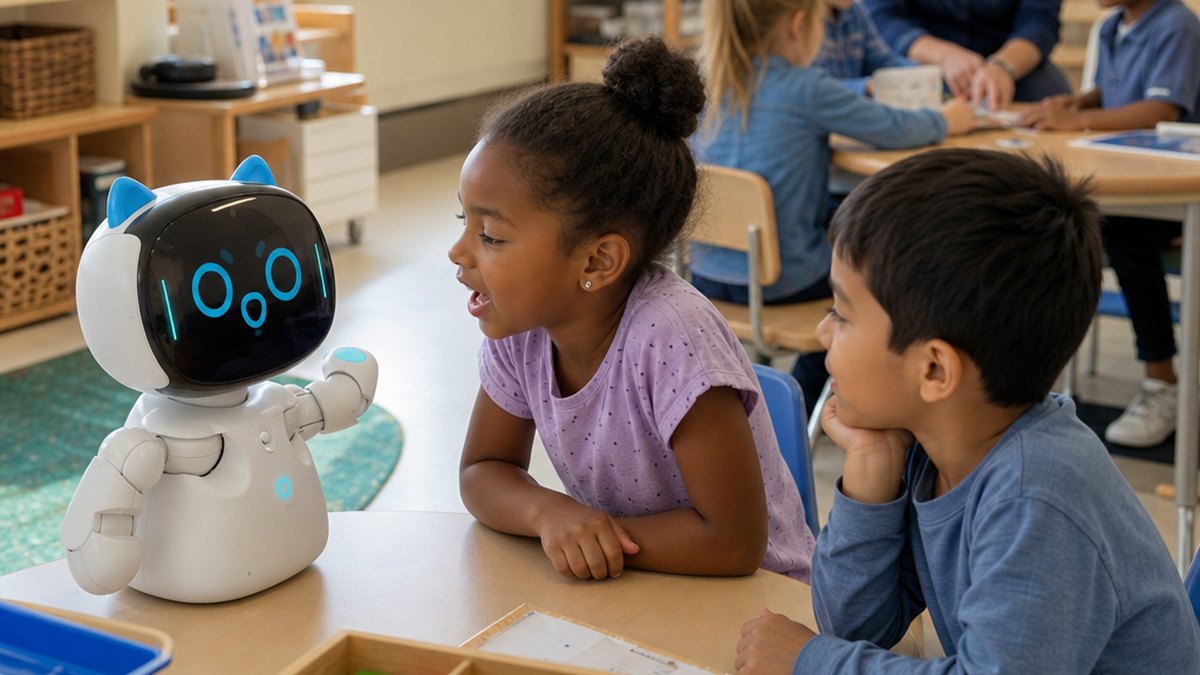
Robots in the classroom earn their place only when they fit a real instructional routine, not when they sit on a shelf as a novelty. The most valuable K-12 use cases use a robot to add individual practice and engagement that a teacher cannot scale. This guide covers practical robots-in-the-classroom use cases, with a focus on English Learner speaking practice, and how to make them add real value.
Table of contents
Executive Summary
The best classroom use cases for robots share a pattern: the robot handles individual, repeatable interaction while the teacher does instruction. For English Learners, the standout use case is a speaking-practice station in a rotation, where each student converses with the robot while the teacher leads a small group. Other uses include engagement for reluctant learners, pronunciation and vocabulary practice, and early-grade foundational skills. The test for any use case is whether it adds practice and engagement that translate into learning.
Key Takeaways
- The best use cases add individual practice, not novelty.
- Speaking-practice stations are the standout EL use case.
- Rotation models let the robot and teacher work in parallel.
- Engagement uses help reluctant and young learners.
- Integration matters: a robot must fit a routine to add value.
Practical Use Cases
| Use Case | How It Works | Value |
|---|---|---|
| Speaking-practice station | Students rotate to converse with the robot | Adds individual EL practice at scale |
| Pronunciation / vocabulary | Repeated, patient drills with feedback | Consistent targeted practice |
| Engagement for reluctant learners | Robot lowers anxiety and draws participation | More time on task |
| Early-grade foundations | Interactive practice of basic skills | Strong fit for young learners |
Quick answer: the most valuable classroom use cases put a robot in a speaking-practice or skills-practice station so it adds individual interaction while the teacher instructs.
The Rotation Model
The rotation model is what makes robots practical. The class splits into groups: one works with the teacher, another with the robot for speaking practice, others on independent work. Over the block, every student gets both teacher time and individual robot practice. This is the same structure as effective small-group instruction, with the robot solving the problem of what the other groups do, see our guide to small group instruction.
District Benchmark
Translate it. In a class of 25 with five English Learners, a robot in a 15-minute station gives each EL real individual conversation while the teacher runs a small group, practice the teacher could not provide one-to-one. Across a campus, that is hundreds of added speaking minutes a day. The use case works because it fits the routine; a robot with no station and no rotation just gathers dust.
The Use Case That Closes the Gap
The standout use case targets the Speaking Time Gap: the shortfall between the speaking practice a student needs and what one teacher can provide across a full class.
The math: a teacher with 25 students in a 45-minute block has 1,125 student-minutes and can speak with one student at a time. A speaking-practice station lets the robot converse with students the teacher is not with, multiplying individual practice. That is why the station use case is the one to build a robot program around.
Common Mistakes District Leaders Make
- No routine. Buying a robot without a station or rotation to use it.
- Whole-class demos. Using the robot as a one-to-many novelty instead of individual practice.
- Wrong subjects. Forcing robots where they add little.
- No measurement. Not tracking the practice the use case adds.
Recommended Actions
Immediate (this month): Choose one use case, usually an EL speaking station, and design the rotation around it.
Medium-term (this year): Pilot it in a few classrooms and measure added speaking minutes.
Long-term (strategy): Standardize the use cases that demonstrably add practice and scale them.
Questions District Leaders Should Ask
- What routine will the robot fit into?
- Does the use case add individual practice, or just demos?
- Is it matched to where robots are strong (language, young learners)?
- How will we measure the practice it adds?
Classroom Roles Beyond Language Practice
While speaking practice for English Learners is the strongest use case, it is worth knowing the other roles a robot can play, because a district may already have some of these needs. For reluctant or anxious learners in any subject, a robot’s patient, non-judgmental manner can draw out participation from students who freeze when called on in front of peers. In the early grades, robots support foundational skills through interactive, repeatable practice that holds young children’s attention. Telepresence robots serve a different purpose entirely, letting a homebound or medically fragile student attend class remotely with a physical presence in the room, which supports inclusion and access. Each of these roles follows the same principle as the speaking station: the robot does something individual and repeatable that extends what a single teacher can cover, while the teacher keeps the instruction. A district is best served by picking the one or two roles that match its most pressing needs rather than trying to use a robot for everything at once.
Robots, Special Education, and Autism Support
Beyond English Learners, one of the most researched roles for classroom robots is in special education, and particularly for students with autism. Studies of social robots report that their predictable, patient, and low-pressure interaction can help some students on the autism spectrum rehearse social communication, turn-taking, and emotion recognition, skills that are harder to practice in the less predictable dynamics of peer interaction. In this research the robot is consistently a tool that supports specialists and teachers, never a therapy or a replacement for them.
For district leaders the principle matches the language case: the value is individual, repeatable, low-anxiety practice that extends a specialist’s reach, always under professional oversight and matched to each student’s IEP goals. Robots in special education are a developing area, and a district exploring it should weigh the evidence, student data privacy, and fit with existing services before adopting anything.
Getting Teacher Buy-In
A robot program succeeds or fails on whether teachers embrace it, so the human side of implementation deserves as much planning as the purchase. Teachers reasonably worry that a new device will mean more work, unreliable technology, or a gimmick imposed from above. The way to address this is to involve teachers early, position the robot clearly as a tool that gives them time and information rather than one that replaces any part of their job, and start small. A pilot in a few willing classrooms, with real training and a simple routine, lets teachers experience the benefit directly, one group practicing productively at the station while they work intensively with another, before any wider rollout. When teachers see the tool reduce the impossible task of talking with every student at once, and when they get useful data back about who is progressing, skepticism usually gives way to ownership. A robot introduced with teacher input becomes part of how a class runs; one imposed without it tends to end up on the cart at the back of the room.
Frequently Asked Questions
How are robots used in the classroom?
The most valuable uses put a robot in a station for individual practice, especially speaking practice for English Learners, while the teacher leads small groups. Other uses include pronunciation and vocabulary drills, engagement for reluctant learners, and early-grade skills.
What is the best classroom use case for a robot?
A speaking-practice station in a rotation: each student converses individually with the robot while the teacher works with a small group, adding practice the teacher cannot provide one-to-one.
How does the rotation model work?
The class splits into groups that rotate among the teacher, the robot, and independent work, so every student gets both teacher time and individual robot practice within the block.
How do we know a robot adds value in the classroom?
Measure the individual practice it adds (e.g., speaking minutes per student) and whether that practice shows up in proficiency growth. Value comes from integration into a routine, not presence alone.
What can classroom robots do besides language practice?
They can draw participation from reluctant or anxious learners in any subject, support foundational skills in the early grades, and, in the case of telepresence robots, let a homebound student attend class remotely. Speaking practice for English Learners remains the strongest use case, but these roles fit real needs too.
How do we get teachers on board with a classroom robot?
Involve teachers early, position the robot as a tool that gives them time and data rather than replacing their role, and start with a small pilot that includes real training. When teachers see one group practicing productively while they work with another, skepticism usually turns into ownership.
Why do some classroom robots end up unused?
Almost always because they were bought without a routine to use them in. A robot with no station, no rotation, and no teacher buy-in becomes a novelty. The value comes from integration into a daily structure, not from the device sitting in the room.
Can classroom robots help students with autism or in special education?
Research on social robots suggests they can help some students with autism practice social communication, turn-taking, and emotion recognition through predictable, low-pressure interaction. They work best as a tool that supports special education teachers and specialists under professional oversight and matched to a student’s IEP, not as a therapy or a replacement. It is a developing area districts should evaluate carefully.
Related Resources
- AI Robots for Elementary Schools
- Educational Robots for Schools
- Robots for Language Learning
- Robots in Education
- Small Group Instruction for English Learners
- Best Strategies for EL Speaking Practice
Conclusion
Robots in the classroom add value when they fit a routine and do a job teachers cannot scale, above all, individual speaking practice in a station rotation. Chosen for a clear use case and measured by the practice they add, robots become a working part of instruction. Bought as a novelty with no routine, they become an expensive shelf decoration. The use case makes the difference.
Sources: Belpaeme et al., “Social robots for education: A review,” Science Robotics (2018).
The Routine Is What Makes It Work
A robot on a cart at the back of the room does nothing. The classrooms that get value have built a place for it in the day, usually a station a group rotates through while the teacher works with another group nearby.
That design answers the real constraint. A teacher cannot lead a small group and also converse with every waiting student at the same time, so the students not with her often sit quiet. The limit is bandwidth, not lesson quality, and a station simply gives those minutes somewhere productive to go.
The robot handles the individual, repeatable practice; the teacher keeps the instruction, the relationships, and the judgment. Telo AI is one example built for that station role, delivering language practice in English plus Spanish and French with progress data for teachers.
See how a robot slots into a small-group rotation: https://mytelo.ai/how-telo-works/
The use case, not the hardware, is what separates a working program from an expensive shelf ornament. Design the routine first, and the robot has a job worth doing every single day.