

Last updated:
Estimated reading time: 8 minutes
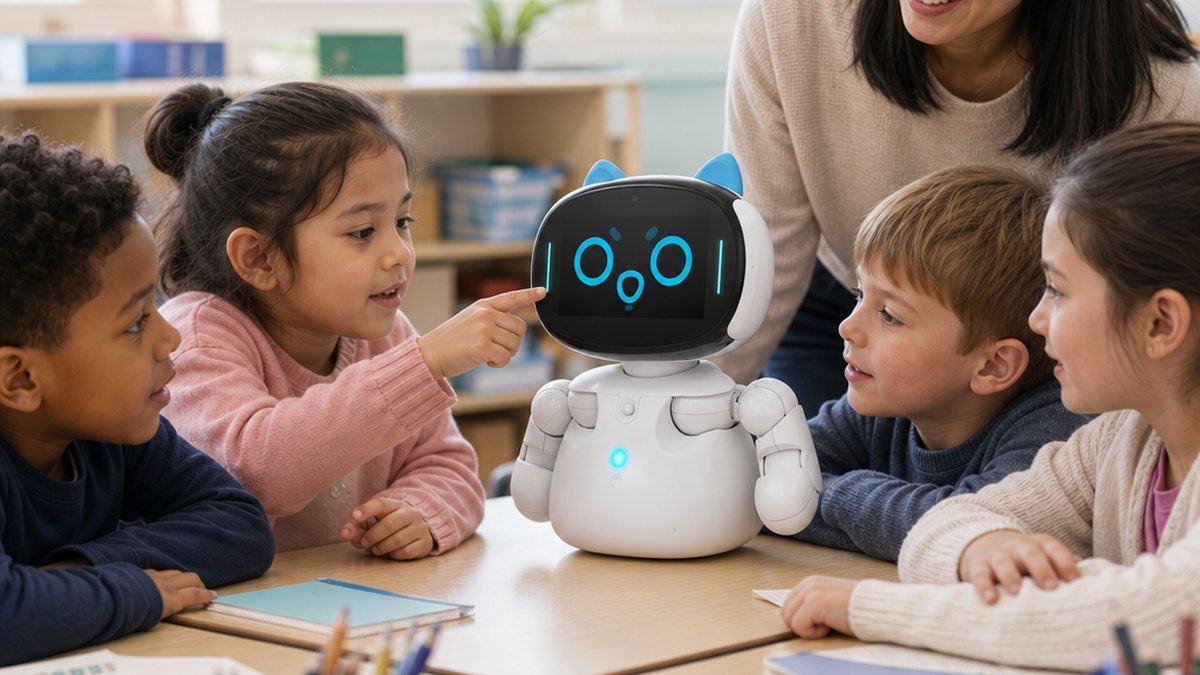
Robots in education have moved from novelty to a researched tool, and the evidence is more encouraging than skeptics expect and more limited than vendors claim. Used well, robots boost engagement and can improve learning, especially for young learners and language practice. This guide covers the real benefits of robots in education, what the research shows, where they help most, and how district leaders should evaluate them.
Table of contents
Executive Summary
Robots in education, particularly social robots, can improve both cognitive and affective outcomes, with a 2018 Science Robotics review finding effects comparable to human tutoring on focused tasks and largest for elementary-aged learners and language learning. Their advantage over screens is physical presence, which drives engagement. The benefits are real but conditional: they depend on how the robot is used, and robots complement teachers rather than replace them. For district leaders, the clearest benefit is added individual practice, especially speaking, that classrooms cannot scale.
Key Takeaways
- Robots in education boost engagement through physical presence.
- Research shows positive learning effects, largest for young learners and language.
- The biggest practical benefit: individual practice teachers cannot scale.
- Benefits are conditional on good instructional design.
- Robots augment teachers; they do not replace them.
The Benefits of Robots in Education
- Engagement. Physical presence draws attention and motivation more than screens alone.
- Individual practice. A robot can interact one-to-one at a scale teachers cannot.
- Lower anxiety. Many students feel safer practicing speaking with a robot than in front of peers.
- Consistency. A robot delivers the same patient practice every time.
- Data. Interactions can be logged to inform teachers.
Quick answer: the main benefits of robots in education are engagement, individual practice at scale, lower speaking anxiety, consistency, and useful data, with engagement and practice the most important.
What the Evidence Shows
The most cited synthesis, a 2018 review of social robots for education in Science Robotics, concluded that social robots can achieve learning gains similar to human tutoring on restricted tasks and that physical presence is a key advantage. Meta-analyses report positive overall effects, strongest in language learning and for elementary-aged students, and for interventions lasting a few weeks rather than one-off sessions. The honest caveat: effects vary with implementation, and robots are a complement to good teaching, not a substitute.
Where Robots Help Most
| Context | Strength of Fit |
|---|---|
| Language learning / speaking practice | Strong, especially elementary |
| Engagement for reluctant learners | Strong |
| Early-grade foundational skills | Good |
| Tertiary / lecture replacement | Weak |
District Benchmark
Translate it. A district adding robots to EL classrooms should expect the benefit to show up as added speaking practice and engagement, not as a replacement for instruction. If each student gains several minutes of guided conversation per day from a robot in a station rotation, that is practice the teacher could not deliver one-to-one across 25 students. Measured that way, the benefit is concrete; measured as novelty, it disappears.
The Benefit That Matters Most
The benefit of robots in education that most directly helps EL programs is closing the Speaking Time Gap: the shortfall between the speaking practice a student needs and what one teacher can provide across a full class.
The math: a teacher with 25 students in a 45-minute block has 1,125 student-minutes and can speak with one student at a time, leaving each learner only minutes of practice per day. A robot adds individual conversation at the same time, with engagement screens lack. That is why “robots in education” is more than a trend for language programs, it targets the exact constraint.
Common Mistakes District Leaders Make
- Overselling. Expecting robots to transform outcomes on their own.
- Underusing. Buying a robot and not integrating it into instruction.
- Ignoring fit. Using robots where they are weak (e.g., replacing lectures).
- Skipping measurement. Not tracking the practice and engagement gains.
Recommended Actions
Immediate (this month): Identify where added engagement and individual practice would help most, usually EL speaking.
Medium-term (this year): Pilot robots in those contexts with clear use and measurement.
Long-term (strategy): Scale only the uses that demonstrably add practice and outcomes.
Questions District Leaders Should Ask
- What specific benefit are we buying, engagement, practice, or both?
- Does the use match where robots are strong (young learners, language)?
- How will we measure the benefit?
- Is the robot integrated into instruction, not just present?
Two Kinds of Benefit: Cognitive and Affective
When researchers evaluate robots in education, they distinguish two kinds of outcomes, and understanding the difference helps a district set the right expectations. Cognitive outcomes are what students actually learn, the vocabulary acquired, the pronunciation improved, the skill mastered. Affective outcomes are how students feel and behave, their motivation, engagement, confidence, and willingness to participate. The research on social robots finds positive effects on both, but the two do not always move together, and for many classroom purposes the affective gains are what unlock the cognitive ones.
This matters for English Learners in particular. A student who is anxious about speaking will not produce much language no matter how good the lesson, so lowering that anxiety, an affective effect, is often the precondition for the practice that drives proficiency, a cognitive effect. A robot’s patient, non-judgmental presence tends to raise participation first, and the extra speaking practice that follows is what produces measurable language growth. A district evaluating a robot should therefore watch both dimensions: whether students are more willing to engage and speak, and whether that engagement translates into skills over time. Expecting only test-score gains, and ignoring the engagement changes that precede them, can lead a district to abandon a tool just before its benefits show up.
How to Measure Whether Robots Are Working
Because the benefits are real but conditional, a district should decide in advance how it will judge a robot pilot rather than relying on impressions. A few practical measures work well. The most direct is added practice: how many additional minutes of individual speaking or skills practice each student gets per day or week compared with before. Participation is a useful affective measure: are more students, and especially reluctant ones, engaging and speaking? Over a longer window, look at proficiency growth using the assessments you already use, such as progress on English language development measures for ELs. Finally, gather teacher feedback on whether the tool fits the routine and produces useful information. Set a baseline before the pilot, choose a realistic window of several weeks so sustained-use effects can emerge, and compare against it. This turns a subjective sense of whether the robot helped into evidence a district can act on, and it protects against both the hype that oversells robots and the impatience that discards them before the benefits appear.
Frequently Asked Questions
What are the benefits of robots in education?
Engagement through physical presence, individual practice at a scale teachers cannot provide, lower speaking anxiety, consistent patient practice, and useful interaction data. Engagement and individual practice are the most valuable.
Do robots improve learning?
Research, including a 2018 Science Robotics review, finds positive effects on cognitive and affective outcomes, strongest for elementary learners and language learning. Effects depend on implementation, and robots complement rather than replace teachers.
Where do robots help most in education?
In language learning and speaking practice, for engaging reluctant learners, and in early grades. They are weak as substitutes for lectures or higher-education instruction.
Will robots replace teachers?
No. The evidence and the practical case both point to augmentation: robots add practice and engagement, while teachers provide instruction, relationship, and judgment.
What is the difference between cognitive and affective benefits?
Cognitive outcomes are what students learn, such as vocabulary or pronunciation. Affective outcomes are how students feel and behave, including motivation, confidence, and willingness to participate. Research finds robots improve both, and the affective gains, like lower speaking anxiety, often unlock the cognitive ones.
How should a district measure whether a robot is working?
Track added practice minutes per student, participation among reluctant learners, proficiency growth on the assessments you already use, and teacher feedback on fit. Set a baseline before the pilot and use a window of several weeks so sustained-use effects can emerge.
Why might benefits take time to appear?
Effects depend on sustained, integrated use rather than a single session, and affective changes like increased willingness to speak usually come before measurable skill gains. Judging a pilot too early, on test scores alone, can lead a district to discard a tool just before its benefits show.
Related Resources
- AI Robot vs Tablet Learning
- Educational Robots for Schools
- Social Robots in Education
- Robots for Language Learning
- Robot Teacher: Can a Robot Teach?
- AI for English Learners
Conclusion
Robots in education are neither a miracle nor a gimmick. The research shows real benefits, engagement and learning gains, strongest for young learners and language practice, when robots are used well and integrated into instruction. For district leaders, the clearest benefit is individual speaking practice at a scale teachers cannot match. Buy for that benefit, measure it, and robots become a genuine addition to an EL program rather than a novelty in the corner.
Sources: Belpaeme et al., “Social robots for education: A review,” Science Robotics (2018).
Reading the Evidence Like a Practitioner
The studies are helpful, but a leader has to translate them into a classroom. Strip the findings down and they point at one stubborn reality: in a full class, each student gets only a few minutes of real back-and-forth a day, and no amount of good teaching stretches one adult across every mouth in the room.
That is why the research clusters where it does, in language and the early grades, and why the effects hinge on sustained use rather than a single demo. The benefit is not that a robot teaches better than a teacher; it is that it can take the individual practice a teacher has no hours left to give.
Read that way, the evidence is a buying guide. It rewards districts that use a robot for consistent, one-to-one practice inside a routine. Telo AI is one example built for that, adding conversation in English plus Spanish and French.
See how the practice behind these effects works day to day: https://mytelo.ai/how-telo-works/
The honest reading is neither hype nor dismissal. The gains are real, conditional, and concentrated exactly where a teacher runs short of hands, which is precisely where a well-used robot has something to add.
Found this guide useful?
Preferred sources show up more often in your Google results, including AI Overviews.