

Last updated:
Estimated reading time: 7 minutes
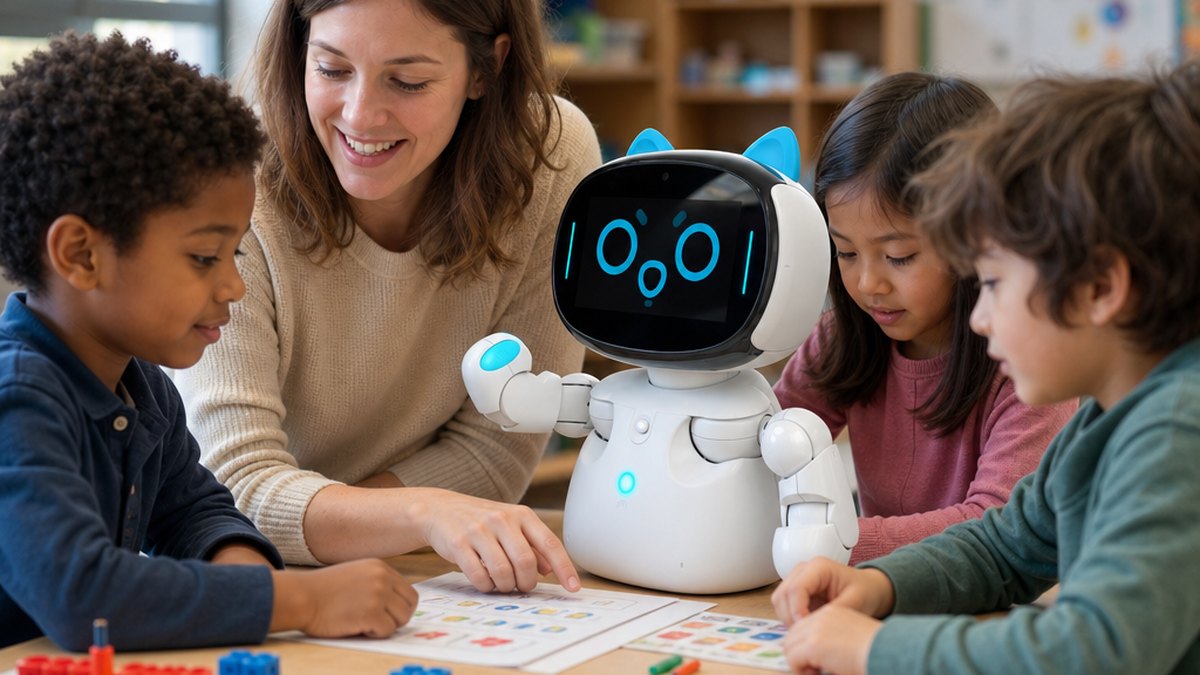
The phrase robot teacher sparks both excitement and worry, but the honest answer is simpler than the headlines: a robot can teach focused tasks and add practice, yet it cannot replace a human teacher. The useful question for schools is not whether a robot teacher will take over the classroom, it will not, but where a robot can augment teachers to do more for students. This guide explains what robot teachers can and cannot do, what the evidence says, and how schools should use them.
Table of contents
Executive Summary
A robot teacher, more precisely a social or AI robot used for instruction, can deliver focused practice, tutoring on narrow tasks, and engaging individual interaction. Research finds these robots can match human tutoring on restricted tasks and boost engagement, especially for young learners and language. But teaching is far more than delivering tasks: it involves relationship, judgment, classroom management, and responding to the whole child, which robots cannot do. The right model is augmentation: the robot handles scalable practice; the teacher does the teaching.
Key Takeaways
- A robot teacher cannot replace a human teacher.
- It can deliver focused practice and tutoring on narrow tasks.
- Evidence shows engagement and learning gains for young learners and language.
- Teaching requires relationship and judgment robots lack.
- The right model is augmentation, not replacement.
What a Robot Teacher Can Do
- Deliver focused practice on specific skills, repeatedly and patiently.
- Tutor on narrow tasks, with results comparable to human tutoring in studies.
- Engage learners through physical presence and interaction.
- Provide individual speaking practice at a scale one teacher cannot.
What a Robot Teacher Cannot Do
- Build genuine relationships and respond to the whole child.
- Exercise professional judgment across complex, changing situations.
- Manage a classroom and the social dynamics within it.
- Teach the full curriculum, not just narrow tasks.
Quick answer: a robot teacher can deliver focused practice and engaging tutoring on narrow tasks, but it cannot replace the relationship, judgment, and breadth of a human teacher.
What the Evidence Says
A 2018 review of social robots for education in Science Robotics found that robots can achieve learning outcomes similar to human tutoring on restricted tasks, with physical presence driving engagement and the largest effects for elementary learners and language learning. Crucially, the research frames robots as tutors or peer learners that support instruction, not as replacements for teachers.
District Benchmark
Translate it. A district that imagines a robot teacher replacing staff is solving the wrong problem and inviting backlash. A district that uses a robot to give every English Learner extra speaking practice, while teachers teach, is solving a real one. The same hardware, framed as augmentation, turns a controversial idea into a practical capacity gain, and avoids the morale and trust costs of replacement framing.
Why Augmentation Works
Augmentation works because it targets the Speaking Time Gap: the shortfall between the speaking practice a student needs and what one teacher can provide across a full class.
The math: a teacher with 25 students in a 45-minute block has 1,125 student-minutes and can speak with one student at a time. A robot adds individual conversation for the students the teacher cannot reach at that moment, multiplying practice without removing the teacher. That is the difference between a robot that helps and a “robot teacher” that threatens.
Common Mistakes District Leaders Make
- Replacement framing. Pitching robots as substitutes for teachers.
- Overestimating breadth. Expecting a robot to teach the whole curriculum.
- Ignoring relationships. Forgetting that teaching is relational.
- Underusing strengths. Not deploying robots for the practice they do well.
Recommended Actions
Immediate (this month): Frame any robot initiative as teacher augmentation, with staff input.
Medium-term (this year): Pilot a robot for focused practice (e.g., EL speaking) and measure the added practice.
Long-term (strategy): Integrate robots as the practice layer while investing in teachers as the instructional core.
Questions District Leaders Should Ask
- Are we framing this as augmentation, not replacement?
- What narrow, high-value task will the robot handle?
- Do teachers support and shape the initiative?
- How will we measure the added practice and outcomes?
The Real-World Track Record of Robot Teachers
The idea of a robot teacher is not new, and its history is instructive. One of the most widely reported experiments came in 2010, when South Korea placed nearly 30 egg-shaped English-teaching robots, called Engkey, in elementary classrooms in the city of Daegu. The robots wheeled around the room, read to students, led activities, and could recognize a child’s English speech and correct pronunciation, and many were teleoperated by remote teachers based in the Philippines (AFP via Phys.org, 2010<\/a>). Despite headlines about robots taking over classrooms, the reality was more modest: the robots functioned as assistants that added engaging language practice, not as replacements for teachers.
That pattern has held across more than a decade of pilots worldwide. Where robots have been useful, it has been in the assistant role, delivering practice, boosting engagement, and helping shy students speak, while human teachers kept responsibility for instruction. Where projects have overpromised a robot that teaches on its own, they have tended to disappoint. The lesson for a district considering the idea today is that the technology has genuinely improved, especially the conversational AI, but the successful model is the same one the evidence has pointed to all along: augmentation, not replacement.
Guardrails When a Robot Takes a Teaching Role
Putting a robot into any instructional role responsibly means setting a few guardrails, and these overlap with the AI-policy expectations districts are increasingly held to. Transparency comes first: families should know when and how a robot is used with their children, and what it does. Human oversight comes next: a teacher should remain responsible for what the robot does and able to review its interactions, so the robot never becomes an unsupervised authority. Data privacy matters as much here as with any AI tool, since a robot that converses with children may process their voice and responses, which must be protected under FERPA and, for under-13 students, COPPA. Finally, a district should guard against over-reliance, keeping the robot in its lane of focused practice rather than letting it crowd out the human interaction that teaching depends on. Set these guardrails up front and a robot can add real value; skip them and even a capable tool can create problems of trust and compliance.
Frequently Asked Questions
Can a robot teacher replace a human teacher?
No. A robot can deliver focused practice and tutoring on narrow tasks and boost engagement, but it cannot provide the relationship, judgment, classroom management, and curriculum breadth a human teacher does. The right model is augmentation.
What can a robot teacher do?
Deliver repeated, patient practice on specific skills, tutor on narrow tasks with results comparable to human tutoring in studies, engage learners through presence, and provide individual speaking practice at a scale teachers cannot.
Is there evidence robot teachers work?
Yes, within limits. A 2018 Science Robotics review found social robots can match human tutoring on restricted tasks and improve engagement, especially for elementary learners and language learning, while functioning as support, not replacement.
How would a robot teacher help English Learners?
By giving each student extra individual speaking practice, the input EL programs most lack, while the human teacher provides instruction and support. That augmentation directly addresses the speaking gap.
Have robot teachers been tried in real classrooms?
Yes. A widely reported example is South Korea’s 2010 Engkey project, which placed nearly 30 English-teaching robots in Daegu elementary classrooms. The robots led language practice and corrected pronunciation, many teleoperated remotely, but they served as assistants, not replacements for teachers, a pattern repeated in pilots since.
What guardrails should a district set for a teaching robot?
Transparency with families about how the robot is used, human oversight so a teacher stays responsible and can review interactions, data privacy under FERPA and COPPA for the voice and responses it processes, and protection against over-reliance so the robot stays in its lane of focused practice.
Has the technology improved enough to change the answer?
Conversational AI has improved significantly, so robots hold better, more adaptive conversations than a decade ago. But the successful model is unchanged: augmentation, not replacement. Better technology makes the assistant role more valuable; it does not make a robot a substitute for a teacher.
Related Resources
- Future of Educational Robotics
- Educational Robots for Schools
- Robots in Education
- Robots for Language Learning
- AI for English Learners
- Technology for English Learners
Conclusion
A robot teacher will not replace human teachers, and framing it that way is both inaccurate and self-defeating. What a robot can do is real and useful: deliver focused, engaging practice at a scale teachers cannot, especially individual speaking practice for English Learners. Schools that adopt the augmentation model, robot for practice, teacher for teaching, get the benefit without the backlash.
Sources: Belpaeme et al., “Social robots for education: A review,” Science Robotics (2018).
Adding Practice Without Replacing the Teacher
The fear behind the phrase robot teacher is replacement, and on that the evidence is reassuring: a robot cannot build relationships, manage a room, or exercise the judgment teaching demands. Framed as a substitute, it solves the wrong problem and invites backlash.
Framed as augmentation, though, it answers a real one. The domain English Learners most need, individual speaking practice, is the hardest for a teacher to deliver, because a full class leaves each student only a couple of minutes of real conversation a day. That shortfall is set by staffing, not effort, and no amount of dedication changes the arithmetic.
This is why some schools are using robots for exactly that narrow, high-value task: giving students extra individual conversation while the teacher does the teaching. Telo AI’s robot is one example, adding speaking practice in English plus Spanish and French, with the teacher still at the center.
See how a robot can add individual speaking practice while teachers teach: https://mytelo.ai/how-telo-works/
The same hardware is a threat or a tool depending on the framing, and only one framing survives contact with a classroom. A robot will not teach; it can give every student more of the practice a teacher never has enough hours to provide, and that is the version worth having.
Found this guide useful?
Preferred sources show up more often in your Google results, including AI Overviews.