

Last updated:
Estimated reading time: 5 minutes
The future of educational robotics is less about humanoid teachers and more about a quiet, practical shift: AI-driven robots that hold real conversations, personalize to each learner, and add the practice teachers cannot scale. For English Learner programs, that future is arriving now. This guide outlines where K-12 educational robotics is heading and what district leaders should watch.
Table of contents
Executive Summary
The next phase of educational robotics is defined by better AI: robots that converse naturally, adapt in real time, and integrate with teacher dashboards. The trend is away from novelty and STEM-kit gimmicks toward capacity, robots that reliably add individual practice, especially speaking, to language programs. Hardware will matter less than the AI and content behind it. The districts that benefit will treat robots as the practice layer of instruction, governed by the same standards of evidence, privacy, and teacher augmentation that apply to any edtech.
Key Takeaways
- AI-driven conversation is the defining advance.
- Personalization and teacher dashboards deepen.
- From novelty to capacity: robots judged by practice added.
- Software and AI matter more than hardware.
- Augmentation, privacy, and evidence remain the guardrails.
Trends Shaping the Future
- Natural conversation. Advances in AI make robot dialogue more fluent and useful for language practice.
- Real-time personalization. Robots adapt to each learner’s level and needs.
- Teacher integration. Dashboards turn robot interactions into actionable data.
- Capacity over novelty. Buyers focus on measurable practice and outcomes.
- Affordability and access. Cooperative purchasing and funding broaden adoption.
Quick answer: the future of educational robotics is AI-driven, conversational, personalized robots that add practice and integrate with teachers, judged by capacity rather than novelty.
What Will Not Change
Two things stay constant. First, robots augment teachers; the human role in instruction, relationship, and judgment remains central. Second, the bar for adoption, evidence of impact, student-data privacy (FERPA, COPPA), and instructional fit, does not lower just because the technology improves. The future rewards tools that meet those bars while adding real capacity.
District Benchmark
Translate it. A district planning for the future should not chase the flashiest robot but build the routine that any good robot plugs into: a speaking-practice station that adds individual practice for every English Learner. As AI improves, the same routine gets more effective without re-architecting the program. Invest in the model, not the gadget.
The Constant Behind the Future
Whatever the technology, the problem it must solve stays the same: the Speaking Time Gap, the shortfall between the speaking practice a student needs and what one teacher can provide across a full class. The future of educational robotics matters precisely because better AI makes robots more capable of closing that gap, at scale, with engagement. That is the lens for evaluating every advance.
Common Mistakes District Leaders Make
- Chasing novelty instead of capacity.
- Buying hardware over AI and content quality.
- Lowering the evidence/privacy bar for new tech.
- Forgetting augmentation in favor of replacement hype.
Recommended Actions
Immediate (this month): Build the speaking-station routine that future robots will plug into.
Medium-term (this year): Pilot an AI-driven language robot and evaluate AI/content quality, not just hardware.
Long-term (strategy): Adopt advances that add measurable practice while meeting evidence and privacy standards.
Questions District Leaders Should Ask
- Does the robot’s value come from its AI and content, not just hardware?
- Does it integrate with teacher data and instruction?
- Does it meet evidence and privacy standards?
- Will our routine still work as the technology improves?
From STEM Kits to Social Robots
To see where educational robotics is heading, it helps to see where it has been. The first wave in K-12 was the buildable STEM kit: programmable bricks and small coding robots that taught engineering and computational thinking. Their value was in the making and the coding, and they remain useful for that. The limitation was that the robot was an object the student programmed, not a partner the student talked with, so its reach stopped at the STEM lesson.
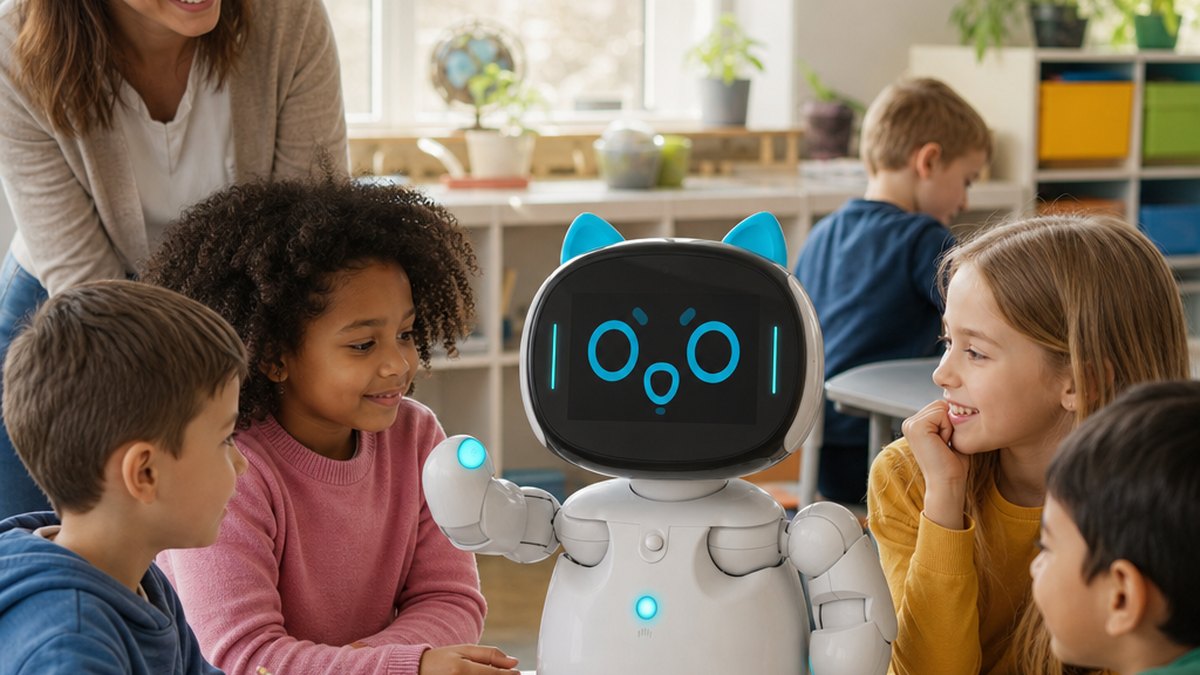
The current wave is different in kind. Social robots are designed to interact, to hold a back-and-forth exchange, respond to a learner, and sustain engagement over time. Advances in conversational AI are what moved the field from the workbench to the language block, because a robot that can listen and respond becomes useful for the parts of learning that depend on interaction rather than construction. This is the shift that makes the future of educational robotics relevant to English Learner programs, which were never the natural home of a coding kit but are an obvious fit for a patient conversation partner.
Why a Physical Robot Adds Value
A fair question is why a robot at all, when a tablet app can also run conversational AI. The answer is embodiment. Research on social robots in education, including the widely cited review in Science Robotics, finds that a physical presence tends to draw more attention and engagement than the same content on a screen, particularly for younger learners. A robot occupies the room, makes eye-level contact, and turns practice into something closer to a real interaction, which can sustain the repeated effort that language practice demands. Embodiment is not magic and it does not replace good content or a skilled teacher, but for the specific job of keeping a young student talking, day after day, a physical partner can hold attention in a way a screen sometimes cannot. As the AI improves, that engagement advantage becomes more valuable, because the robot has more to say and can adapt more precisely to the learner in front of it.
Frequently Asked Questions
What is the future of educational robotics?
AI-driven robots that hold natural conversations, personalize to each learner, and integrate with teacher dashboards, shifting the field from novelty toward measurable capacity, especially individual practice for language learners.
Will robots replace teachers in the future?
No. The trajectory is augmentation: robots add scalable practice while teachers provide instruction, relationship, and judgment. That balance is expected to hold.
Is hardware or software more important?
Increasingly the AI and content behind the robot matter more than the hardware. Evaluate conversational quality, personalization, and teacher integration over physical specs.
How should districts prepare?
Build the instructional routine, a speaking-practice station, that any capable robot plugs into, and adopt advances that add measurable practice while meeting evidence and privacy standards.
How has educational robotics changed over time?
The first wave was buildable STEM kits and coding robots that taught engineering and computational thinking. The current wave is social robots designed to interact and converse, which opened the field to language practice and other interaction-based learning that a coding kit could not support.
Why use a robot instead of a tablet app?
Embodiment. Research on social robots in education, including a widely cited Science Robotics review, finds a physical presence tends to draw more attention and engagement than the same content on a screen, especially for younger learners. That sustained engagement is valuable for the repeated effort language practice requires.
Are STEM robot kits still useful?
Yes, for their original purpose of teaching coding and engineering. They are simply a different tool from a conversational social robot. A district choosing a robot for language practice should look at conversational quality and adaptation, not building or programming features.
Related Resources
- Educational Robot Cost
- What Is an Educational Robot?
- Educational Robots for Schools
- Robots for Language Learning
- Robots in Education
- AI for English Learners
- Technology for English Learners
Conclusion
The future of educational robotics is practical, not science-fiction: AI-driven, conversational robots that add individual practice and integrate with teachers, judged by capacity rather than novelty. For English Learner programs, that future is already useful. District leaders who build the routine now, and hold new technology to standards of evidence, privacy, and augmentation, will turn each advance into more of the speaking practice their students need.
Sources: Belpaeme et al., “Social robots for education: A review,” Science Robotics (2018).
What Better Robots Are Actually For
Strip away the forecasts and one classroom fact stays fixed. In a full class of English Learners, each student gets only a few minutes of real conversation a day, and no advance in hardware changes the arithmetic of one adult and twenty-five voices.
What newer AI robots change is who can supply the rest of that practice. The limit was never teacher skill; it was the number of hours in a period. A robot that converses and adapts can hold a patient, one-to-one exchange for the students waiting their turn, which is the part of the day a teacher cannot clone.
That is why districts increasingly plan the routine first and let the technology plug into it. Telo AI is one example of that direction, an embodied robot that adds speaking practice in English plus Spanish and French.
See how a classroom robot turns waiting time into practice time: https://mytelo.ai/how-telo-works/
The future worth planning for is not a smarter gadget on a shelf but a dependable second voice in the room. Judge each advance by that test, and the forecasts sort themselves into the ones that matter.
Found this guide useful?
Preferred sources show up more often in your Google results, including AI Overviews.