

Estimated reading time: 17 minutes
Functional IEP goals are measurable annual goals for skills that are not academic: the self-care, communication, safety, community and work skills a student needs in everyday life. IDEA requires every IEP to include measurable annual goals, “including academic and functional goals,” for the needs that result from the child’s disability. This guide covers what “functional” means under IDEA, how functional goals differ from academic goals, functional performance in the PLAAFP, task analysis, 31 example goals, adaptations by age, and how to measure progress.
Table of contents
Executive Summary
Of the 8.2 million students served under IDEA in 2024-25, 5% were served under intellectual disability, a category whose federal definition includes “deficits in adaptive behavior.” OSEP reports that in fall 2024, fewer than one-third of students with intellectual disabilities or multiple disabilities spent 80% or more of the school day in general classes, against more than two-thirds of students with learning disabilities.
The U.S. Department of Education declined to list functional skills in its regulations. In 2006 it said their range “is as varied as the individual needs of children with disabilities.” IEP teams do the work: break each skill into steps, teach it where it is used, and measure each step until the student needs no help.
Key Takeaways
- “Functional” means not academic: the Department describes it as skills or activities “not considered academic or related to a child’s academic achievement.”
- Every IEP addresses functional performance. The Department refused to make the functional statement in the present levels optional.
- Break routines into steps with a task analysis, an evidence-based practice for autistic learners.
- Teach and measure in the real setting: the cafeteria, the crosswalk, the work site.
- Link to transition: from age 16, postsecondary goals cover training, education, employment and, where appropriate, independent living skills.
What Are Functional IEP Goals?
A functional IEP goal is a measurable annual goal for a non-academic skill a student needs to take part in daily life at school, at home, in the community or at work.
The IDEA regulations do not define the word. When commenters asked for a definition, the Department answered, in its 2006 analysis of comments on the Part B regulations, that “functional” is “generally understood to refer to skills or activities that are not considered academic or related to a child’s academic achievement. Instead, ‘functional’ is often used in the context of routine activities of everyday living.” It declined to list examples, and left measurement methods to public agencies. The complete guide to IEP goals covers the shared requirements.
Functional vs Academic IEP Goals
| Area | Academic goal example | Functional goal example |
|---|---|---|
| Reading | Answers questions about a grade-level passage | Reads 10 community safety signs |
| Math | Solves two-step word problems | Pays using the next-dollar strategy |
| Writing | Writes an organized paragraph | Writes name, address and phone number on a form |
| Communication | Retells a story in sequence | Requests help with a speech-generating device |
Many students need both; academic goals are covered in guides such as math IEP goals.
Functional Performance in the PLAAFP
Every IEP opens with “a statement of the child’s present levels of academic achievement and functional performance” (34 CFR 300.320(a)(1)), and the team must consider “the academic, developmental, and functional needs of the child” (34 CFR 300.324(a)(1)). In 2006, commenters asked that functional statements and goals be included only when the team found them appropriate. The Department replied: “We cannot make the changes requested by the commenters,” because the Act requires the statement.
A useful functional baseline is specific: “Given a 10-step handwashing sequence, Ana completes 4 steps independently and needs gestural prompts for 6.” More examples are in PLAAFP examples.
How to Write Functional IEP Goals
- List the routines in the student’s day, now and in the next setting: arrival, lunch, hallway, home, community, work.
- Prioritize skills that affect safety, independence or access to peers.
- Break each skill into steps with a task analysis.
- Record a baseline for each step, with the support level needed.
- Write the criterion as steps completed independently, across sessions and settings.
- Plan where the skill is taught: the setting where the student will use it.
Weak goal: “Ana will improve her hygiene.” Measurable goal: “By the annual review, given a picture sequence, Ana will complete all 10 handwashing steps independently before lunch on 4 of 5 days for 3 consecutive weeks, as measured by task analysis data sheets.”
Task Analysis for Functional Goals
The AFIRM project at UNC’s Frank Porter Graham Child Development Institute explains that task analysis “can be used to break down complex skills or behaviors into smaller, discrete steps.” Based on the National Clearinghouse on Autism Evidence and Practice’s 2020 review, it “meets evidence-based practice criteria with 13 single case design studies,” for autistic learners from about ages 3 to 22.
| Method (AFIRM) | How it works |
|---|---|
| Forward chaining | “The first step in a chain is taught first”; each next step follows mastery |
| Backward chaining | “The final step in a chain is taught first”; the previous step follows |
| Total task presentation | The learner performs the whole chain, with reinforcement at each step |
To find the steps, AFIRM suggests watching someone competent complete the task, asking an expert, or completing it yourself and recording each step.
Functional and Life Skills IEP Goals Bank: 31 Examples
These are original examples. Adapt each criterion from the student’s baseline, define “independently” (no prompts of any kind) or the allowed prompt level, and add the timeline at the start (“By [date of the next annual IEP review],”).
Self-Care and Daily Living: Independent Functioning IEP Goals
- Handwashing: Given a picture sequence, [Student] will complete all 10 handwashing steps independently before lunch on 4 of 5 days, as measured by task analysis data.
- Dressing for outdoors: At dismissal, [Student] will put on and zip a coat and put on a backpack independently on 4 of 5 days, as measured by task analysis data.
- Lunch independence: At lunch, [Student] will open all food containers and eat using utensils with no more than one prompt on 4 of 5 days, as measured by event recording.
- Toileting routine: [Student] will complete the toileting routine, including flushing and handwashing, independently in 4 of 5 opportunities, as measured by task analysis data.
Fine Motor IEP Goals
Fine motor IEP goals target the hand skills a student needs for school routines: cutting, fastening clothing, handling small materials and using classroom tools. When the IEP team finds that these needs call for OT services, those services are a related service, and 34 CFR 300.34(c)(6) describes OT as including “improving ability to perform tasks for independent functioning if functions are impaired or lost.” Write these goals with the OT provider so the baseline, the criterion and the classroom practice match. Handwriting goals are in IEP goals for writing.
- Cutting: Given a 6-inch line with one curve, [Student] will cut along it with scissors, staying within 1/4 inch of the line, in 4 of 5 trials, as measured by work samples.
- Fasteners: [Student] will fasten and unfasten the buttons, snaps and zipper on their own clothing within 2 minutes without help in 4 of 5 opportunities, as measured by task analysis data.
- Small materials: During a sorting or packaging task, [Student] will pick up 20 small items (washers, beads, clips) one at a time between thumb and fingertip and place each in the correct container within 5 minutes in 4 of 5 sessions, as measured by duration recording.
- Classroom tools: [Student] will use a glue stick, a hole punch and a stapler to assemble a 3-page packet with no more than one prompt in 4 of 5 trials, as measured by task analysis data.
Functional Communication IEP Goals
Teams must consider communication needs and assistive technology (34 CFR 300.324(a)(2)(iv) and (v)); see also speech IEP goals.
- Requesting: Using words, signs or a speech-generating device, [Student] will request a preferred item or activity with a two-word phrase in 8 of 10 opportunities across 3 sessions, as measured by event recording.
- Refusing appropriately: When offered something they do not want, [Student] will say, sign or select “no thank you” in 4 of 5 opportunities, as measured by event recording.
- Making choices: Given two or three options at snack or free time, [Student] will indicate a choice within 10 seconds in 8 of 10 opportunities, as measured by event recording.
- Reporting pain or illness: When hurt or unwell, [Student] will tell or show an adult using words, a sign or a device in 4 of 5 role-play probes and real instances, as measured by event records.
Functional Reading and Math IEP Goals
- Safety signs: Shown 10 community and safety signs (EXIT, STOP, DO NOT ENTER, restroom), [Student] will state or show what each means in 9 of 10 trials across 3 probes, as measured by probe sheets.
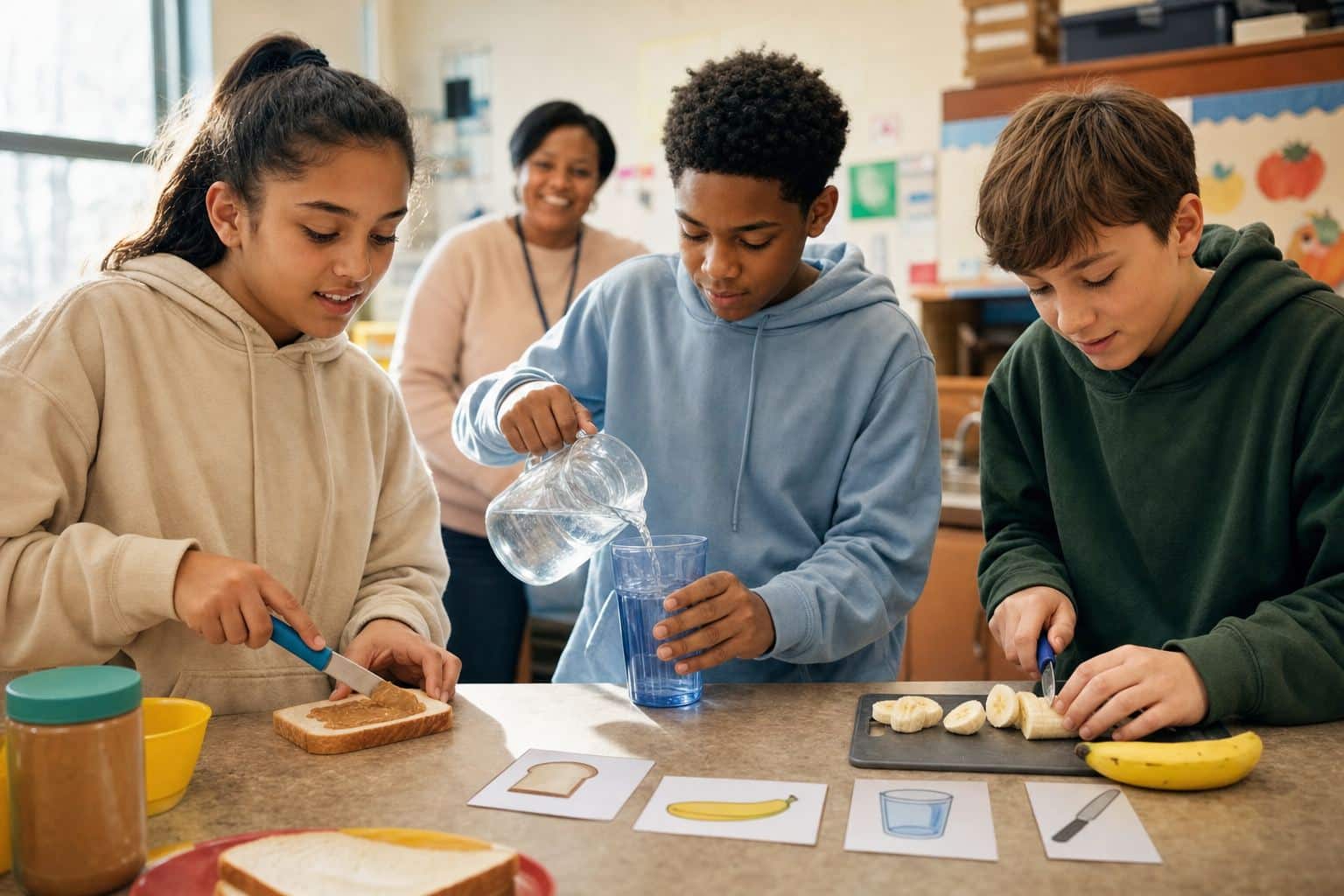
- Picture recipe: Given a 6-step picture recipe, [Student] will prepare a simple snack with no more than two prompts in 4 of 5 sessions, as measured by task analysis data.
- Next-dollar strategy: Given a price up to $10, [Student] will pay using the next-dollar strategy in 8 of 10 trials in the classroom store and in the community, as measured by probe sheets.
- Budgeting with a calculator: Given a $10 budget and three items, [Student] will total the prices with a calculator and say whether the budget covers them in 4 of 5 trials, as measured by work samples.
- Telling time for the schedule: [Student] will read a digital clock and name the next scheduled activity in 4 of 5 daily checks, as measured by teacher data sheets.
Community and Safety IEP Goals
- Crossing the street: During community instruction, [Student] will stop at the curb, look both ways, wait for the walk signal and cross at the crosswalk with no prompts in 4 of 5 crossings, as measured by task analysis data.
- Personal information: When asked by a trusted adult, [Student] will state or show their full name, a caregiver’s phone number and their address in 4 of 5 probes, as measured by probe sheets.
- Calling a caregiver: [Student] will use a phone to call a caregiver from the contact list in 4 of 5 trials, as measured by task analysis data.
- Ordering at a counter: On community outings, [Student] will order an item, pay and wait for change with no more than one prompt in 3 of 4 outings, as measured by task analysis data.
Home and Classroom Routines IEP Goals
- Following a visual schedule: At each transition, [Student] will check the visual schedule and move to the next activity without an adult prompt in 80% of transitions per day for 4 weeks, as measured by event recording.
- Cleaning up after snack: [Student] will throw away trash, wipe the table and push in the chair on 4 of 5 days, as measured by task analysis data.
- Sorting laundry: In the life skills classroom, [Student] will sort clothes into lights and darks and load the washer following a picture sequence in 4 of 5 trials, as measured by task analysis data.
Independence IEP Goals: Working Without Prompts
Independence IEP goals measure whether a student starts, completes and finishes a task or routine without adult help, so each goal names the prompt level at baseline and the level required by the annual review. In its prompting brief, the AFIRM project defines independent as performing a skill “without assistance or support from others” and warns that “failure to appropriately fade prompts can cause the learner to become prompt dependent.” Plan the fade with the prompt hierarchy; for independent work stations, see task boxes.
- Independent work system: Given three tasks set out left to right, [Student] will complete each one, place it in the finished bin and check the schedule for the next activity with no adult prompts in 4 of 5 sessions, as measured by task analysis data.
- Arrival routine: On entering the classroom, [Student] will unpack, hang up the coat, turn in the folder and start the first task within 3 minutes without a verbal prompt on 4 of 5 days, as measured by latency and task analysis data.
- Self-checking a grooming routine: After the grooming routine in the life skills classroom (washing face, combing hair, applying deodorant), [Student] will check each step on a picture checklist and complete any missed step without an adult prompt in 4 of 5 sessions, as measured by task analysis data.
Pre-Vocational IEP Goals
- School job: [Student] will complete a school job (a recycling route, delivering folders) following a picture task list with no more than one prompt on 4 of 5 days, as measured by task analysis data.
- Work stamina: [Student] will complete a sorting or assembly task for 20 minutes, from a baseline of 5, with no more than one prompt in 4 of 5 sessions, as measured by duration recording.
- Asking for the next task: When a task is finished, [Student] will tell the supervisor “I’m done, what’s next?” within 1 minute in 4 of 5 opportunities, as measured by latency recording.
- Starting a shift: At a work site, [Student] will sign in, store belongings and begin the first task within 3 minutes in 4 of 5 shifts, as measured by task analysis data.
Adapting Functional IEP Goals by Age
| Age band | Typical focus |
|---|---|
| Preschool and kindergarten | Dressing, toileting, requesting, following a picture schedule |
| Elementary | Handwashing, choices, safety signs, classroom jobs |
| Middle school | Money, telling time, phone use, simple snacks |
| High school | Community travel, ordering, work tasks, self-advocacy |
From the first IEP in effect when the student turns 16, IDEA requires postsecondary goals for training, education, employment and, “where appropriate, independent living skills” (34 CFR 300.320(b)). Transition services can include, “if appropriate, acquisition of daily living skills and provision of a functional vocational evaluation” (34 CFR 300.43). See transition IEP goals, and for autistic students, IEP goals for autism. Planning and organization skills are in executive function IEP goals.
How to Measure Functional IEP Goals
| Data type | What it records | Fits goals such as |
|---|---|---|
| Task analysis data | The support level for each step (verbal, gestural, model, physical, independent) | Handwashing, crossing the street, recipes |
| Event recording | How often or what percent | Requests, choices, signs read |
| Duration | How long the student works | Work stamina |
| Latency | Time from a cue to the start | Asking for the next task |
The AFIRM data sheet records the support needed for each step; event, duration and latency are defined by the Kentucky Department of Education, which adds that authentic assessment, performance on real-life tasks, must be paired with another method. Probe where the skill is used and report the share of steps done independently; templates are in IEP data collection sheets. If progress stalls, the team must revise the IEP (34 CFR 300.324(b)).
Funding and Staffing
| Source | What it can support |
|---|---|
| IDEA Part B | Special education, which includes “travel training” and “vocational education” (34 CFR 300.39(a)(2)); transition services |
| State vocational rehabilitation (Pre-ETS) | States must “reserve at least 15 percent” of their federal VR grant for pre-employment transition services, for students generally 14 to 21 (RSA) |
| Local funds | Life skills materials, community outings; cooperatives such as TIPS simplify purchasing |
Staffing is the constraint behind every row: special education is the shortage area states report most often, named by 45 states for 2024-25 in the Learning Policy Institute’s 2026 overview of teacher shortages.
Common Mistakes District Leaders Make
- Treating functional goals as optional. Every IEP must address functional performance.
- Writing a goal without a task analysis. “Will wash hands” hides 10 steps.
- Leaving “independently” undefined. Name the prompt level.
- Teaching only in the classroom. A skill used at the crosswalk must be measured there.
- Choosing skills that do not fit the student’s age or the next setting they will move to.
- Forgetting communication. A student who cannot request help cannot use other skills safely.
- Waiting until 16 to start independent living skills.
Recommended Actions
- Audit present levels for a functional statement with step-level baselines.
- Build a district task analysis library for common routines.
- Standardize prompt levels and one task analysis data sheet.
- Schedule community instruction where goals require it.
- Coordinate with state vocational rehabilitation on Pre-ETS for students 14 and older.
- Track goal attainment by program at each annual review.
Questions District Leaders Should Ask
- Does every IEP’s present levels statement describe functional performance in measurable terms?
- How many functional goals are taught and measured in the setting where the skill is used?
- Do our teams share task analyses, or rebuild them for every student?
- How many students age 14 and older are connected to Pre-ETS?
- What share of functional goals were met at the last annual review?
Frequently Asked Questions
What are examples of functional goals?
Washing hands with a picture sequence, opening lunch containers, requesting with a device, reading safety signs, paying with the next-dollar strategy, crossing at a crosswalk, calling a caregiver, following a visual schedule and completing a school job. Each names a condition, an observable skill, a criterion and a measurement method, usually task analysis data.
What are some examples of functional language IEP goals?
Requesting a preferred item with a two-word phrase, refusing with “no thank you,” making a choice within 10 seconds, reporting pain or illness, asking for the next task, and stating personal information. They can use speech, signs or a speech-generating device; the IEP team must consider communication needs and assistive technology for every child.
Can you give me some examples of functional life skills?
Self-care (dressing, toileting, handwashing), meals (opening containers, following a picture recipe), money (paying, budgeting with a calculator), time (reading a clock to follow a schedule), safety (crossing streets, sharing personal information with trusted adults), home skills (cleaning up, laundry) and work skills (completing a job, asking for the next task). Classroom ideas for each are in our life skills activities guide.
What are functional needs on an IEP?
Functional needs are needs in skills that are not academic, often the routine activities of everyday living, that result from the student’s disability. IDEA requires the IEP team to consider the child’s “academic, developmental, and functional needs,” to describe functional performance in the present levels, and to write functional goals where those needs exist.
Can an IEP have both academic and functional goals?
Yes. The regulation itself says “measurable annual goals, including academic and functional goals.” A student may have a reading comprehension goal and a goal for reading community signs in the same IEP. The mix follows the student’s needs, as described in the present levels, not the eligibility category or the setting.
Related Resources
- IEP Goals: How to Write Measurable Goals
- Transition IEP Goals
- IEP Goals for Autism
- Speech IEP Goals
- Executive Function IEP Goals
- IEP Data Collection Sheets
Conclusion
Functional IEP goals cover the skills that shape a student’s independence: self-care, communication, safety, money, time and work. IDEA leaves the list to IEP teams, so quality depends on method: a step-level baseline, a task analysis, teaching in the real setting, and data on every step until prompts are gone.
Sources: U.S. Department of Education, Analysis of Comments and Changes, 71 Fed. Reg. 46661-46662 (August 14, 2006); 34 CFR 300.320, Definition of individualized education program; 34 CFR 300.324, Development, review, and revision of IEP; 34 CFR 300.8, 300.39 and 300.43 (eCFR, Part 300 Subpart A); U.S. Department of Education, OSEP, 2024-25 Static Tables (Part B Child Count & Educational Environments); AFIRM, Task Analysis EBP Brief Packet (UNC Frank Porter Graham Child Development Institute, 2024); AFIRM, Prompting EBP Brief Packet (UNC Frank Porter Graham Child Development Institute, updated 2024); 34 CFR 300.34, Related services; Kentucky Department of Education, Method of Measurement and Type of Data; Rehabilitation Services Administration, Pre-Employment Transition Services (RSA-4, 2024); Learning Policy Institute, An Overview of Teacher Shortages: 2026, July 13, 2026.
Join the 2027 Special Education Pilot
Life skills are learned through the same routine repeated many times, step by step, and few students get an adult beside them for every repetition. Telo AI is being adapted for students with IEPs: patient, 1-on-1 practice aligned to each student’s IEP goals, including daily living skills. We are inviting districts to shape it with us in a 2027 pilot.
Apply to pilot Telo AI in your Special Education program
Found this guide useful?
Preferred sources show up more often in your Google results, including AI Overviews.