

Estimated reading time: 17 minutes
Executive function IEP goals are measurable annual goals that teach the self-management skills behind schoolwork: starting a task, planning it, keeping materials organized, managing time, holding directions in mind, shifting strategies and checking one’s own work. This guide explains what executive function is, why lists of “7” or “12” skills differ, how students qualify for an IEP, 28 example goals by skill (including goals for ADHD), how to adapt them by grade, and how to measure progress.
Table of contents
Executive Summary
Other health impairment, the IDEA category whose federal definition names ADHD, covers 15% of the 8.2 million students served under IDEA; specific learning disability covers 31% and autism 15%. The U.S. Department of Education’s guidance on ADHD describes students who may need “behavioral and executive function supports to improve focus and organizational skills.”
The Center on the Developing Child at Harvard University notes that these skills “do not automatically develop with maturity over time”; they are built through practice. A goal that names a routine to practice daily can produce progress; “will be more organized” cannot.
Key Takeaways
- Harvard groups executive function into three core functions: working memory, mental flexibility and self-control.
- There is no official list of 7 or 12 skills. Counts depend on the author’s framework.
- Executive dysfunction is not an IDEA category. Students qualify under a category such as other health impairment (which names ADHD), specific learning disability or autism, and must need special education.
- Write the skill, not the accommodation: “will use a planner to record assignments” is a goal; “will receive extra time” is not.
- Plan the fade: each goal should move from adult prompts toward independent use.
What Is Executive Function?
Executive function is the set of mental skills a student uses to hold and work with information, focus, filter distractions and switch gears, so that work gets planned, started and finished.
The Harvard Center compares it to air traffic control: the ability to “focus, hold, and work with information in mind, filter distractions, and switch gears.” Its brief on executive function names “three types of brain function: working memory, mental flexibility, and self-control.” In school terms:
- Working memory: holding a multi-step direction in mind.
- Mental flexibility: switching gears when a strategy fails or the plan changes.
- Self-control: filtering distractions and resisting the urge to act before thinking.
The brief calls ages 3 to 5 “a window of opportunity for dramatic growth” and says the skills keep maturing “through the teen years and into early adulthood.” It recommends “repeated practice of skills over time.”
Why Lists of 7 or 12 Executive Functioning Skills Vary
There is no standard list in IDEA or federal guidance; the count depends on the framework.
| Framework | Count | Skills named |
|---|---|---|
| Harvard Center on the Developing Child | 3 core functions | Working memory, mental flexibility, self-control |
| Russell Barkley (Child Mind Institute) | 5 executive abilities | Inhibiting behavior, nonverbal working memory (visual imagery), self-talk, controlling emotions, planning and problem solving |
| Dawson and Guare, Executive Skills Questionnaire | 12 skills | Response inhibition, working memory, emotional control, task initiation, sustained attention, planning/prioritization, organization, time management, goal-directed persistence, flexibility, metacognition, stress tolerance |
Sources: Harvard Center on the Developing Child; Child Mind Institute; Dawson and Guare questionnaire. A list of 7 is one author’s selection; for an IEP, the observable behavior matters more than the label.
Executive Function and IEP Eligibility
IDEA has no executive function category, and 34 CFR 300.8 does not use the term. A child qualifies by meeting one of the listed categories and, “by reason thereof,” needing special education and related services. Executive function needs can appear within several categories:
| Category | Federal definition (34 CFR 300.8) | Share of IDEA students |
|---|---|---|
| Other health impairment | “Limited strength, vitality, or alertness,” due to health problems such as “attention deficit hyperactivity disorder” | 15% |
| Specific learning disability | A disorder in “basic psychological processes” involved in understanding or using language | 31% |
| Autism | A developmental disability affecting communication and social interaction | 15% |
| Traumatic brain injury | Includes impairments in “memory; attention; reasoning; abstract thinking; judgment; problem-solving” | 2% or less |
Shares are from OSEP (2024-25). A student whose needs do not require special education may still be covered by Section 504: the Office for Civil Rights’ resource guide on students with ADHD says that finding a student with ADHD ineligible under IDEA “does not relieve” the district of its obligation to evaluate the student, as appropriate, under Section 504. Eligibility is covered in the IEP meeting guide.
How to Write Executive Function IEP Goals
Every IEP needs “measurable annual goals, including academic and functional goals” (34 CFR 300.320). Executive function goals are usually functional IEP goals with the structure set out in the complete guide to IEP goals. Three rules matter most:
- Name the routine. “Will use a three-column planner at the end of each class” is teachable; “will improve organization” is not.
- State the support level: the prompt the student starts with and the independence the goal requires.
- Keep it apart from accommodations. Extended time reduces the load; a goal teaches the skill (see IEP accommodations).
Weak goal: “Sam will be more organized.” Measurable goal: “By the annual review, at the end of each class period, Sam will record every assignment and due date in a planner with no more than one adult prompt on 4 of 5 days for 4 consecutive weeks, as measured by daily planner checks.”
Executive Function IEP Goals Bank: 28 Examples
These are original examples. Adapt each criterion from the student’s baseline in the PLAAFP, name the real setting, and add the timeline at the start (“By [date of the next annual IEP review],”). For emotional regulation goals, see social emotional IEP goals; for refusal with a clear function, see behavior IEP goals.
Task Initiation IEP Goals
- Starting independently: After independent work is assigned, [Student] will begin the first step within 2 minutes without an adult prompt in 4 of 5 opportunities, as measured by latency recording.
- Using a start card: Given a start card listing the first step, [Student] will read it and begin the task within 1 minute in 4 of 5 assignments, as measured by latency recording.
- Breaking the ice on writing: Given a writing prompt, [Student] will write a first sentence or list three ideas within 5 minutes in 4 of 5 prompts, as measured by work samples.
Planning and Prioritizing IEP Goals
- Breaking down a project: Given a multi-week assignment, [Student] will divide it into at least four steps with a due date for each in 4 of 5 projects, as measured by planning sheets.
- Ordering tasks: Given a list of three to five tasks, [Student] will number them by due date and importance and explain the order in 4 of 5 opportunities, as measured by teacher checklists.
- Planning before writing: Before a written response, [Student] will complete a graphic organizer with a main idea and three supporting points in 4 of 5 assignments, as measured by work samples.
Organization IEP Goals
Organization IEP goals teach organizational skills: keeping papers, materials and digital files in a system the student can run without an adult. Dawson and Guare define organization as “the ability to create and maintain systems to keep track of information or materials.” Their teaching strategies call for a system that is monitored, “initially on a daily basis,” and for letting students choose among organizational systems. Build each goal around one system and a regular check, then fade the adult check.
- Binder system: [Student] will file handouts in the correct labeled section of a binder, with no loose papers, in 4 of 5 weekly binder checks, as measured by a binder checklist.
- Homework folder: [Student] will place completed homework in a “to turn in” folder and submit it at the start of class on 4 of 5 days, as measured by teacher records.
- Materials for class: [Student] will arrive at each class with the items on a class materials card (for example a notebook, a pencil, a charged device and the class folder) in at least 90% of class periods each week for 4 consecutive weeks, as measured by a materials checklist.
- Weekly clean-out: During a weekly 10-minute organization time, [Student] will empty the backpack and binder, sort papers into file, take home and recycle, and repack, following a four-step checklist with no more than one prompt in 4 of 5 weeks, as measured by checklist records.
- Digital files: [Student] will save each assignment in the correct class folder of the school drive, with a file name that includes the class and the date, in 4 of 5 weekly folder checks, as measured by a folder checklist.
Time Management IEP Goals
- Estimating time: Before a task, [Student] will estimate how long it will take, then record the actual time, with estimates within 5 minutes of actual in 4 of 5 tasks, as measured by time logs.
- Using a timer: During independent work, [Student] will set a timer for each work segment and move to the next step when it sounds in 4 of 5 sessions, as measured by teacher observation.
- Meeting due dates: [Student] will submit at least 85% of assignments by the due date for 9 consecutive weeks, as measured by gradebook records.
Working Memory IEP Goals
- Multi-step directions: Given a three-step oral direction, [Student] will complete all steps in order without a repeat in 4 of 5 opportunities, as measured by teacher data sheets.
- Self-cueing: When given multi-step directions, [Student] will write or draw a quick note of each step before starting in 4 of 5 opportunities, as measured by work samples.
Flexible Thinking and Shifting IEP Goals
- Trying a second strategy: When a first strategy for a problem does not work, [Student] will choose a second taught strategy and try it within 2 minutes in 4 of 5 opportunities, as measured by teacher data sheets.
- Shifting between problem types: On mixed practice sets, [Student] will identify the operation each problem needs before solving it with 90% accuracy across 3 sets, as measured by work samples.
- Revising a plan: When a planned step cannot be done (missing materials, a changed due date), [Student] will state a new plan within 3 minutes in 4 of 5 instances, as measured by teacher observation.
Self-Monitoring and Goal-Directed Persistence IEP Goals
Self-monitoring IEP goals teach a student to check and record their own behavior or work, then compare the record with a target. The IRIS Center’s module on self-monitoring describes it as teaching students “to self-assess their behavior and record the results,” and separates self-monitoring of attention, cued at set intervals, from self-monitoring of performance, such as counting the problems completed correctly. It adds that self-monitoring “does not create new skills or knowledge,” so pair the goal with instruction in the skill itself. For autistic learners, the National Clearinghouse on Autism Evidence and Practice’s 2020 review lists self-management as an evidence-based practice in which adult support “is faded over time.” Goals for self-monitoring of attention during instruction are in behavior IEP goals.
- Checking work: Before turning in an assignment, [Student] will use an editing or math checklist and correct at least half of their own errors in 4 of 5 assignments, as measured by work samples.
- Sustained work: [Student] will work on an independent task for 15 minutes, from a baseline of 5, with no more than one prompt in 4 of 5 sessions, as measured by duration recording.
- Weekly goal review: At a weekly check-in, [Student] will state a personal academic goal, report progress with evidence and name one next step in 4 of 5 check-ins, as measured by conference notes.
- Graphing correct work: After each independent math or reading assignment, [Student] will count the items completed correctly, record the number on a personal graph and match the teacher’s count within one item in 4 of 5 assignments, as measured by the student graph and teacher checks.
- Daily work target: At the start of independent work, [Student] will set a target number of items, record the number completed at the end of the period and state whether the target was met in 4 of 5 sessions, as measured by self-recording sheets.
- Self-monitoring without reminders: [Student] will start and complete the self-monitoring form without an adult reminder in 4 of 5 sessions, while teacher accuracy checks fade from every session to one unannounced check a week, as measured by completed forms and spot checks.
Executive Functioning IEP Goals for ADHD
For students served under other health impairment because of ADHD, pair each skill with an external cue, such as a timer or a checklist, and plan how it fades.
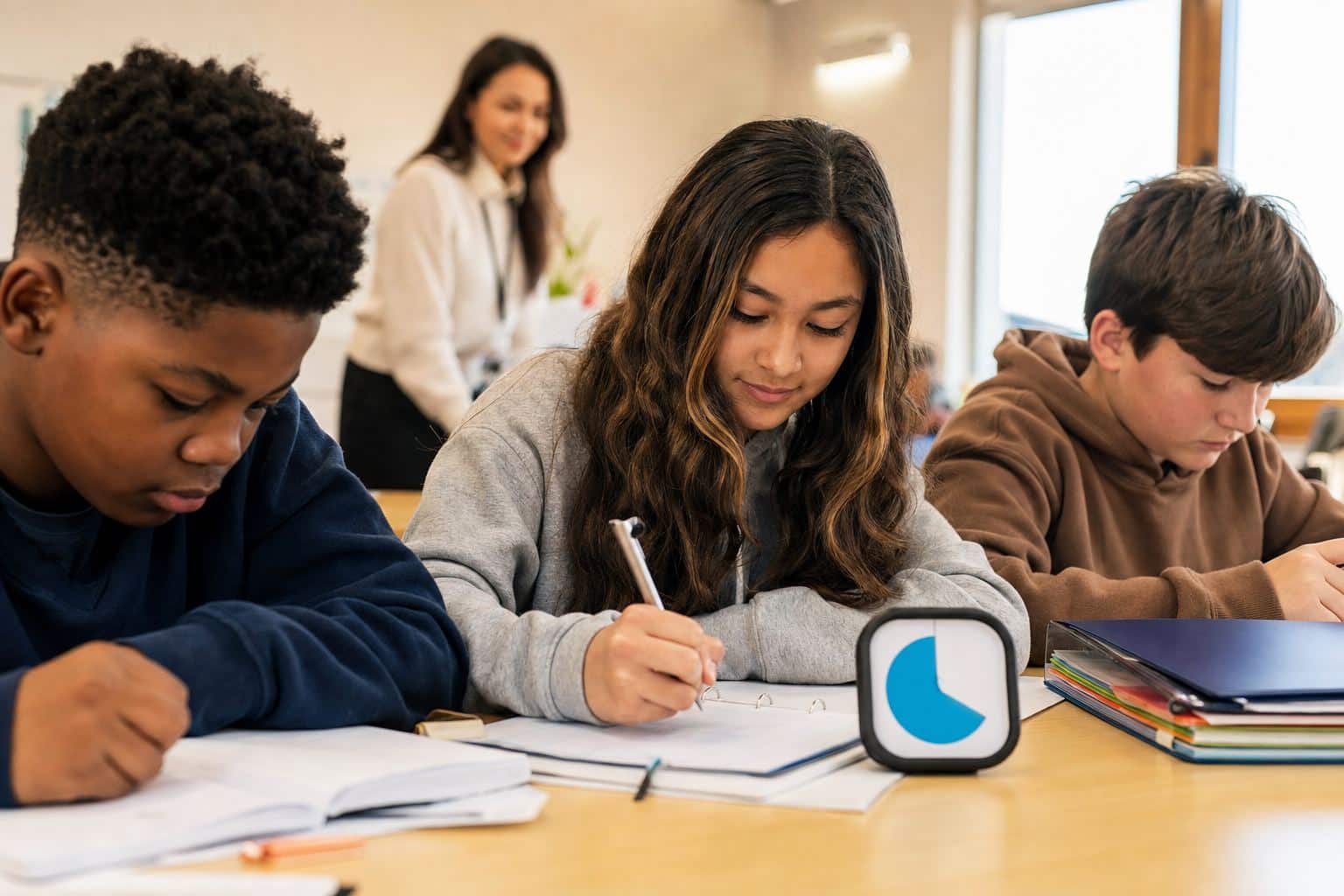
- Work sprints: Using a visual timer for 10-minute work sprints with a 1-minute movement break, [Student] will complete the assigned portion of each sprint in 4 of 5 sessions, as measured by work samples.
- End-of-day check-out: At dismissal, [Student] will check the planner against a homework list and pack every needed item on 4 of 5 days, as measured by a check-out checklist.
- Fading prompts: [Student] will start independent work within 2 minutes after a single nonverbal cue, moving to no cue by the final quarter, in 4 of 5 opportunities, as measured by latency recording.
Executive Function IEP Goals by Grade Level
| Grade band | Typical focus | Example target |
|---|---|---|
| Kindergarten | Following routines, two-step directions, waiting | Completes a three-picture morning routine with one prompt |
| Elementary | Starting work, homework folder, checking work | Starts independent work within 2 minutes using a start card |
| Middle school | Planner use across classes, long assignments | Breaks a project into dated steps |
| High school | Independent time management, self-advocacy | Submits 85% of work on time and requests help from teachers |
In high school, these skills feed transition IEP goals, required no later than the first IEP in effect when the student turns 16 (34 CFR 300.320(b)).
How to Measure Executive Function IEP Goals
| Skill | Data type | What to record |
|---|---|---|
| Task initiation | Latency | Time from the direction to the first step |
| Sustained work, persistence | Duration | Minutes on task before a prompt |
| Working memory, flexibility | Event | Steps completed or strategies tried, as a count or percent |
| Organization, time management | Checklist or work sample probes | Binder and planner checks, share of work turned in on time |
Event, duration and latency are defined by the Kentucky Department of Education, which also notes that authentic assessment, performance on real-life tasks, must be paired with another method. Pair grades with a direct probe. Templates are in IEP data collection sheets. If progress stalls, the team must revise the IEP (34 CFR 300.324(b)).
Funding and Staffing
| Source | What it can support |
|---|---|
| IDEA Part B | Specially designed instruction in executive skills, supplementary aids, staff training |
| IDEA CEIS (up to 15% of Part B) | Academic and behavioral supports for K-12 students not identified, emphasis K-3 (TEA) |
| Local funds | Planners, timers, study skills courses; cooperatives such as TIPS simplify purchasing |
Staffing limits daily coaching: special education is the shortage area states report most often, named by 45 states for 2024-25 in the Learning Policy Institute’s 2026 overview of teacher shortages.
Common Mistakes District Leaders Make
- Writing accommodations as goals. “Will receive extended time” teaches nothing.
- Writing traits. “Will be more responsible” cannot be measured.
- Never fading support. A goal met only with a daily adult check is not yet independence.
- Measuring with grades alone. A grade does not show which skill broke down.
- Assuming ADHD means a 504 plan only. Other health impairment explicitly includes ADHD.
- Writing five executive function goals at once. Pick the one or two skills that block the most work.
- Ignoring the setting. A resource-room routine must transfer to general education.
Recommended Actions
- Sample IEPs with executive function goals and check each for a named routine, a support level and a baseline.
- Separate goals from accommodations in IEP templates and training.
- Adopt common tools (one planner format, one binder system) per grade band so routines carry across classes.
- Write a fading plan into every goal with adult prompts.
- Train general education teachers to run the 2-minute checks inside their own routines.
- Review 504 and IEP referrals for students with ADHD so need, not diagnosis, drives the decision.
Questions District Leaders Should Ask
- How many IEPs include executive function goals, and how many state a baseline?
- Which goals still depend on daily adult prompts at the annual review?
- Do general education teachers know which routine each student is practicing?
- What share of these goals were met at the last annual review?
- How do our teams decide between a 504 plan and an IEP for students with ADHD?
Frequently Asked Questions
Can you get an IEP for executive functioning disorder?
Not under that label: IDEA has no executive function category. A student qualifies by meeting a category, such as other health impairment (which names ADHD), specific learning disability, autism or traumatic brain injury, and needing special education as a result. The IEP can then include executive function goals. Otherwise, a Section 504 plan may apply.
What are the 7 executive functioning skills?
There is no official list of seven. Harvard’s Center on the Developing Child names three core functions (working memory, mental flexibility, self-control), Russell Barkley describes five executive abilities, and Dawson and Guare’s questionnaire names twelve skills. A list of seven is one author’s selection. For an IEP, target the observable skill, not the label.
What are the 12 executive functioning skills?
One list of twelve comes from Peg Dawson and Richard Guare’s Executive Skills Questionnaire: response inhibition, working memory, emotional control, task initiation, sustained attention, planning/prioritization, organization, time management, goal-directed persistence, flexibility, metacognition and stress tolerance. It is one framework, not a legal or clinical standard, but it maps well onto IEP goal areas.
What are some examples of functional IEP goals?
Functional goals target skills that are “not considered academic,” in the U.S. Department of Education’s 2006 explanation. Examples include using a planner, following a daily routine, asking for help, managing money, handling self-care or using a communication system. Many executive function goals are functional goals. For life skills, communication and community goals, see functional IEP goals.
Are executive function supports goals or accommodations?
Both, and they do different jobs. An accommodation, such as extended time or a copy of class notes, reduces the demand. A goal teaches the skill, such as recording assignments or breaking down a project, so the student needs less support over time. Strong IEPs pair the two and fade the accommodation as the skill grows.
Can AI help write executive function IEP goals?
AI tools can turn notes on a routine and a baseline into measurable wording, and help break a skill into teachable steps. Leave out names and identifiable details, follow district policy, and keep decisions with the IEP team. Our ChatGPT for teachers guide covers safe prompting practices.
Related Resources
- IEP Goals: How to Write Measurable Goals
- Functional IEP Goals
- Behavior IEP Goals
- Social Emotional IEP Goals
- IEP Accommodations
- IEP Data Collection Sheets
Conclusion
Executive function goals work when they name a routine the student practices every day, state the support level, and plan how that support fades. The count on a list matters less than the observable behavior. Routines built into ordinary class transitions, rather than added on top, are the ones students can carry into the next grade.
Sources: Center on the Developing Child at Harvard University, InBrief: Executive Function, Skills for Life and Learning; Center on the Developing Child, What Is Executive Function?; Child Mind Institute, ADHD and Executive Function (Russell Barkley); Dawson and Guare, Executive Skills Questionnaire; 34 CFR 300.8, Child with a disability (eCFR); 34 CFR 300.320, Definition of individualized education program; 34 CFR 300.324, Development, review, and revision of IEP; U.S. Department of Education, Office for Civil Rights, Students with ADHD and Section 504: A Resource Guide, July 2016; U.S. Department of Education, OSEP, 2024-25 Static Tables (Part B Child Count & Educational Environments); Kentucky Department of Education, Method of Measurement and Type of Data; TEA, Requirements of Coordinated Early Intervening Services; Learning Policy Institute, An Overview of Teacher Shortages: 2026, July 13, 2026; U.S. Department of Education, Analysis of Comments and Changes, 71 Fed. Reg. 46661 (August 14, 2006).
Join the 2027 Special Education Pilot
Executive skills grow through daily repetition of the same small routines, and most students get only as many repetitions as an adult has time to run. Telo AI is being adapted for students with IEPs: patient, 1-on-1 practice aligned to each student’s IEP goals. We are inviting districts to shape it with us in a 2027 pilot.
Apply to pilot Telo AI in your Special Education program
Found this guide useful?
Preferred sources show up more often in your Google results, including AI Overviews.