

Estimated reading time: 14 minutes
A prompt hierarchy is the planned order of prompts an adult uses to help a student perform a skill, from the least to the most assistance or the reverse, with a plan to fade each prompt until the student performs the skill alone. Prompts can be verbal, gestural, visual, modeled or physical. This guide covers the types of prompts, the hierarchy from least to most intrusive, least-to-most versus most-to-least prompting, prompt fading and time delay, an example classroom routine, a prompt-level data sheet, prompting for students who use AAC and how to write prompt levels into IEP goals.
Table of contents
Executive Summary
Prompting has the largest evidence base of the 28 evidence-based practices identified for autistic learners by the National Clearinghouse on Autism Evidence and Practice (NCAEP) in 2020: 140 articles, more than any other practice. NCAEP calls prompting foundational, because it is used with or built into other practices such as time delay, discrete trial training, video modeling and social skills training.
The risk is help that never goes away. AFIRM, the free training modules built on the NCAEP review, warns that failure to fade prompts “can cause the learner to become prompt dependent.” A written prompt hierarchy, a fading plan and prompt-level data are what keep prompting temporary, and they matter for every adult who works with the student, including paraprofessionals, whom IDEA allows to assist when they are appropriately trained and supervised (34 CFR 300.156).
Key Takeaways
- A prompt is temporary help; the goal is a response to the natural cue.
- Five prompt types: verbal, gestural, visual, model and physical, with “independent” as the first level.
- There is no single correct order: the hierarchy depends on the student and the skill.
- Least-to-most fits skills used inconsistently; most-to-least and simultaneous prompting limit errors on new skills.
- Plan fading before you start, with time delay and a rule for stepping down.
- Record the prompt level and write the target level into the IEP goal.
What Is a Prompt?
A prompt is any help given to a student, before or as they attempt a skill, that assists them in performing it correctly, and that is removed as the student learns.
The AFIRM prompting brief (2024 update) describes prompting as a way to reduce incorrect responses while a learner acquires a new skill. The target is the natural cue: the bell, the written direction, the empty tray. Prompts bridge the gap until the student responds to that cue alone.
The Texas Education Agency’s Hierarchy of Cueing and Prompting (2024) separates two kinds of help. A cue is “a hint or a nudge in the right direction that does not provide a direct answer.” A prompt “pulls the student through each step to the end of the task and directly leads to the answer.” Try a cue before a prompt.
Types of Prompts
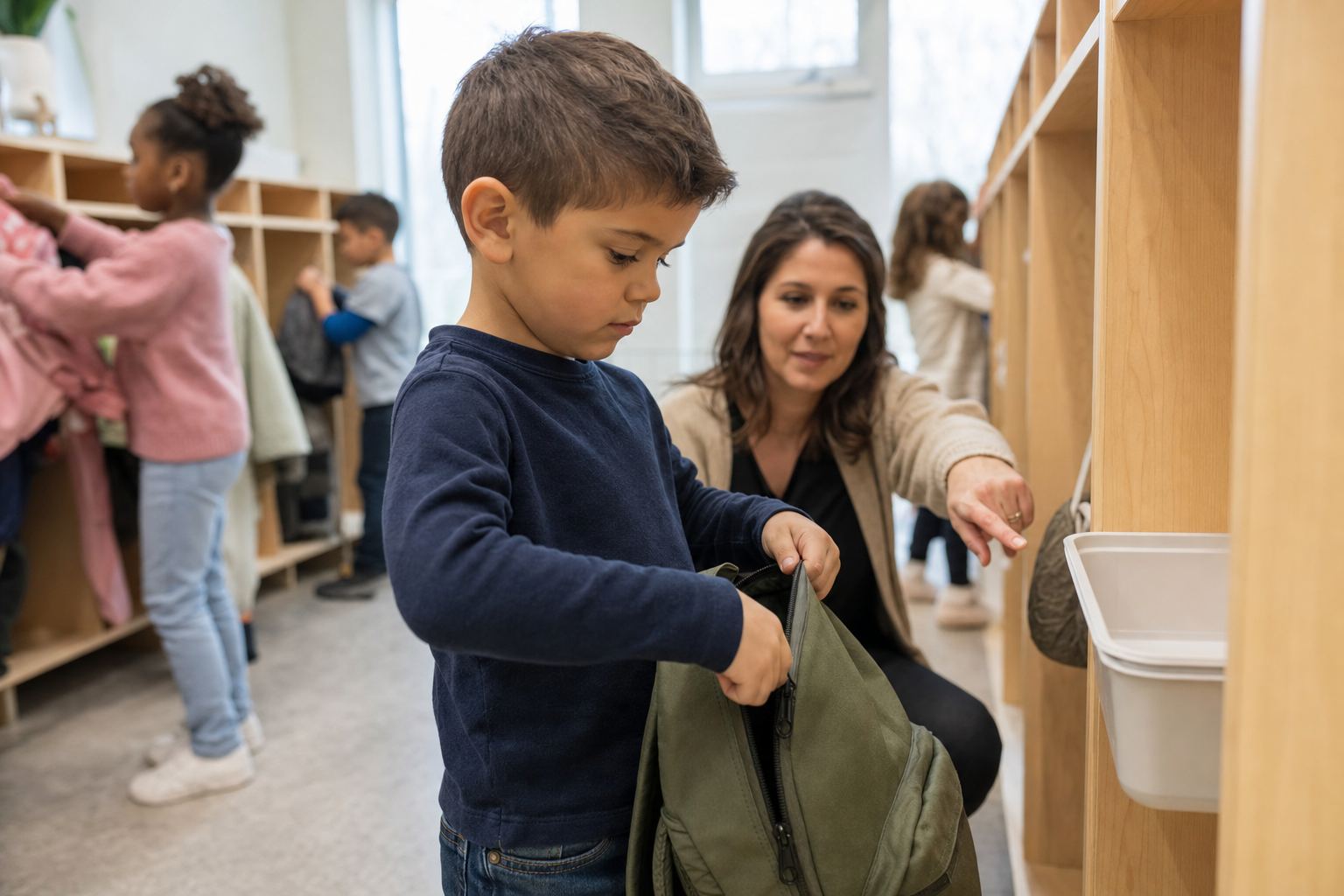
The definitions below follow AFIRM; the classroom examples are original and use one routine, unpacking a backpack on arrival.
| Prompt | What it is | Example |
|---|---|---|
| Independent | No prompt: the student responds to the natural cue | Student unpacks after walking in |
| Verbal | Spoken words, from a hint (less restrictive) to a direct instruction (more restrictive) | “What comes next?” or “Put your folder in the tray.” |
| Gestural | A movement that shows what to do | Pointing at the folder tray |
| Visual | A picture, icon or object that shows how to do the step | A photo strip of the arrival routine |
| Model | Demonstrating the step, fully or partly | The adult unzips her own bag |
| Physical | Hands-on help, partial (a light touch) or full | A touch at the elbow toward the zipper |
The Prompt Hierarchy From Least to Most Intrusive
A common hierarchy, from the least to the most intrusive help, looks like this:
| Level | Prompt | What the adult does |
|---|---|---|
| 1 | Independent | Gives the natural cue and waits a few seconds |
| 2 | Indirect verbal or gestural | Asks “What’s next?” or points |
| 3 | Visual | Shows the picture for the step |
| 4 | Model | Demonstrates the step |
| 5 | Partial physical | Light touch to start the movement |
| 6 | Full physical | Guides the whole movement |
The order is not fixed. AFIRM defines the prompting hierarchy as the order and types of prompts for a learner and notes that it “can be different depending on the needs of the student and the type of goal.” TEA’s chart starts with wait time, then orders cues from verbal hints to a physical gesture and prompts from a verbal direction to a physical assist, while a TEA classroom video notes that, for one student, a gestural prompt was less intrusive than a verbal one. TEA advises planning the least invasive support the student needs to succeed, with a plan for fading, and says hand-under-hand is preferable for students who need a full physical prompt.
Least-to-Most vs Most-to-Least Prompting
The hierarchy says which prompts exist; the procedure says how to move through them. AFIRM describes least-to-most prompting as “a prompt hierarchy with at least three levels”: the student first has a chance to respond without prompts, help then increases one level at a time, and the last level is the controlling prompt, the one that ensures a correct response. Most-to-least prompting runs the other way: teaching starts with the prompt that ensures a correct response, which is then reduced step by step until it is removed (Aykut, 2012). In the sample data sheet published with one study, the adult moved to a lighter physical prompt after two consecutive correct responses (Libby et al., 2008).
| Procedure | How it works | When AFIRM or research suggests it |
|---|---|---|
| Least-to-most | Wait, then add help one level at a time | The student uses the skill, but not consistently, or may be regressing |
| Most-to-least | Start with the controlling prompt, step down after correct responses | New skills, when errors should stay low; fewer errors than least-to-most in Libby et al. |
| Graduated guidance | A controlling prompt, almost always physical, removed gradually during the activity | Chained skills embedded in routines, such as washing hands |
| Simultaneous prompting | Cue and controlling prompt together in teaching sessions; separate probes without prompts | Beginning a new skill |
Direct comparisons are mixed. In Libby et al. (2008), every child learned with most-to-least prompting and made fewer errors, but three children learned faster with least-to-most; adding a delay to most-to-least gave nearly the speed of least-to-most with fewer errors. A 2016 study found most-to-least more effective and efficient for all three participants, while a 2020 study found least-to-most the most efficient fading procedure for all of its participants. All three studies involved autistic children; the practical lesson is to choose per student and let the data decide.
Prompt Fading and Avoiding Prompt Dependence
A student who waits for an adult before every step has learned to respond to the prompt, not to the task. AFIRM advises deciding on prompt fading strategies before prompting begins, “to decrease prompt dependence.”
Time delay is an evidence-based practice for fading prompts. NCAEP describes it as a brief delay between the instruction and any prompt, always used with a prompting procedure. The AFIRM time delay brief describes two versions:
- Constant time delay: a 0-second delay at first, then, after at least two trials, a fixed wait, typically 3 to 5 seconds, before the controlling prompt.
- Progressive time delay: the wait starts at 0 seconds and grows gradually, usually to 5 seconds and sometimes to 10.
Three habits make fading routine. Set the step-down rule in advance and write it on the student’s plan. Prompt from behind the student so they look at the materials, not the adult, as AFIRM advises for visual supports. And move toward natural cues and visual supports the student can use without an adult.
Example: Prompting a Classroom Routine
NCAEP defines task analysis as dividing an activity into “small, manageable steps” to assess and teach a skill. Each step then gets its own prompt level. In this original example, Leo, a second grader, is learning the arrival routine with least-to-most prompting and a 4-second wait.
| Step | Week 1 | Week 4 |
|---|---|---|
| 1. Walk to the cubby | Gestural | Independent |
| 2. Unzip the backpack | Partial physical | Independent |
| 3. Put the folder in the tray | Model | Independent |
| 4. Put the lunch box in the bin | Gestural | Independent |
| 5. Zip the backpack | Partial physical | Gestural |
| 6. Hang the backpack on the hook | Visual | Independent |
| 7. Check the visual schedule | Verbal | Visual |
By week 4, Leo completes 5 of 7 steps independently. The team keeps prompting only steps 5 and 7. Once the routine is independent, related skills can move into structured independent practice such as task boxes, and longer routines such as cooking or shopping are covered in life skills activities.
Prompt Level Data Sheet
A prompt-level sheet records the most intrusive prompt needed on each step or trial. This layout is an example to adapt; the codes resemble the prompt key in AFIRM’s data sheets.
| Step | Mon | Tue | Wed | Thu | Fri |
|---|---|---|---|---|---|
| 1. Walk to the cubby | I | I | G | I | I |
| 2. Unzip the backpack | PP | M | M | G | I |
| 3. Folder in the tray | M | G | G | I | I |
| Steps independent | 1 of 3 | 1 of 3 | 0 of 3 | 2 of 3 | 3 of 3 |
Key: I = independent, VB = verbal, G = gestural, V = visual, M = model, PP = partial physical, FP = full physical. For least-to-most prompting, AFIRM’s data sheet also tracks correct, incorrect and no-response trials at each level. Graph the share of independent steps weekly; more formats are in IEP data collection sheets.
Prompting Students Who Use AAC
NCAEP’s definition of augmentative and alternative communication (AAC) includes methods of teaching AAC use, such as aided language modeling, which may draw on prompting. A 2018 meta-analysis of 26 single-case and 2 group studies found interventions that include aided AAC input, such as an adult modeling language on the student’s system, highly effective; they typically combined that input with expectant delay, direct prompting and contingent responding. In a 2017 study, a least-to-most procedure increased multisymbol messages for six autistic children ages 8 to 12 during storybook reading.
As a suggestion, not a published procedure, one sequence consistent with that research starts with a model on the device, then an expectant pause, then a gesture toward the symbol area, then a model of the exact message, with physical help last and hand-under-hand if used. The speech-language pathologist (SLP) individualizes it; see speech IEP goals and assistive technology for students with disabilities.
Writing Prompt Levels Into IEP Goals
IEP goals must be measurable (34 CFR 300.320(a)(2)), and the prompt level is part of the criterion. “With prompts” cannot be measured; “independently” or “with no more than one gestural prompt” can. For students who take alternate assessments aligned to alternate academic achievement standards, the IEP must also include benchmarks or short-term objectives (300.320(a)(2)(ii)), and stepping down prompt levels is a natural way to write them. These goals are original examples to adapt; see functional IEP goals for the structure.
- Daily routine: By the annual review, given the arrival cue, Leo will complete the 7-step arrival routine with 6 of 7 steps independent on 4 of 5 consecutive days, as measured by prompt-level data.
- AAC request: By the annual review, during snack and centers, Ana will request a preferred item with a two-symbol message on her device with no more than a gestural prompt in 8 of 10 opportunities, as measured by event recording.
- Vocational task: By the annual review, Jamal will complete a 10-step mail-sorting task at the school office with no prompts beyond a visual checklist in 4 of 5 sessions, as measured by task analysis data.
A short-term objective for Leo might read: by the first grading period, 4 of 7 steps at the gestural level or less.
Discrete Trial Training and the Prompt Hierarchy
Prompt hierarchies are often linked to applied behavior analysis (ABA) and discrete trial training (DTT). NCAEP describes DTT as a most typically one-to-one approach with repeated trials that each have a clear beginning and end, data on every trial, and prompting, time delay and reinforcement built in. Schools use the same prompting rules inside daily routines, where NCAEP’s naturalistic intervention embeds teaching in typical activities. The IEP team, with the BCBA where one supports the student, decides which format fits.
Common Mistakes to Avoid
- Repeating the verbal direction. Saying it again is a prompt; choose the next level instead.
- Prompting before the wait time ends. The student never gets a chance to respond alone.
- No written fading plan. Help that has no exit becomes permanent.
- Different hierarchies across adults. The teacher, aide and SLP should use the same order and codes.
- Recording correct or incorrect only. Without the prompt level, progress toward independence is invisible.
- Hand-over-hand by default. Use physical prompts last and consider hand-under-hand.
- “With prompts” in the IEP goal. Name the level.
Recommended Actions
- Adopt one prompt key across the district’s special education classrooms.
- Train paraprofessionals with AFIRM’s free modules, including its paraeducator modules on prompting and time delay.
- Post a one-card hierarchy per student with the order, the wait time and the step-down rule.
- Add a prompt-level column to every skill data sheet.
- Review fading monthly and lower the planned level when data allow.
- Agree on AAC prompting with the SLP before staff prompt a device.
Frequently Asked Questions
What is the prompt hierarchy in ABA?
In applied behavior analysis and in special education classrooms, the prompt hierarchy is the planned order of help used to teach a skill, for example independent, verbal or gestural, visual, model, partial physical and full physical. Teams move through it from least to most help, or the reverse, and fade prompts until the student responds to the natural cue. The order is individualized to the student and the goal.
What does least-to-most prompting involve?
Least-to-most prompting uses a hierarchy of at least three levels. The adult gives the cue and waits, usually 3 to 5 seconds, for an independent response. If none comes, the adult gives the least intrusive prompt, waits again, and moves up one level at a time until the controlling prompt ensures a correct response. It suits skills a student uses inconsistently.
When using most-to-least prompting, where do you start?
You start with the controlling prompt, the level of help that makes a correct response almost certain, often a full or partial physical prompt or a full model. After a set number of correct responses at that level, you step down to a lighter prompt, and you continue until the student responds independently. Write the step-down rule before teaching begins.
What is an advantage of most-to-least prompting?
Its main advantage is fewer errors while a skill is new, which matters when mistakes are hard to undo or frustrating for the student. In a comparison study, children made fewer errors with most-to-least than with least-to-most prompting, though some learned faster with least-to-most. The trade-off is a risk of more help than needed, so fading must be planned.
What is an AAC prompt hierarchy?
It is a prompt sequence for a student who communicates with a device or picture system. One order, suggested here rather than taken from a published procedure, is a model on the device as the adult talks, an expectant pause, a gesture toward the symbols, a model of the exact message and, last, physical help. Research on aided AAC input supports modeling plus expectant delay. The SLP individualizes the sequence.
Can AI help build a prompt hierarchy?
An AI tool can break a routine into task analysis steps, suggest example prompts for each level or draft a blank prompt-level data sheet, which staff then check against the student’s needs. Do not enter student names or records, follow your district’s rules on approved tools, and leave prompting decisions to the IEP team. Our ChatGPT for teachers guide covers safe use.
Related Resources
- Task Boxes for Special Education
- Life Skills Activities
- IEP Data Collection Sheets
- Functional IEP Goals
- Autism Classroom Setup
- IEP Goals for Autism
Conclusion
A prompt hierarchy is only as good as its exit plan. Choose the prompt types and order for each student, pick a procedure that fits the skill, wait before helping, fade on a written rule and record the level every time. When every adult uses the same hierarchy and the data show steps turning independent, prompting has done its job.
Sources: Steinbrenner et al., Evidence-Based Practices for Children, Youth, and Young Adults with Autism, NCAEP (2020); AFIRM, Prompting Brief Packet (2024 update); AFIRM, Time Delay Brief Packet (2024 update); Texas Education Agency, Hierarchy of Cueing and Prompting; Libby et al., A Comparison of Most-to-Least and Least-to-Most Prompting on the Acquisition of Solitary Play Skills (2008); Aykut, Effectiveness and Efficiency of Constant-Time Delay and Most-to-Least Prompt Procedures in Teaching Daily Living Skills to Children with Intellectual Disabilities (2012); Cengher et al., A Comparison of the Effects of Two Prompt-Fading Strategies on Skill Acquisition in Children with Autism Spectrum Disorders (2016); Schnell et al., Assessment to Identify Learner-Specific Prompt and Prompt-Fading Procedures for Children with Autism Spectrum Disorder (2020); O’Neill, Light and Pope, Effects of Interventions That Include Aided AAC Input: A Meta-Analysis (2018); Finke et al., Effects of a Least-to-Most Prompting Procedure on Multisymbol Message Production in Children With Autism Who Use AAC (2017); AFIRM, Autism Focused Intervention Resources and Modules. Sections of 34 CFR Part 300 are linked where they are cited.
Join the 2027 Special Education Pilot
Fading a prompt takes many short, consistent practice turns, and a busy classroom rarely gives each student enough of them at the right level of help. Telo AI is being adapted for students with IEPs: patient, 1-on-1 practice aligned to each student’s IEP goals and pace, including daily living skills. We are inviting districts to shape it with us in a 2027 pilot.
Apply to pilot Telo AI in your Special Education program
Found this guide useful?
Preferred sources show up more often in your Google results, including AI Overviews.