

Estimated reading time: 15 minutes
Task analysis examples show how a routine such as washing hands or packing a backpack is broken into small, observable steps that are taught one at a time and tracked step by step. The National Clearinghouse on Autism Evidence and Practice (NCAEP) defines task analysis as a process in which an activity or behavior “is divided into small, manageable steps in order to assess and teach the skill,” and counts it among 28 evidence-based practices for autistic learners (2020). This guide gives 10 original task analysis examples for self-care, classroom routines, the cafeteria and work tasks, how to write one, the three chaining methods, a data sheet, IEP goals, and fading and generalization.
Table of contents
Executive Summary
Task analysis meets NCAEP’s evidence-based practice criteria with 13 single-case design studies, and AFIRM, the free modules built on that review, reports it effective for autistic learners ages 3 to 22, for self-help, communication, social and vocational outcomes.
In the National Longitudinal Transition Study 2012, parents reported that 52% of youth with an IEP usually or always fixed their own breakfast or lunch, against 60% of youth without an IEP. A written task analysis, step data and a fading plan help students learn such routines.
Key Takeaways
- One observable action per step, in the order the task is done.
- Write it by doing the task, then test it.
- Size the steps to the student: split any step that keeps needing the most help.
- No chaining method wins for every learner; pick one and let the data decide.
- Record the prompt level on every step, not just “done.”
- Fade prompts and pictures, and practice in new places.
What Is a Task Analysis?
A task analysis is a written list of the steps of a chained skill, in order, that adults use to teach and measure the skill one step at a time.
NCAEP’s 2020 report adds that other practices, “such as reinforcement, video modeling, or time delay,” help the learner acquire the smaller steps, and that a task can be taught from the first step, from the last step, or as a whole (see the AFIRM task analysis brief, 2024 update).
Virginia Commonwealth University’s Autism Center for Education, funded by the Virginia Department of Education, stresses that a task analysis is a tool for the person teaching, not a checklist for the student: it keeps instruction consistent. Students can still see the steps as pictures, text or video, as AFIRM notes.
How to Write a Task Analysis
Writing a task analysis means doing the task, listing each action, sizing the steps and testing the list, following AFIRM and two VCU centers:
- Choose an authentic task in its real setting.
- Do the task yourself or watch a competent person do it, writing each step down.
- Write one observable action per step, starting with a verb: “push the chair in,” not “get ready to leave.”
- Word each step as the spoken cue, so every adult prompts alike.
- Check prerequisite skills; teach missing ones first or add them as steps.
- Size the steps to the student. Split any step that keeps needing the most intrusive prompt.
- Build in natural cues and quality standards, such as the bell or towel edges that line up.
- Test it. Follow the list exactly and fix gaps; VCU’s Center on Transition Innovations notes that very few are perfect on the first attempt.
Forward Chaining, Backward Chaining and Total Task Presentation
Chaining is the order in which the steps are taught: from the first step, from the last step, or all steps every session. Descriptions follow AFIRM; the last column gives practical reasons, not research rules.
| Method | How it works | Consider it when |
|---|---|---|
| Forward chaining | The first step is taught first and the adult guides the rest; the next step is added after mastery | The student can already start the task, or later steps depend on earlier ones, as in logging in |
| Backward chaining | The adult helps with every step but the last, which the student completes and is reinforced for; the previous step is added after mastery | Finishing brings a natural reward, such as going outside once the coat is zipped |
| Total task presentation | The student performs every step each time, with reinforcement at each step and the most effective reinforcer at the end | The student already does several steps, or the routine happens once a day and every step needs practice |
Research does not crown a winner. A 1984 review by Spooner and Spooner found mixed results across comparison studies. In Slocum and Tiger (2011), children learned every task under both forward and backward chaining, but no child consistently learned more efficiently with either. When Kayser and colleagues (1986) compared total task, single-trial instruction with backward chaining in multiple trials for eight children with severe disabilities, total task gave superior acquisition of independent steps in the training setting for three and took substantially less instructional time in every case. Pick one and change course if the data stay flat.
Task Analysis Examples for Self-Care
All examples on this page are original starting points; adjust the step size and wording to each student.
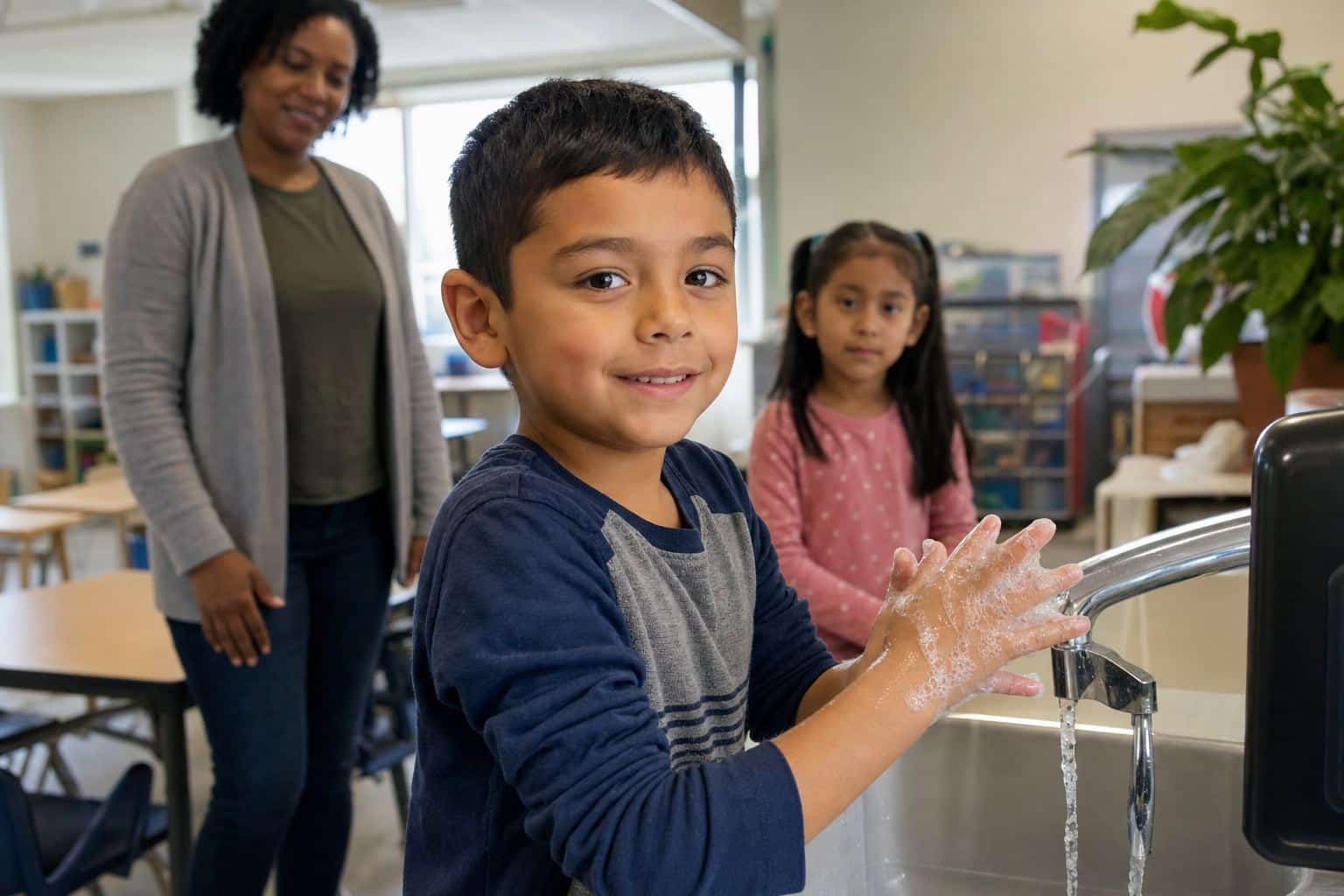
Washing Hands
The steps follow CDC’s five handwashing steps (wet, lather, scrub for at least 20 seconds, rinse, dry) as restated by the Virginia Department of Health (2024).
| Step | What the student does |
|---|---|
| 1 | Turn on the water |
| 2 | Wet both hands |
| 3 | Turn off the water |
| 4 | Press the soap pump once |
| 5 | Rub palms together |
| 6 | Rub the backs of the hands, between the fingers and under the nails |
| 7 | Keep scrubbing until the sand timer runs out (20 seconds or more) |
| 8 | Turn on the water and rinse until no soap is left |
| 9 | Turn off the water |
| 10 | Pull one paper towel and dry both hands |
| 11 | Throw the towel in the trash |
Brushing Teeth
Teach it only where the school runs a self-care routine, with the family’s agreement.
| Step | What the student does |
|---|---|
| 1 | Take the toothbrush and toothpaste from the cup |
| 2 | Open the toothpaste |
| 3 | Squeeze a small amount onto the bristles |
| 4 | Close the toothpaste |
| 5 | Brush the top teeth: left side, front, right side |
| 6 | Brush the bottom teeth: left side, front, right side |
| 7 | Spit in the sink |
| 8 | Rinse the toothbrush |
| 9 | Put the toothbrush and toothpaste back in the cup |
Putting On a Coat
A fit for backward chaining: the adult helps with steps 1 to 7, the student zips up and goes outside.
| Step | What the student does |
|---|---|
| 1 | Take the coat off the hook |
| 2 | Hold the coat by the collar |
| 3 | Push one arm into its sleeve |
| 4 | Reach back and find the other sleeve |
| 5 | Push the other arm in |
| 6 | Pull the coat up onto both shoulders |
| 7 | Fit the zipper pin into the slider |
| 8 | Pull the zipper up |
Task Analysis Examples for Classroom Routines
Daily routines give many natural chances to practice each step.
Packing a Backpack at Dismissal
| Step | What the student does |
|---|---|
| 1 | Get the backpack from the hook |
| 2 | Open the main zipper |
| 3 | Put the take-home folder inside |
| 4 | Put the lunch box inside |
| 5 | Check the picture card for anything else to bring home |
| 6 | Close the zipper |
| 7 | Put on both straps |
| 8 | Line up at the door |
Morning Arrival Routine at a Middle School Locker
A student who stalls at step 2 may need it split into dialing each number of the combination.
| Step | What the student does |
|---|---|
| 1 | Walk to the locker |
| 2 | Open the lock |
| 3 | Hang up the coat |
| 4 | Take out the first-period binder |
| 5 | Put the lunch on the shelf |
| 6 | Close the locker door |
| 7 | Walk to homeroom |
| 8 | Put the homework folder in the tray |
| 9 | Check the day’s schedule |
Logging In to a School Laptop
Each step depends on the one before, so forward chaining is a natural fit.
| Step | What the student does |
|---|---|
| 1 | Take the laptop from the cart slot with your number |
| 2 | Open the lid |
| 3 | Press the power button |
| 4 | Click the sign-in box |
| 5 | Type the username from your login card |
| 6 | Type the password and press Enter |
| 7 | Put the login card back in your folder |
| 8 | Open the class page from the bookmarks bar |
Task Analysis Examples for the Cafeteria and Work Tasks
Longer community routines are covered in life skills activities.
Going Through the Cafeteria Line
| Step | What the student does |
|---|---|
| 1 | Take a tray |
| 2 | Take a fork and a napkin |
| 3 | Choose the main dish by saying, pointing or using a device |
| 4 | Choose a side and a drink |
| 5 | Enter the lunch number on the keypad |
| 6 | Say or sign “thank you” |
| 7 | Walk to the assigned table and sit down |
Making a Simple Snack
Follow the district’s food allergy procedures before any food activity.
| Step | What the student does |
|---|---|
| 1 | Wash hands (use the handwashing task analysis) |
| 2 | Get a plate |
| 3 | Take four crackers from the box |
| 4 | Place the crackers on the plate |
| 5 | Put one cheese slice on each cracker |
| 6 | Close the box and put it on the shelf |
| 7 | Sit down to eat |
Wiping a Table
| Step | What the student does |
|---|---|
| 1 | Get the cloth and the approved spray bottle |
| 2 | Put any trash in the bin |
| 3 | Spray the table three times |
| 4 | Wipe in rows from the far edge toward you |
| 5 | Sweep the crumbs into your hand at the edge |
| 6 | Drop the crumbs in the trash |
| 7 | Put the cloth and bottle back in the bin |
Folding Towels: A Vocational Task
Step 6 builds in a quality standard; the empty basket is the natural cue that the job is done.
| Step | What the student does |
|---|---|
| 1 | Take one towel from the basket |
| 2 | Lay it flat on the table |
| 3 | Fold the left edge over to the right edge |
| 4 | Fold the top edge down to the bottom edge |
| 5 | Fold it in half once more |
| 6 | Check that the edges line up |
| 7 | Place it on the stack |
| 8 | Repeat until the basket is empty, then report “done” |
Short chains like this also make good independent work in task boxes.
Task Analysis Data Sheet With Prompt Levels
A task analysis data sheet records the help each step needed each day, showing which steps are independent and which are stuck. In this original example, Ava learns to put on her coat by backward chaining, so the last steps turn independent first.
| Step | Mon | Wed | Fri |
|---|---|---|---|
| 1. Coat off the hook | FP | M | G |
| 2. Hold by the collar | FP | PP | M |
| 3. First arm in | FP | PP | M |
| 4. Find the other sleeve | FP | FP | PP |
| 5. Other arm in | FP | FP | PP |
| 6. Coat onto shoulders | FP | M | G |
| 7. Pin into slider | M | G | I |
| 8. Zipper up | I | I | I |
| Steps independent | 1 of 8 | 1 of 8 | 2 of 8 |
Key: I = independent, VB = verbal, G = gestural, V = visual, M = model, PP = partial physical, FP = full physical, as on our prompt hierarchy page. As AFIRM’s task analysis data sheet asks, record the level of support on every step (the most intrusive prompt), graph the share of independent steps weekly, and split steps 4 and 5 if they still need a physical prompt. For prompt order and fading rules, see the prompt hierarchy; more templates are in IEP data collection sheets.
Writing IEP Goals With a Task Analysis
A task analysis makes a functional IEP goal measurable, because the criterion can name the number of steps and the level of help. IDEA requires measurable annual goals, “including academic and functional goals” (34 CFR 300.320(a)(2)(i)), plus benchmarks or short-term objectives for students assessed against alternate academic achievement standards. These goals are original examples; see functional IEP goals.
- Classroom routine: By the annual review, given the arrival bell, Omar will complete the 9-step locker routine with at least 8 steps independent on 4 of 5 consecutive days, as measured by task analysis data.
- Technology: By the end of the second grading period, given his login card, Mateo will complete all 8 steps of logging in to his school laptop independently in 3 consecutive sessions, as measured by task analysis data.
- Vocational: By the annual review, at the school laundry station, Dana will fold and stack 10 towels with edges aligned, with no more than a gestural prompt on any step, in 4 of 5 sessions, as measured by task analysis data.
A short-term objective for Ava: by the first grading period, she will complete steps 5 to 8 of putting on her coat independently on 4 of 5 days.
Fading and Generalization
The goal is the routine done in the real setting, with natural cues and no adult help.
- Fade help on a written rule. Step prompts down as data allow and, as AFIRM advises for total task presentation, fade reinforcers as quickly as possible.
- Shift to natural cues. The bell or the empty basket, not the adult’s voice, should start the routine. A picture strip can shrink to a first-and-last-step card.
- Plan generalization. Stokes and Baer’s 1977 review named strategies such as training sufficient exemplars, programming common stimuli and introducing natural maintaining contingencies. In school terms: practice with several sinks, coats and laptops, carry the same picture card into new settings, and let natural payoffs (lunch, recess) replace extra rewards.
If progress stalls, AFIRM suggests checking staff training, the goal’s definition, the time devoted and the fit before switching practices; see also paraprofessional training.
Common Mistakes to Avoid
- Steps that are whole tasks. “Get ready for lunch” hides a dozen actions.
- Steps no one can observe, such as “remember the folder.”
- A different version for each adult. Post one and use its wording as the cue.
- Recording only “done” or “not done,” which hides progress toward independence.
- Never splitting a step that stays at full help for weeks.
- Teaching at one sink only, then expecting it to transfer.
- Leaving the picture strip forever. Fade visual supports too.
Recommended Actions
- Test every new task analysis by doing the task yourself.
- Choose a chaining method per student and write it on the plan.
- Review step data every two weeks and split steps that are stuck.
- Train every adult who runs the routine on the same cues.
- Probe a second setting before calling a skill mastered.
Frequently Asked Questions
What is an example of a task analysis?
Washing hands is the classic example: turn on the water, wet hands, turn off the water, pump soap, rub palms, backs, between the fingers and under the nails, scrub until the timer ends, rinse, turn off the water, dry and throw the towel away. Each step is one observable action that an adult can teach, prompt and score.
What is a task analysis in special education?
In special education, a task analysis breaks a functional, academic or vocational routine into small, ordered steps that staff teach and measure one at a time. NCAEP lists it as an evidence-based practice for autistic learners, and teams use it to write measurable functional IEP goals, collect step data and fade adult help.
What is a task analysis for washing hands?
A handwashing task analysis lists every action from turning on the water to throwing away the paper towel; the example on this page has 11 steps. It should include CDC’s core steps: wet, lather, scrub for at least 20 seconds, rinse and dry. A sand timer helps students with the scrub step.
What is task analysis in ABA?
In applied behavior analysis (ABA), task analysis is the same tool: a chained skill broken into discrete steps taught with prompting, reinforcement and chaining. Schools use it inside daily routines. The IEP team, with a behavior specialist or BCBA where one supports the student, decides how it is taught and measured.
How is task analysis different from discrete trial training?
Task analysis teaches a chain of different steps that together make one routine, such as putting on a coat. Discrete trial training, as NCAEP describes it, uses repeated trials with a clear beginning and end, usually one-to-one. A hard step from a task analysis can be practiced in short trials, then put back into the chain.
How do you use task analysis in the classroom?
Pick a daily routine such as arrival, dismissal or snack, write the steps, post a picture version where the routine happens and teach it at the natural time. Record the prompt level for each step, review the data every two weeks and fade prompts and pictures as steps become independent.
Can AI help write a task analysis?
Yes, as a first draft. An AI tool can list possible steps or suggest picture-card wording, but staff must then do the task to check every step against the real sink, locker or laptop. Do not enter student names or IEP details, and use only approved tools; our ChatGPT for teachers guide explains safe use.
Related Resources
- Task Boxes for Special Education
- Life Skills Activities
- Functional IEP Goals
- Prompt Hierarchy
- IEP Data Collection Sheets
- Paraprofessional Training
Conclusion
Good task analysis examples share a pattern: one observable action per step, wording every adult can use as a cue, a chaining method chosen for the student, a prompt level on every step and a plan to fade help across settings. Start with a daily routine, test the steps yourself and let the data tell you when to split a step or move on.
Sources: Steinbrenner et al., Evidence-Based Practices for Children, Youth, and Young Adults with Autism, NCAEP (2020); AFIRM, Task Analysis Brief Packet (2024 update); VCU Autism Center for Education, Creating a Task Analysis for Instruction; VCU Center on Transition Innovations, A Guide to Creating a Task Analysis (2026); Spooner and Spooner, A Review of Chaining Techniques (1984); Kayser et al., A Comparison of In-Context and Traditional Instructional Approaches: Total Task, Single Trial versus Backward Chaining, Multiple Trials (1986); Stokes and Baer, An Implicit Technology of Generalization (1977); Lipscomb et al., Preparing for Life after High School, National Longitudinal Transition Study 2012, Volume 1 (NCEE 2017-4016); AFIRM, Autism Focused Intervention Resources and Modules. Other sources are linked where they are cited.
Join the 2027 Special Education Pilot
Chained routines are learned through many repetitions of the same steps, and few classrooms have enough adults to guide every student through every routine daily. Telo AI is being adapted for students with IEPs: patient, 1-on-1 practice aligned to each student’s IEP goals and pace, including daily living skills. We are inviting districts to shape it with us in a 2027 pilot.
Apply to pilot Telo AI in your Special Education program
Found this guide useful?
Preferred sources show up more often in your Google results, including AI Overviews.