

Last updated:
Estimated reading time: 6 minutes
ESL lesson plans take time that teachers rarely have, especially when one class holds several proficiency levels at once. AI does not replace your planning judgment, but it can draft a standards-aligned, differentiated plan in minutes so you spend your time teaching, not formatting. This guide shows how, with ready-to-use prompts at three levels.
Table of contents
Build Your Prompt in 20 Seconds
The hardest part of using AI is writing the prompt. Skip that: pick your task, standard, proficiency level, grade, and topic, then open the ready prompt in ChatGPT, Claude, or Gemini.
What Strong ESL Lesson Plans Include
Quick answer: a strong ESL lesson plan states a content objective and a language objective, aligns to a standard (WIDA, ELPAC, or your state’s ELD standards), builds in structured speaking and student talk time, differentiates for the proficiency levels in the room, and ends with a formative check. The language objective and the speaking time are what set an ESL plan apart from a general one.
Best Practices
- Write a separate language objective, not just a content objective.
- Plan for student talk: ELs need to produce language, not just receive it.
- Differentiate by proficiency level within the same plan.
- Align to a standard so the lesson connects to assessment.
Common Mistakes
- A content objective with no language objective.
- Teacher talk that crowds out student speaking.
- One plan with no differentiation for mixed proficiencies.
- No formative check to see who understood.
How to Write a Lesson Plan Prompt That Works
AI tools like ChatGPT, Claude, and Gemini can draft a full plan in seconds, but only a detailed prompt gives you one you can actually teach.
The five ingredients every lesson-plan prompt needs
- Grade and length (for example, a 45-minute Grade 5 lesson).
- Proficiency level (WIDA Level 2, ELPAC Expanding), so the plan fits your ELs.
- Standard and objective, and always ask for a separate language objective, not just a content one.
- Structured speaking time: name it, because AI plans usually skimp on student talk.
- Differentiation and a formative check for the levels in your room.
Weak prompt vs strong prompt
| Weak | Strong |
|---|---|
| Write a lesson plan about the water cycle. | Write a 45-minute ESL lesson plan on the water cycle for Grade 5 English Learners at WIDA Level 2, with a content objective, a language objective, a speaking activity with sentence frames, differentiation, and an exit ticket. |
The builder at the top of this page produces the strong version. Generate it, then refine.
Refine the output with one line
- Add a separate language objective.
- Add more student talk time and say how many minutes.
- Add sentence frames to the speaking task.
- Differentiate for a newcomer and for a student one level up.
- Shorten it to 30 minutes.
- Add a quick formative check.
A 30-second check before you teach it
Confirm four things: there is a language objective, students actually speak for a meaningful stretch, the plan differentiates for your levels, and there is a formative check. Fix any gap with a follow-up line above.
How to Structure a Great Prompt
The builder above writes strong lesson-plan prompts for you. Knowing how they are built lets you tweak them with confidence. A good prompt grows in layers, from a bare request to an expert, teachable one.
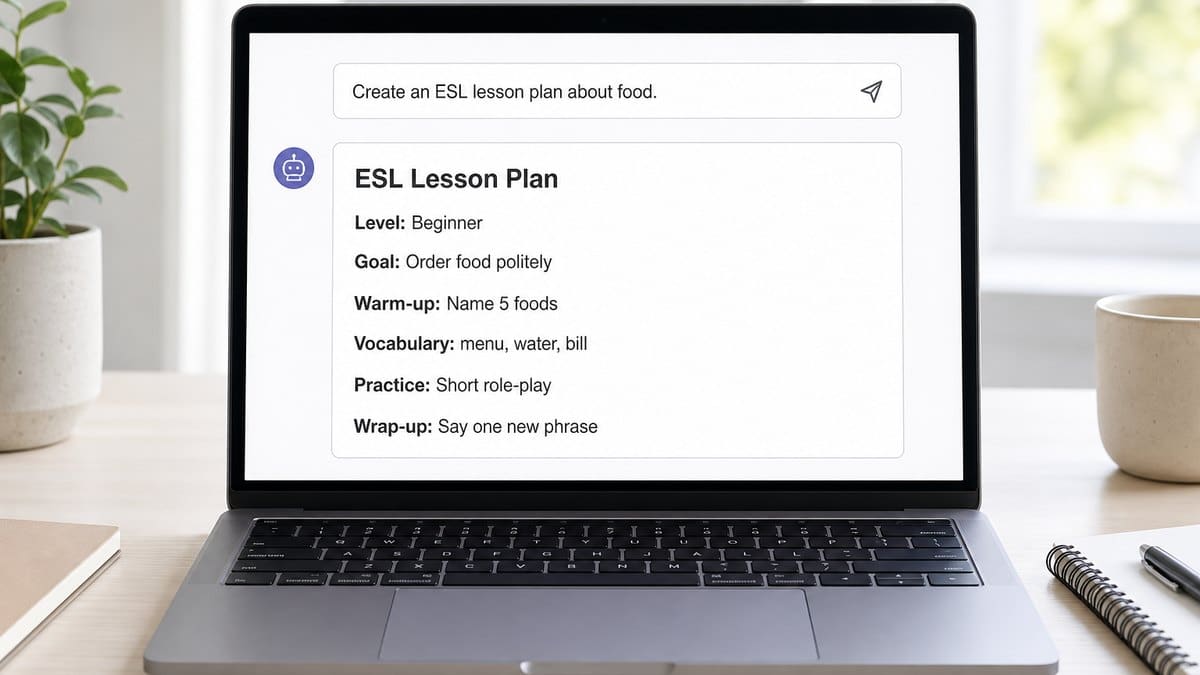
Basic (just the task): Write an ESL lesson plan about ordering food at a restaurant. Fast, but generic and missing the parts ELs need.
Better (adds grade, level, objectives): Write an ESL lesson plan about ordering food for Grade 6 at WIDA Level 2, with a content objective, a language objective, key vocabulary, guided practice, and a formative check. Now it fits your class.
Expert (adds speaking, differentiation, structure): Write a 45-minute plan for a Grade 6 class at WIDA Levels 1, 2, and 4, with content and language objectives, a role-play speaking activity with sentence frames, differentiation, a newcomer accommodation, an extension, and an exit ticket. This is what the builder produces.
Five techniques that upgrade any prompt
- Give the AI a role. Begin with “Act as an ESL teacher for English Learners” to set tone and expertise.
- Name the output format. “As a lesson plan with timings and an exit ticket” controls the result.
- Show an example (few-shot). Paste a sentence frame or activity you like and add “use this style.”
- Differentiate in one prompt. Ask for the plan “at WIDA Levels 1, 2, and 4” so one request covers your class.
- Iterate. Treat the first output as a draft: “add a language objective,” “add more student talk time,” “shorten to 30 minutes.”
For a full prompt library across tasks, see AI prompts for ELL teachers.
Writing Strong Language Objectives
The language objective is the heart of an ESL plan, and it is the part AI most often gets wrong when a prompt does not ask for it specifically. A content objective states what students will learn about the topic; a language objective states how they will use English to do it. A useful way to write one is to name a language function, the thing students will do with language, plus the form and the support. For example, students will compare two ecosystems using comparative sentence structures and a word bank pairs a function (comparing) with a form (comparative structures) and a support (word bank). That is far more teachable than a vague students will practice speaking. When you prompt AI, ask it explicitly to write a language objective in this function-plus-form-plus-support pattern, and to align it to the speaking, listening, reading, or writing domain you are targeting. Reviewing the objective it produces is worth a moment, because a precise language objective is what tells you, and your students, exactly what language success looks like by the end of the lesson.
Planning for the Four Language Domains
Strong ESL instruction develops all four language domains, listening, speaking, reading, and writing, and a good plan is deliberate about which ones a given lesson emphasizes. Over-reliance on reading and writing is common, partly because those produce artifacts that are easy to collect, but English Learners need substantial listening and speaking to build the oral foundation that literacy rests on. When you plan, decide which domains the lesson targets and make sure speaking and listening are not perpetually crowded out by written tasks. It also helps to distinguish integrated ELD, where language development happens inside content instruction, from designated ELD, the dedicated time for building English itself; a plan should be clear about which it is serving. Ask AI to balance the domains explicitly, for instance by requesting a lesson that includes a listening input, a structured speaking task, and a short writing output, so the plan exercises more than one domain. A lesson that touches multiple domains, with speaking protected rather than optional, gives English Learners the rounded practice that moves proficiency across the board rather than in only the written direction.
Frequently Asked Questions
What should an ESL lesson plan include?
A content objective and a language objective, a standard alignment, key vocabulary, guided and independent practice, structured speaking time, differentiation by proficiency level, and a formative check.
Can AI write ESL lesson plans?
Yes. Tools like ChatGPT and Claude draft strong plans when you give them the grade, standard, objective, and proficiency levels. Review and adjust before teaching.
Where can I find free ESL lesson plans?
Many sites share free plans, but they rarely match your exact standards and class profile. Generating your own with AI gives a closer fit in less time.
How do I write a good language objective?
Name a language function plus a form plus a support. For example, students will compare two ecosystems using comparative sentence structures and a word bank. That is far more teachable than students will practice speaking. Ask AI to write objectives in this pattern and aligned to a specific domain.
Should an ESL lesson cover all four language domains?
A plan should be deliberate about which domains it targets and protect listening and speaking, which are often crowded out by written tasks. Over a unit, develop all four, listening, speaking, reading, and writing, since oral language is the foundation literacy rests on.
What is the difference between integrated and designated ELD?
Integrated ELD develops language inside content instruction, while designated ELD is dedicated time for building English itself. A plan should be clear about which it serves, so the language work matches the purpose of the block.
Related Resources
Conclusion
AI turns lesson planning from an hour of formatting into a few minutes of prompting and reviewing. Give it your standard, objective, and proficiency levels, insist on a language objective and real speaking time, and you have a differentiated ESL plan ready to teach. Then let a tool built for speaking carry the practice your plan calls for.
Sources: WIDA Consortium; Colorín Colorado.
The Language Objective That Only Talk Makes Real
What separates an ESL plan from an ordinary one is the language objective: the promise that students will not just learn the content but produce the language around it. A well-built plan writes that objective in and schedules the speaking to meet it. On paper, the promise is kept.
In the room, the promise runs into a hard number. A language objective is met only when each student actually speaks, and a single teacher across a full class of mixed proficiencies can reach each learner for barely a minute of real conversation. The plan can name the talk; it cannot manufacture the time for it. The constraint is capacity, not the quality of the plan.
Teachers are answering this by pairing the plan with a way to deliver the speaking it promises. Telo AI is one example, giving each student individualized conversational practice tied to the lesson objectives and to WIDA, TELPAS, and ELPAC, in English plus Spanish and French for bilingual programs.
See how a lesson’s language objective reaches every student: https://mytelo.ai/how-telo-works/
A plan can write the language objective in ink; only talk turns it into learning. The teachers who plan best treat the speaking line not as a box to schedule but as the part of the lesson most likely to go undelivered without help reaching every student.
Found this guide useful?
Preferred sources show up more often in your Google results, including AI Overviews.