

Estimated reading time: 6 minutes
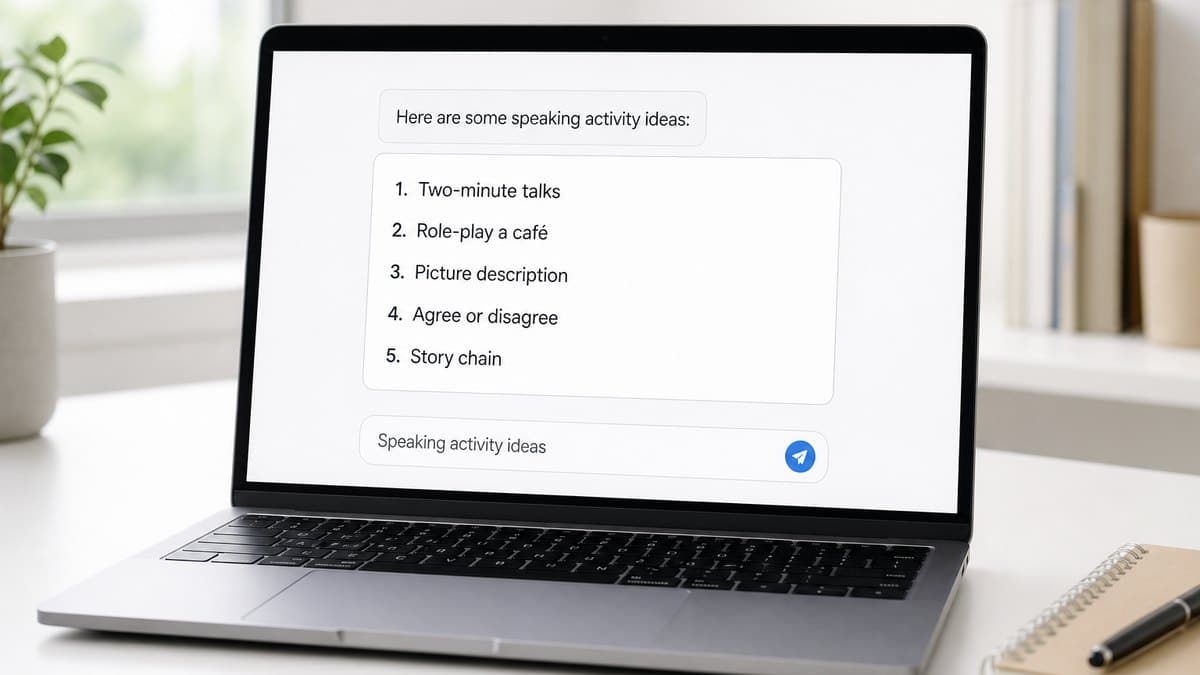
Generating ESL speaking activities with AI lets you get every student talking without hours of prep. Speaking is where English Learners make their fastest gains, because language is acquired through use, yet the real challenge is not finding ideas but giving every student enough talk time. This guide shows how to build ESL speaking activities with AI, plus proven ideas by proficiency level.
Table of contents
Build Your Prompt in 20 Seconds
The hardest part of using AI is writing the prompt. Skip that: pick your task, standard, proficiency level, grade, and topic, then open the ready prompt in ChatGPT, Claude, or Gemini.
What Makes a Speaking Activity Work for ELs
Quick answer: effective ESL speaking activities give students a real reason to talk, provide scaffolds like sentence frames at lower proficiency levels, keep every student active rather than waiting for a turn, and target academic language, not just casual conversation. The best ones maximize the number of words each student actually produces.
Activity Ideas by Proficiency Level
| Level | Activities that fit |
|---|---|
| Entering / Emerging | Sentence-frame partner talk, picture description, total physical response, “find someone who” |
| Developing | Information gap, role-plays, think-pair-share, structured interviews |
| Expanding / Bridging | Debates, oral presentations, problem-solving discussions, Socratic seminar |
Best Practices
- Provide sentence frames for lower levels so students can start talking immediately.
- Maximize talk time: pairs and small groups beat whole-class Q&A.
- Give a purpose: an information gap or a decision to reach.
- Target academic language, not only social conversation.
Common Mistakes
- Whole-class questions where only a few students speak.
- No scaffolds, so lower-level students stay silent.
- Activities with no real communicative purpose.
- Correcting every error, which discourages risk-taking.
How to Create ESL Speaking Activities with AI
AI tools like ChatGPT, Claude, and Gemini are good at generating role-plays, information gaps, and discussion questions, if your prompt tells them how to keep every student talking.
The five ingredients every speaking prompt needs
- Grade and proficiency level, so the language load fits.
- A topic students already know something about.
- A communicative purpose: an information gap, a decision to reach, a role to play.
- Sentence frames scaled to the level, so beginners can start immediately.
- A structure that maximizes talk time: pairs or small groups, not whole-class Q&A.
Weak prompt vs strong prompt
| Weak | Strong |
|---|---|
| Give me speaking activities about food. | Design three speaking activities on food for Grade 4 English Learners at WIDA Level 2, each with a communicative purpose, sentence frames, and a pair structure that maximizes talk time. |
The builder at the top of this page writes the strong version for you.
Refine the output with one line
- Add sentence frames for beginners.
- Make it a pair activity so every student talks.
- Give each student a specific role.
- Turn it into an information gap.
- Make it one proficiency level lower.
- Add a quick speaking rubric.
A 30-second check before you use it
Check four things: every student talks (not just a confident few), lower levels have scaffolds, the activity has a real purpose, and it targets academic language, not only chat. Fix any miss with a follow-up above.
How to Structure a Great Prompt
The builder above writes strong speaking-activity prompts for you. Knowing how they are built lets you tweak them with confidence. A good prompt grows in layers, from a bare request to an expert one that keeps every student talking.
Basic (just the task): Give me ESL speaking activities about food. Fast, but generic and often teacher-centered.
Better (adds grade, level, scaffolds): Give me three ESL speaking activities about food for Grade 4 at WIDA Level 2, with sentence frames and target vocabulary for each. Now it fits your students.
Expert (adds purpose, structure, assessment): Design three activities for a Grade 4 class at WIDA Levels 1, 2, and 4, each with a communicative purpose, sentence frames per level, a pair or small-group structure that maximizes talk time, a way to assess speaking, a newcomer accommodation, and an extension. This is what the builder produces.
Five techniques that upgrade any prompt
- Give the AI a role. Begin with “Act as an ESL teacher for English Learners” to set tone and expertise.
- Name the structure. “As pair activities that maximize talk time” keeps every student speaking.
- Show an example (few-shot). Paste a sentence frame you like and add “use this style for the rest.”
- Differentiate in one prompt. Ask for the activity “at WIDA Levels 1, 2, and 4” so one request covers your class.
- Iterate. Treat the first output as a draft: “make it a pair activity,” “add roles,” “add a quick speaking rubric.”
For a full prompt library across tasks, see AI prompts for ELL teachers.
Assessing Speaking Without Slowing It Down
Speaking is the hardest domain to assess, because it is fleeting and you cannot collect it like a stack of papers. The trick is to keep assessment light enough that it does not interrupt the talking. A single-point rubric works well: instead of describing every level, it names the one target for the activity, such as uses past-tense verbs to describe an event, and leaves space to note whether the student met it. Sampling also helps; rather than trying to hear every student every day, listen closely to a rotating handful each session so that over a week you have observed everyone. Simple checklists tied to the language objective let you record evidence in a word or two as you circulate. And peer or self-assessment, using a short checklist the students hold, turns assessment into part of the activity rather than an add-on, while giving learners a clearer sense of what good speaking sounds like. Ask AI to generate any of these, a single-point rubric, a checklist, or a student self-assessment, in the same prompt that builds the activity, so the assessment is ready before the talking starts.
Managing Talk in a Mixed-Proficiency Room
Getting everyone talking is harder when one class spans newcomers and near-proficient students, and grouping is the main lever. Pairing students of similar proficiency lets you give each pair a version of the task at the right level, while pairing a more advanced student with a beginner can work when the task gives the beginner a clear, scaffolded role so they are not simply spoken over. Be intentional about the home language: allowing a beginner to plan or clarify in their first language before speaking in English can lower anxiety and produce stronger output, and it respects the linguistic resources multilingual students bring. Protect wait time, since English Learners often need a few extra seconds to formulate a response, and rushing that silence shuts down exactly the students you want to hear. Finally, make sure newcomers always have a way in, a sentence frame, a picture, or a role, so that a mixed-level activity never leaves the least proficient students silent by default. AI can help by generating the same activity at several levels at once, so every group in the room has an appropriate version without you writing three separate plans.
Frequently Asked Questions
What are good ESL speaking activities?
Activities with a real purpose that keep every student talking: information gaps, role-plays, think-pair-share, structured interviews, and debates, scaffolded with sentence frames for lower proficiency levels.
What speaking activities work for beginners?
Sentence-frame partner talk, picture description, total physical response, and “find someone who,” all of which give newcomers a scaffolded way to produce language.
How do I get every student more speaking time?
Use pairs and small groups instead of whole-class questions, and add a dedicated tool that gives each student individual conversational practice beyond the group activity.
How do I assess speaking without interrupting the activity?
Keep it light: use a single-point rubric naming the one target for the activity, sample a rotating handful of students each session, jot evidence on a checklist as you circulate, and use short peer or self-assessment checklists. Ask AI to generate these alongside the activity so they are ready before the talking starts.
How do I keep everyone talking in a mixed-proficiency class?
Group intentionally: similar-level pairs get a task at their level, and mixed pairs work when the beginner has a scaffolded role. Allow home-language planning before speaking, protect wait time, and always give newcomers a way in with a frame, picture, or role. AI can produce the same activity at several levels at once.
Should students be allowed to use their home language?
Strategically, yes. Letting a beginner plan or clarify in their first language before speaking in English can lower anxiety and produce stronger output, and it respects the linguistic resources multilingual students bring. The goal is more English production, and home-language support often helps students get there.
Related Resources
- EL Speaking Practice Strategies
- Why English Learners Need More Speaking Time
- ESL Lesson Plans
- AI Prompts for ELL Teachers
- ChatGPT for Teachers
Conclusion
You do not lack activity ideas; you lack minutes for each student to talk. Use these ideas and the builder to create purposeful, scaffolded ESL speaking activities with AI fast, then close the talk-time gap with a tool that lets every English Learner practice speaking individually, every day.
Sources: WIDA Consortium; Colorín Colorado.
The Arithmetic of Talk Time
A great speaking activity does its job: it gives students a reason to talk, scaffolds the language, and shifts the room from teacher voice to student voice. Pairs beat whole-class questions, small groups beat pairs. The design is sound, and students genuinely produce more.
Then the arithmetic asserts itself. Split a class of twenty-five into pairs and each learner still speaks for only half the time; add turn-taking and hesitation and the real minutes of production per student shrink further. English Learners need far more individual talk than any group structure can hand out in a period. The wall here is capacity, not the creativity of the activity.
That is why a growing number of teachers extend the group work with something that gives each student their own conversation. Telo AI is one example, providing unlimited individualized speaking practice aligned to WIDA and the day’s topic, in English plus Spanish and French for bilingual programs.
See how group activities extend into individual practice for every student: https://mytelo.ai/how-telo-works/
The activity opens the conversation for the class; it cannot give each learner the volume of talk that acquisition actually takes. The teachers who move speaking fastest use the group work to start the talk, then make sure it does not stop when the pair does.