

Estimated reading time: 15 minutes
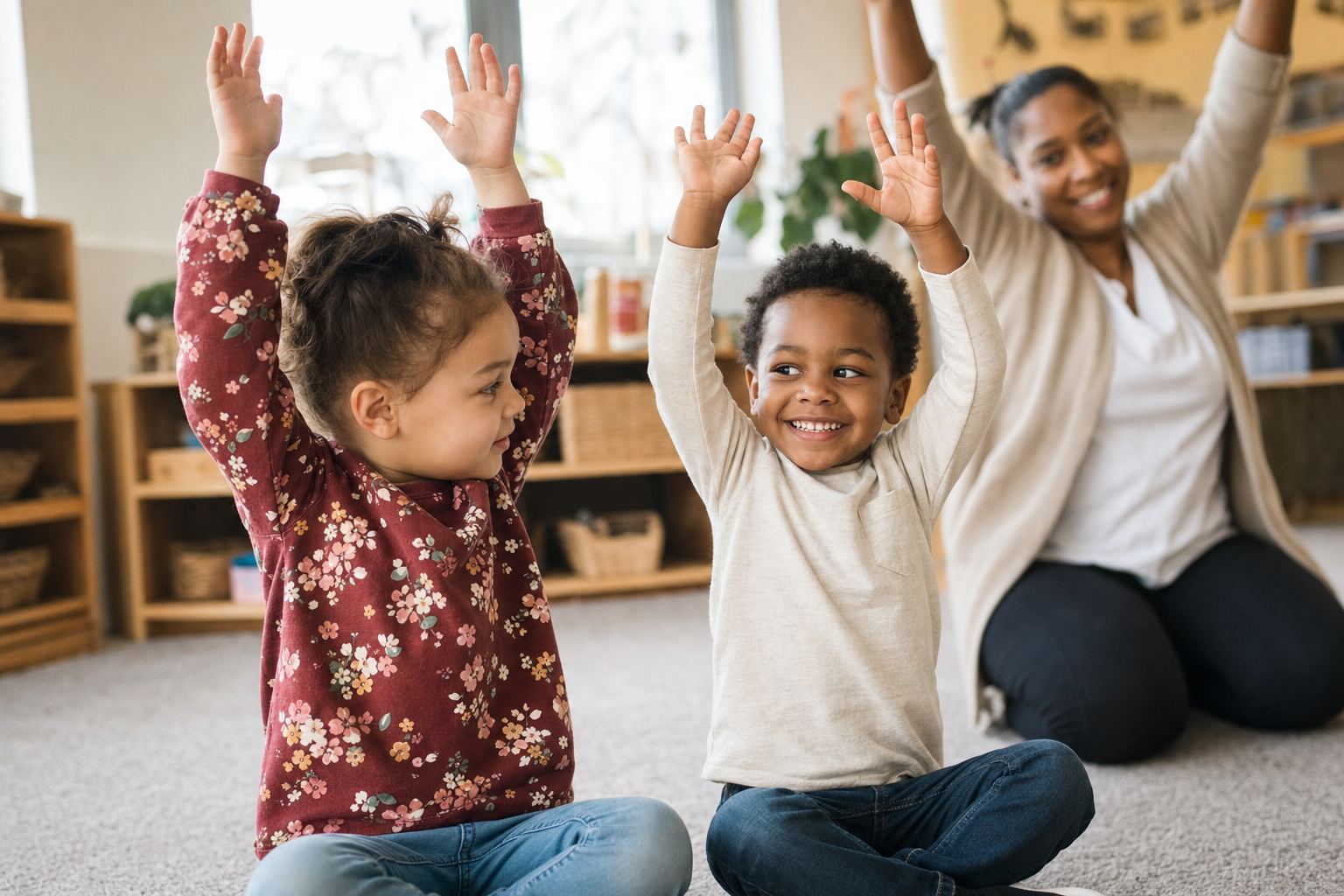
Motor imitation is the ability to watch another person’s movement and copy it: tapping a drum after the teacher taps it, raising both arms during a song, or making a thumbs-up. It covers imitation with objects, gross motor imitation (large body movements) and fine motor imitation (hand and finger movements). This guide covers the types, why imitation matters, its link to joint attention, how schools teach it, a teaching sequence, target lists, a tracking sheet, IEP goal examples and measurement. It describes school practice: the IEP team, with the speech-language pathologist (SLP), the board certified behavior analyst (BCBA) or the OT, individualizes every plan.
Table of contents
Executive Summary
Imitation differences are common in autism. A meta-analysis of 53 studies found that autistic participants scored on average 0.81 standard deviations below non-autistic participants on imitation tasks (Edwards, 2014). In 2024-25, autism was the category for 15% of the 8.2 million students ages 3 to 21 served under IDEA, and developmental delay for 7% (OSEP).
Imitation can be taught. In a randomized trial with 21 young autistic children, reciprocal imitation training, a play-based approach, produced greater gains in elicited and spontaneous imitation than the control condition (Ingersoll, 2010). The harder part is breadth: in an early study, imitation generalized within one type (vocal, toy play or gestures) but not across types (Young et al., 1994).
Key Takeaways
- Three types of motor imitation: with objects, gross motor and fine motor. Vocal imitation is a separate skill.
- Imitation is a learning tool: modeling and video modeling assume the student can copy a model.
- Start with objects: young children imitate actions with objects more easily than body movements.
- Teach in trials and in play: model, prompt, fade and reinforce, then add contingent imitation and reciprocal imitation training.
- Measure independence and breadth: record the prompt level on every trial and probe actions the student was never taught.
- An observation is not a diagnosis: targets come from present levels, set by the IEP team.
What Is Motor Imitation?
Motor imitation is copying the form of another person’s action, with or without an object, so that the student’s movement matches the model, either right away or later.
The form matters more than the result. In Edwards’s meta-analysis, autistic participants showed deficits on tests that scored how an action was done and its end point, but not on tests that scored only the end point. Guidance posted by the Kansas technical assistance network (KSDE TASN) makes a related point: avoid always targeting an object’s intended use, such as a peg into a pegboard, because it blurs task completion and imitation.
| Type | What the student copies | Examples |
|---|---|---|
| Imitation with objects | An action on a toy or material | Shaking a maraca, pushing a car, stirring in a bowl |
| Gross motor imitation | Large movements of the arms, legs or whole body | Arms up, stomping, marching in place |
| Fine motor imitation | Small hand and finger movements | Thumbs-up, wiggling fingers, pinching thumb and finger |
| Vocal imitation (not motor) | Sounds and words | “Ba ba,” “uh-oh,” a word the adult says |
Motor Imitation vs Vocal Imitation
Vocal imitation, copying sounds and words, is usually planned with the SLP. In the Young et al. (1994) study of four autistic children, imitation did not carry over from one type to another. The types still interact: when gesture imitation was added to object imitation training, three of four autistic children used more language, and the children imitated words more often during gesture training (Ingersoll & Lalonde, 2010).
Why Motor Imitation Matters for Early Social Learning
Imitation lets a child learn by watching others and join them in play. Research with young autistic children links it to both:
- Language and play: among 26 autistic two-year-olds, imitation of body movements was associated with expressive language, then and a year later, and imitation with objects with play skills (Stone et al., 1997).
- Early language: among 60 autistic preschoolers, immediate imitation and initiating joint attention were most strongly associated with language at ages 3 to 4 (Toth et al., 2006).
- Learning from models: AFIRM’s modeling module tells staff to check first that the learner can imitate others; its video modeling module lists missing imitation skills as one reason a video model may not work.
- Social contact: when an adult imitated autistic children over three sessions, the children spent more time looking at, smiling at and playing reciprocally with that adult than children in a play-only condition (Field et al., 2001).
When Imitation Develops
A review of infant research concluded that the evidence for newborn imitation is weak and that infants imitate others from their second year (Jones, 2009). The CDC’s Learn the Signs. Act Early. milestones show related skills:
| By age | CDC milestone (paraphrased) |
|---|---|
| 1 year | Plays games such as pat-a-cake; waves bye-bye |
| 15 months | Copies other children while playing, such as taking toys out of a container when another child does |
| 18 months | Copies adults doing chores, such as sweeping with a broom |
| 3 years | Draws a circle when shown how |
The CDC states that these resources do not replace standardized developmental screening. In school, the starting point is the student’s present levels, not age.
How Motor Imitation Relates to Joint Attention
Both skills require watching a partner. In a randomized trial with 27 young autistic children, an imitation-focused intervention increased joint attention initiations, although the analysis did not confirm imitation as the mechanism (Ingersoll, 2012). In an earlier study, teaching object imitation in play was followed by gains in language, pretend play and joint attention (Ingersoll & Schreibman, 2006). Plan the two together: imitation games create natural moments of shared focus. Examples and activities are in our guide to joint attention examples.
How to Teach Motor Imitation at School
The 2020 NCAEP review identified 28 evidence-based practices for autistic learners from birth to 22. Modeling, a demonstration that leads the learner to use and acquire the behavior, has motor outcomes for ages 0 to 5; naturalistic intervention has them for ages 3 to 11. The scenes, targets, tracking sheet and goals in this guide are original examples to adapt.
Model, Prompt, Fade, Reinforce
Structured teaching follows the steps in AFIRM’s modeling and prompting modules:
- Get attention and model once: “Do this,” then the action.
- Wait a few seconds. AFIRM calls this the response interval: time without extra help.
- Prompt only as much as needed: a gesture, a second model, a light touch at the elbow (partial physical) or hand-over-hand help (full physical). AFIRM notes that physical prompts are useful for motor skills.
- Reinforce right away with something chosen from the student’s interests.
- Fade on a plan. Least-to-most prompting starts each trial with no prompt and adds help step by step; time delay fades prompts with a brief wait before each one (NCAEP).
- Vary the actions. KSDE TASN recommends teaching several actions, including new ones, with the same material, so the student copies the model rather than a routine.
This format resembles discrete trial training, which NCAEP defines as repeated trials, each with an instruction, a response, a planned consequence and a pause.
Contingent Imitation and Reciprocal Imitation Training
NCAEP classifies reciprocal imitation training (RIT), in which an adult repeats the learner’s actions, sounds or other behaviors to promote the learner’s imitation, within naturalistic intervention.
- Contingent imitation: the adult copies what the student does, right after the student does it, and waits to see whether the student looks up, as AFIRM’s naturalistic intervention module suggests. With six autistic children aged 33 to 63 months, adults who immediately imitated children’s vocalizations got more vocal imitation and vocal turn-taking (Ishizuka & Yamamoto, 2016).
- Reciprocal imitation training: developed to teach young autistic children to imitate during play. Mothers trained in RIT also increased their children’s spontaneous imitation (Ingersoll & Gergans, 2007).
Example: at the sensory table, the aide copies Mateo’s scooping and waits for him to look up. She then pours water over a wheel with her own cup, says “Pour!” and waits. If he does not try, she models again, then guides his elbow lightly.
A Teaching Sequence: From Objects to Gross and Fine Motor Imitation
Stone and colleagues found that young children, autistic or not, imitated actions with objects more easily than body movements, and meaningful actions more easily than nonmeaningful ones. The KSDE TASN guidelines, shared by Pennsylvania’s PaTTAN, also place object imitation first, then order body movements from one-sided to two-sided and midline-crossing movements, with hand and finger positions last. For students with motor delays, they suggest starting from movements the student already makes; an OT or PT can advise.
| Stage | What to teach | Example |
|---|---|---|
| 1. Actions with objects | One action on a familiar toy | Push a car, shake a maraca |
| 2. Meaningful gestures | Gestures with a social meaning | Wave, finger to lips for “shh” |
| 3. Single gross motor movements | One body part, one movement | Touch head, stomp one foot |
| 4. Two-sided and two-step movements | Both arms or legs, then two actions in a row | Hands on knees, then arms up |
| 5. Fine motor positions | Small hand and finger shapes | Thumbs-up, two fingers up |
| 6. New models and settings | Known skills with peers, in groups, with new actions | Follow the leader at recess |
Move faster once the student copies new actions on the first model: KSDE TASN notes that such a student can be probed quickly through a sequence instead of mastering every target. Group games such as follow the leader add peer models; more are in social skills activities by age.
Motor Imitation Targets by Type
Mix actions that match an object’s usual purpose with unusual ones, so the student has to watch the model.
| With objects | Gross motor | Fine motor |
|---|---|---|
| Push a car down a ramp | Arms up high | Thumbs-up |
| Shake a maraca | Touch head | Wiggle fingers |
| Tap two blocks together | Pat legs | Open and close hands |
| Put a hat on a doll | Stomp feet | Point with one finger |
| Stir a spoon in a bowl | Hands on hips | Touch thumb to index finger |
| Roll a ball to a partner | March in place | Make a fist |
| Put a block on your head | Turn around | Hold up two fingers |
| Tap a spoon on the table | Jump with both feet | Tap one finger on the table |
Motor Imitation Tracking Sheet
KSDE TASN posts imitation skill tracking sheets with dates introduced and mastered. The layout below adds the prompt level on each trial and a probe column for actions never taught.
| Date | Target | Type | Trials 1-5 | Independent | New-action probe | Notes |
|---|---|---|---|---|---|---|
| 10/6 | Arms up | Gross | I G I I M | 3 of 5 | Touch ears: no | Better after a movement song |
Codes: I = independent within 3 seconds of the model; G = gesture prompt; M = second model; P = physical prompt. Score a probe on the first try, without prompts. Templates for trial and probe data are in IEP data collection sheets.
Motor Imitation IEP Goal Examples
Set the criterion from the baseline in the present levels, name the setting and models, and open with the timeline (“By [date of the next annual IEP review],”). Communication and social goals are in IEP goals for autism.
- Imitation with objects: During play with a familiar adult, [Student] will imitate a new action with an object within 5 seconds of a single model, without physical prompts, in 8 of 10 opportunities across 3 consecutive sessions, as measured by trial data.
- Two-step gross motor imitation: During movement breaks, [Student] will imitate a two-step sequence (such as touch knees, then reach up) modeled by an adult or a peer in 4 of 5 opportunities in 2 settings, as measured by event recording.
- Fine motor imitation: Given a model of a hand or finger position, [Student] will copy it within 3 seconds in 8 of 10 trials, including at least 3 positions not taught, as measured by trial data and probes.
- Spontaneous imitation of peers: During center time, [Student] will copy a peer’s play action without an adult prompt at least 3 times in a 15-minute observation, in 4 of 5 observations, as measured by event recording.
How to Measure Motor Imitation
The IEP must describe how progress toward each annual goal will be measured (34 CFR 300.320(a)(3)). Kentucky Department of Education guidance on types of data lists event recording (frequency, percent or rate), duration and latency; imitation mostly uses the first and the last.
- Percent independent: correct imitations without prompts, out of the trials given.
- Latency: seconds from the model to the response, when speed matters.
- Prompt level on every trial, so fading shows.
- Probes of untaught actions, the test of generalized imitation.
- Spontaneous imitation in play, which RIT studies measure alongside elicited imitation.
If data stay flat, change the teaching; the team must revise the IEP, as appropriate, to address any lack of expected progress (34 CFR 300.324(b)(1)(ii)(A)).
Funding and Staffing
Imitation teaching costs staff time more than money. IDEA Part B funds special education and related services, including speech-language pathology services and parent counseling and training (34 CFR 300.34). AFIRM calls modeling cost-efficient, and its modules are free. The limit is adult time: the ASHA 2026 Schools Survey reports a median caseload of 50 students per full-time school-based SLP, so plan for teachers and paraprofessionals to run daily practice, coached by the SLP or BCBA.
Common Mistakes District Leaders Make
- Counting task completion as imitation. A peg in a pegboard shows the student knows the toy.
- Stopping at large body movements. KSDE TASN warns against treating early body movement targets as mastery of motor imitation.
- Expecting skills to cross types on their own. Object, gesture and vocal imitation each need teaching.
- Leaving prompts in place because no one records the prompt level.
- Drilling only at the table. Spontaneous imitation in play is the outcome that matters.
- Repeating the same five actions daily. Memorized routines then pass for imitation.
- Starting video modeling too early, before the student copies live models.
Recommended Actions
- Review preschool and early elementary IEPs for imitation goals that name the type: objects, gross motor, fine motor or vocal.
- Adopt one tracking sheet with prompt levels and probes of new actions.
- Train staff in modeling, prompting and naturalistic intervention with the free AFIRM modules.
- Build imitation into routines that already exist: circle songs, centers, the sensory table, outdoor play.
- Coordinate the SLP, BCBA and OT on one sequence per student.
- Review data monthly and change the method when progress stalls.
Questions District Leaders Should Ask
- How many students with imitation goals have data on actions they were never taught?
- Do our goals measure spontaneous imitation in play, or only imitation on request?
- Who coaches paraprofessionals on prompting and fading, and how often?
- Do the SLP, BCBA and OT work from one sequence for each student?
Frequently Asked Questions
What is imitation behavior?
Imitation behavior means copying what another person does or says after watching or hearing them: an action with a toy, a body movement, a gesture, a sound or a word. Researchers separate copying how an action is done from simply reaching the same result. In school, imitation lets a student learn from a model, and modeling is an evidence-based practice for autistic learners.
What is the primary purpose of teaching motor imitation as an early receptive language skill?
The main purpose is to give the student a way to learn from others. Once a student can copy a model, adults and peers can teach new play, self-care and communication skills by showing them. Research also links imitation of body movements in young autistic children to expressive language a year later, and the CDC lists following directions given with a gesture and words at 15 months.
What are some examples of fine motor imitation targets in ABA?
Common fine motor targets include a thumbs-up, wiggling fingers, opening and closing hands, pointing with one finger, touching thumb to index finger, making a fist and holding up a number of fingers. In applied behavior analysis (ABA) programs and school plans alike, teach them after actions with objects and large movements, the order the KSDE TASN guidelines follow. An OT can advise on motor delays.
At what age should a child start imitating?
Imitation builds through the second year. CDC milestones include playing games such as pat-a-cake by 1 year, copying other children while playing by 15 months and copying adults doing chores by 18 months. A review of infant research found different kinds of imitation emerging at different ages. Staff who are concerned talk with the family and follow the district’s child find procedures (34 CFR 300.111).
How does autism affect imitation skills?
On average, autistic people score lower on imitation tasks: a meta-analysis of 53 studies found a gap of 0.81 standard deviations, larger in groups with higher autism symptom scores and unrelated to average IQ. The gap appeared on tasks scoring how an action is done, not on tasks scoring only its result. Autistic children in Stone’s study followed the same pattern as other children, finding body movements harder than actions with objects.
Related Resources
- Joint Attention Examples and How to Teach It
- Social Skills Activities by Age
- IEP Goals for Autism
- IEP Data Collection Sheets
- Speech IEP Goals
- PLAAFP Examples
Conclusion
Motor imitation is a small skill with a large role: once a student copies a model, every adult and peer becomes a teacher. Schools build it in order, from objects to large movements to fine hand positions, in short trials and in play. Districts that record prompt levels and probe new actions turn imitation from a drill into a way of learning.
Sources: Steinbrenner et al., Evidence-Based Practices for Children, Youth, and Young Adults with Autism, National Clearinghouse on Autism Evidence and Practice (2020); AFIRM, Modeling Brief Packet (2024 update); AFIRM, Prompting Brief Packet (2024 update); AFIRM, Naturalistic Intervention Brief Packet (updated 2025); Stone, Ousley & Littleford, Motor Imitation in Young Children with Autism: What’s the Object? (1997); Edwards, A Meta-Analysis of Imitation Abilities in Individuals with Autism Spectrum Disorders (2014); Ingersoll, Pilot Randomized Controlled Trial of Reciprocal Imitation Training (2010); KSDE TASN, Guidelines for Teaching Motor Imitation Skills; KSDE TASN, Motor Imitation Skills Tracking Sheet; CDC, Learn the Signs. Act Early. Developmental Milestones; U.S. Department of Education, OSEP, 2024-25 Static Tables (Part B Child Count & Educational Environments). Other studies and sections of 34 CFR Part 300 are linked where they are cited.
Join the 2027 Special Education Pilot
Imitation is learned in many short turns of watching and copying, and each turn needs an adult’s full attention. Telo AI is being adapted for students with IEPs: patient, 1-on-1 practice aligned to each student’s IEP goals, freeing teachers and aides for small-group and individual work such as imitation teaching. We are inviting districts to shape it with us in a 2027 pilot.
Apply to pilot Telo AI in your Special Education program
Found this guide useful?
Preferred sources show up more often in your Google results, including AI Overviews.