

Estimated reading time: 18 minutes
Social skills activities are short, structured routines in which students practice one specific social skill, such as asking to join a game, taking turns or keeping a conversation going, while an adult or a trained peer sets up the practice and gives feedback. The lesson teaches the skill; the activity gives students repeated chances to use it. This guide covers the evidence base, how to run a social skills lesson, classroom examples by age from preschool to high school, how to connect activities to IEP goals, generalization and data.
Table of contents
Executive Summary
Schools can teach social skills. A meta-analysis of 213 school-based social and emotional learning programs involving 270,034 K-12 students found improved social and emotional skills, behavior and academic performance, including an 11-percentile-point gain in achievement, with programs delivered successfully by school staff. For autistic students, the 2020 review by the National Clearinghouse on Autism Evidence and Practice (NCAEP) counted social skills among the outcomes of 302 of the 972 studies it accepted.
The weak point is transfer. In fall 2024, 68% of school-age students (ages 5 in kindergarten through 21) served under IDEA spent 80% or more of the day in general classes, yet almost 80% of the 2012-2017 studies in the NCAEP review delivered the intervention one-on-one. Good activities are built for the places where students need the skill.
Key Takeaways
- One activity, one skill: name the skill and what a correct response looks like.
- Four evidence-based practices anchor most activities: social skills training, peer-based instruction and intervention, video modeling and social narratives, identified for autistic learners by NCAEP (2020).
- A good lesson has six parts: check-in, new skill, modeling, practice, feedback and a plan to use the skill elsewhere.
- Present levels choose the skill; age chooses the format.
- Plan generalization from day one: several partners, several settings, including lunch, recess and clubs.
- Measure in the real setting with short weekly probes.
What Are Social Skills Activities?
A social skills activity is a planned, repeatable routine that gives a student several chances to use one target social skill with real partners, with support that fades as the student succeeds.
The test: can an observer say which skill the activity practices and count whether the student used it? A board game is entertainment until someone decides it is practice for waiting and taking turns, prompts that skill and records it.
Many activities practice what the CASEL framework calls relationship skills, including the capacities to “communicate clearly, listen actively, cooperate” and “seek or offer help when needed.” CASEL describes high-quality SEL instruction as sequenced, active, focused and explicit (SAFE); activities supply the “active” part. For students with IEPs, they become the practice plan behind social emotional IEP goals.
The Evidence Base Behind Social Skills Activities
The 2020 NCAEP report reviewed research from 1990 to 2017 on autistic individuals from birth to 22 years and identified 28 evidence-based practices. Four of them shape most of the activities in this guide. Their evidence comes from studies of autistic learners; for other students, the case for teaching social skills in school rests on SEL research such as the meta-analysis cited above.
| Practice (NCAEP 2020) | What it is | Ages with social outcomes | In a classroom |
|---|---|---|---|
| Social Skills Training | Group or individual instruction, usually direct instruction, role-play or practice, and feedback | Birth to 22 | A social skills lesson with modeling and role-play |
| Peer-Based Instruction and Intervention | Peers promote the student’s interactions, or an adult organizes the social context (play groups, recess) and supports both | 3 to 18 | Trained peer buddies, play groups, lunch groups |
| Video Modeling | A recorded demonstration of the skill, shown to the student, who then has a chance to perform it | 3 to 22 | A short clip of a peer joining a game, watched before recess |
| Social Narratives | Short, individualized descriptions of a situation that highlight cues and examples of appropriate responding | 3 to 18 | A first-person story about the cafeteria line |
NCAEP notes that social skills training often includes modeling, prompting and reinforcement. It also classifies PEERS® (within social skills training) and Social Stories™ (within social narratives) as manualized interventions that meet its evidence criteria on their own. IDEA asks that IEP services be “based on peer-reviewed research to the extent practicable” (34 CFR 300.320(a)(4)), so name the practice behind each activity.
What Makes Peer-Based Activities Work
Trained peers multiply practice opportunities, but they need adult preparation and follow-up. The AFIRM module on peer-based instruction and intervention recommends recruiting two to six peers for at least three to four months, training them first (respect for individual differences, target behaviors, scripts, role-plays), and scheduling at least one 15-minute session daily, with weekly problem-solving meetings for middle and high school peers.
Video Modeling for Social Skills
Video modeling for social skills means showing a student a short recording of someone using the target skill, then giving the student a chance to use it, right away or later. The NCAEP review counted 97 articles on video modeling from 1990 to 2017 and lists five types: adult or peer as model, video self-modeling, point-of-view video modeling, video prompting and video feedback. The AFIRM video modeling module (updated 2025) describes four of them:
| Type | What the video shows | Social skills example |
|---|---|---|
| Basic video modeling | A peer or adult performing the skill correctly, played before each teaching situation | A classmate asking to join a game of four square |
| Video self-modeling | The student as the model, edited if needed so the clip shows the skill done well | The student greeting a lunch partner, with the adult’s prompts cut out |
| Point-of-view video modeling | The skill as the student would see it while doing it | Walking up to a group at recess, filmed at the student’s eye level |
| Video prompting | The skill in steps, paused after each one so the student can do it | Ordering at the cafeteria counter, one step per clip |
AFIRM sets three prerequisites: the student can imitate, already performs some parts of the skill and can watch the whole clip. Show the video just before the student will use the skill, prompt and reinforce, replay only the scene where an error happened, and fade by starting the clip later or stopping it earlier. Follow district policy before recording any student.
Example: Sofia, a fifth grader, stands at the edge of the group at recess. Her teacher films two classmates showing three steps (walk up, wait for a pause, ask “Can I play next round?”) on the actual playground. Sofia watches the clip before recess, a peer is ready to answer, and the aide counts her join attempts; after two weeks of success, she watches only the last step.
How to Run a Social Skills Lesson
The AFIRM social skills training module describes six session components:
- Check-in: students report on last session’s skill; passing an object to mark whose turn it is builds turn-taking in.
- New skill: name it and break it into steps on a card.
- Modeling: an adult, a peer or a video shows the skill; a correct and an incorrect example can help.
- Practice: role-play, with each student practicing several times.
- Feedback: reinforcement for correct use, correction for errors.
- Generalization: name where, with whom and with what prompt the student will use the skill before the next session.
Example: a lesson on joining a conversation teaches three steps (listen, wait for a pause, add an on-topic comment); that week, each student practices with a peer at lunch while the aide records the steps.
Social Skills Activities by Age
The activities below are original examples written for this guide. Adapt each to the student’s present levels and communication mode (speech, sign, pictures or a device). Age expectations come from the CDC’s Learn the Signs. Act Early. milestones.
Social Skills Activities for Preschool
By age 3, the CDC lists noticing other children and joining them to play; by age 4, asking to play with other children and comforting a friend who is hurt or sad.
| Activity | Skill | How it runs |
|---|---|---|
| Play invitation at centers | Asking a peer to play | An adult models “Can I play?” with a puppet; the child then asks a trained peer at the block center |
| Pass the basket at snack | Offering and requesting | One basket goes around the table; the adult waits a few seconds before prompting a request |
| Two-builder project | Sharing materials | Two children build one tower from one bin: one hands, one stacks, then they switch |
Social Skills Activities for Kindergarteners
By age 5, the CDC lists following rules or taking turns in games and keeping a conversation going for more than three back-and-forth exchanges.
| Activity | Skill | How it runs |
|---|---|---|
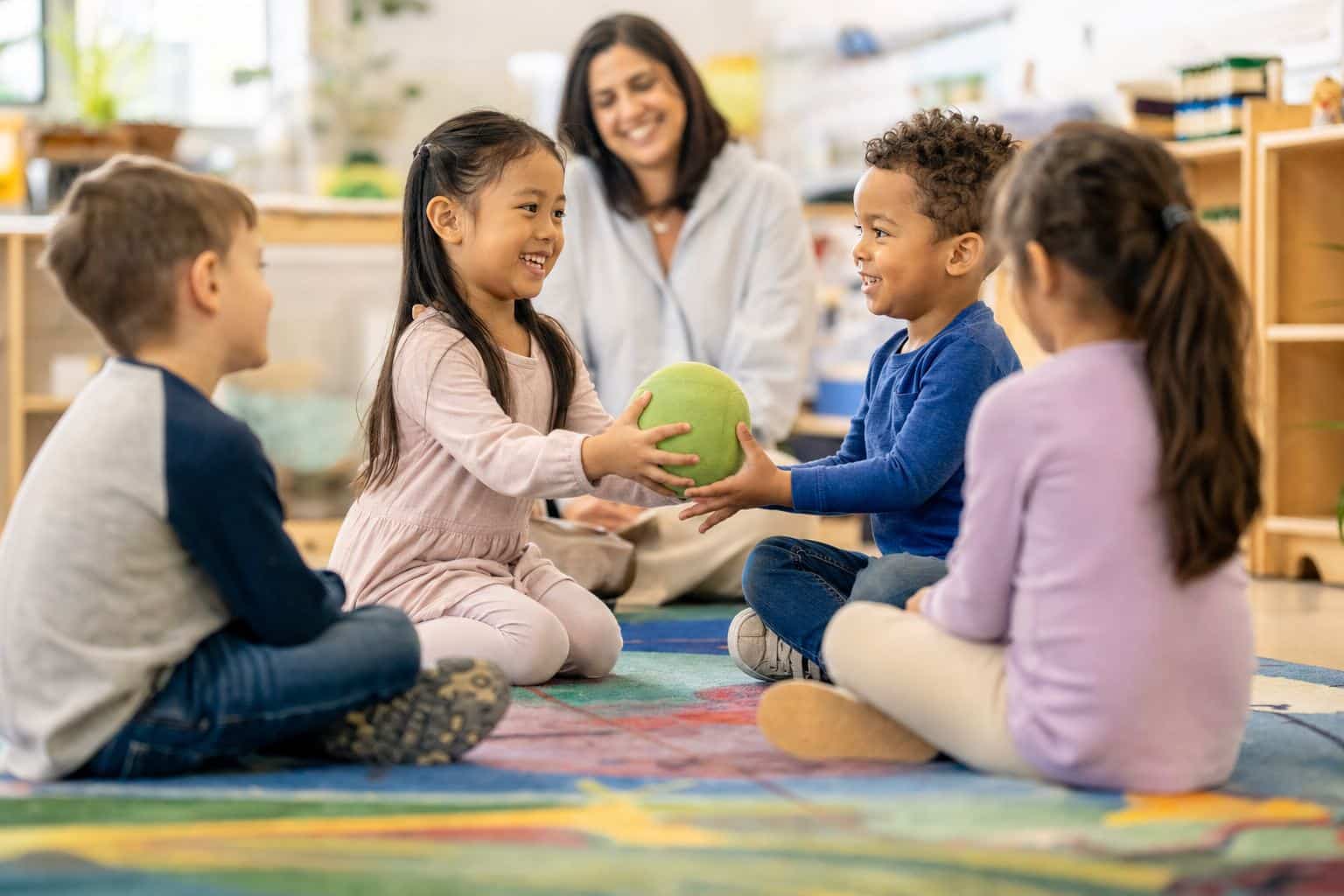
| Conversation ball at morning meeting | Back-and-forth exchanges | A student asks a question and rolls a soft ball to the classmate who answers; the pair aims for three exchanges |
| Turn token board game | Waiting and taking turns | A “my turn” token passes with the die; reminders fade as students pass it on their own |
| Recess rule preview | Joining a game | A short first-person narrative about joining tag before recess, then one prompted join attempt outside |
Social Skills Activities for Elementary Students
From first to fifth grade, activities move toward group work, conversation and problem-solving. CASEL lists cooperative learning among classroom approaches that build social and emotional competence.
| Activity | Skill | How it runs |
|---|---|---|
| Group work with rotating roles | Contributing and building on a peer’s idea | Each member adds one idea and builds on one; roles (recorder, reporter, timekeeper) rotate weekly |
| Video model, then role-play | Joining a conversation | Students watch a peer approach a group, wait and comment, then role-play the same steps |
| Lunch bunch with topic cards | Staying on a peer’s topic | Two trained peers and the student eat together twice a week; the aide counts on-topic turns |
Social Skills Activities for Middle Schoolers
At this age, activities can run inside structures students already value. IDEA lists “special interest groups or clubs sponsored by the public agency” among the nonacademic and extracurricular activities students with disabilities must have an equal opportunity to join (34 CFR 300.107).
| Activity | Skill | How it runs |
|---|---|---|
| Interest club with a peer partner | Asking about a peer’s interest | The student joins a club with a peer who knows the goal; the student’s expertise gets a real role |
| Muted video cue reading | Reading facial expressions and body language | Students watch a short scene with the sound off and name what each person seems to feel, and the cue |
| Group work self-check | Monitoring own participation | The student tallies contributions and interruptions, then compares with the teacher’s tally |
Social Skills Activities for Teens
In high school, the skills serve friendships, self-advocacy and work. In a randomized trial with 47 high school students with severe disabilities, school staff trained and supported 192 peers to join individualized social groups for one semester; students gained significantly more new social contacts and friendships than the control group (Asmus et al., 2017).
| Activity | Skill | How it runs |
|---|---|---|
| Peer network | Building friendships | Four to six peers meet regularly with the student outside class time around a shared activity |
| Workplace role-play | Asking for clarification, accepting feedback | Students rotate through supervisor and employee roles, then practice at a school job site |
| Self-advocacy rehearsal | Requesting an accommodation | The student scripts and records a request, watches it back, then makes the real request |
These skills feed postsecondary goals; see transition IEP goals. The IRIS Center’s module on high school practices for students with autism adds a caution: technology should not replace social interaction, because these skills must carry over to social contexts.
Turn-Taking Activities and Games
Turn-taking activities are games and routines that keep whose turn it is visible, so a student practices waiting, watching a partner’s turn and acting when the turn comes back. Standards name the skill: the Head Start Early Learning Outcomes Framework expects that by 60 months a child “takes turns in conversations and interactions with other children” and waits for a turn, such as in line or on the swings, and the Illinois SEL standards that apply from 2026-27 ask students in kindergarten to grade 2 to “demonstrate the ability to wait, take turns, and share with others.” The games below are original examples to adapt.
| Game or routine | Ages | How it runs |
|---|---|---|
| Drum pass | Preschool | One drum goes around the circle; the child holding it plays, then passes it; the adult names the next child until children pass without help |
| Partner puzzle | K to 2 | Each partner holds half the pieces and places one at a time; a “my turn” card on the table flips after each piece |
| Build-a-story | Grades 2 to 5 | Each student adds one sentence while holding a talking object, building on the sentence before |
| Talk tokens | Grades 6 to 12 | Each group member has three tokens and spends one per comment; a student who runs out waits until everyone has spent theirs |
| One-controller video game | Grades 6 to 12 | Two players share one controller and pass it after each level, with a short scripted handoff (“Your turn”) |
Start with short waits and a visible marker (the object, a card or a timer), praise waiting by name (“You waited for Ana’s turn”), then lengthen the wait and add players. Count turns taken without a prompt with event recording, described below.
When a Student Needs Earlier Foundations
Some students are still learning to share attention with another person: following a point, showing an object, imitating a peer. Start with joint attention examples and activities, then build toward the preschool activities above. For autistic students, IEP goals for autism helps set the order.
How to Connect Social Skills Activities to IEP Goals
An activity is not a goal. The IEP must contain measurable annual goals that meet the needs resulting from the child’s disability (34 CFR 300.320(a)(2)), and those needs come from the present levels; see PLAAFP examples. Goal examples by skill area are in social emotional IEP goals. The activity is how the student gets enough practice to reach the goal.
- Start from the goal’s skill, setting and criterion.
- Pick one or two activities that produce several chances a week to use that exact skill, at least one in the target setting.
- Decide who prompts and who records.
- Write needed supports into the IEP. For meals, recess and other nonacademic settings, the school must provide the supplementary aids and services the IEP team finds necessary for participation (34 CFR 300.117).
Example: a fourth grader’s goal targets staying on a peer’s topic for four exchanges at lunch. The team pairs a weekly video model and role-play with the lunch bunch twice a week, where the aide records on-topic exchanges. When problem behavior is involved, pair the skill with a behavior IEP goal.
Generalization: Getting Skills Out of the Group Room
AFIRM defines generalization as the skill continuing “when the intervention ends, in multiple settings, and with multiple individuals.” The IRIS Center’s module on elementary and middle school practices advises creating opportunities to use skills across activities, settings and people.
- Rotate partners so the skill is not tied to one person.
- Treat lunch, recess, hallways and clubs as instructional settings.
- Brief the general education teacher with a one-line prompt plan.
- Fade prompts on purpose (direct prompt, gesture, visual card, nothing) and record the level used.
- Share the steps with families so the same words are used at home.
Measuring Progress on Social Skills Activities
Kentucky Department of Education guidance on methods of measurement and types of data describes three data types that fit most social skills.
| Data type | What it measures | Fits |
|---|---|---|
| Event recording | How often, as a count, percent or rate | Initiations, on-topic turns, requests for help |
| Duration | How long a behavior lasts | Time playing with a peer |
| Latency | Time from a cue to the behavior | Responding to a greeting |
Record the prompt level, probe weekly in the target setting and graph the results; formats are in IEP data collection sheets. The team must revise the IEP, as appropriate, to address any lack of expected progress (34 CFR 300.324(b)(1)). If data stay flat, change the activity or the practice, not only the criterion.
Funding and Staffing
| Source | What it can support | Note |
|---|---|---|
| IDEA Part B | Special education, related services, supplementary aids and services | Related services include counseling services and school social work, which covers group and individual counseling |
| IDEA CEIS (up to 15% of Part B) | Professional development; behavioral evaluations, services and supports | K-12 students not identified, emphasis K-3 |
| Local and state funds | Curricula, staff time for peer programs | Cooperatives such as TIPS can simplify purchasing |
Sources: 34 CFR 300.34; 34 CFR 300.226. Staff time is the tighter limit: the ASHA 2026 Schools Survey reports a median monthly caseload of 50 students for a full-time school-based SLP, against 40 that SLPs judge manageable. Trained peers and the free AFIRM modules, including a paraeducator module on supporting peer interactions, stretch that time.
Common Mistakes District Leaders Make
- Activities with no target skill. A game with no named skill and no data is recreation.
- Instruction only in the pull-out room, when most students with IEPs spend most of the day in general classes.
- Talking about skills instead of practicing them. A discussion is not a role-play with feedback.
- Untrained peers. A kind seatmate is not peer-based intervention.
- Choosing by grade instead of present levels.
- Targeting looking typical, such as eye contact drills, instead of joining, asking and responding.
- Collecting data only at progress report time.
Recommended Actions
- Map social skills instruction by campus: who teaches it, where, how often and with which practice.
- Adopt one lesson format built on the six components above.
- Train peers and paraprofessionals with the free AFIRM modules.
- Schedule practice at lunch, recess and in clubs, and check that IEPs name the supports students need there.
- Launch peer networks in at least one middle and one high school.
- Review goal results at annual reviews and change activities that are not working.
Questions District Leaders Should Ask
- How many practice opportunities per week does a student get on each social skill, and where?
- Which evidence-based practice is named for each social skills group?
- How many campuses train peers, and who supports them during the year?
- Do IEPs list supplementary aids and services for lunch, recess and extracurricular activities?
- What share of social skills goals were met at the last annual review?
Frequently Asked Questions
What are 10 important social skills?
There is no official list. Ten skills named in the AFIRM peer-based intervention module, several of which overlap with CASEL’s relationship skills, are greeting others, joining an activity, taking turns, following directions, asking for help, keeping a conversation going, responding to invitations, accepting “no,” taking another person’s perspective and resolving conflicts. Which ones a student needs comes from observation and present levels.
What are some examples of social activities?
In school: structured play groups, cooperative group work, lunch groups with trained peers, recess games, clubs, athletics and peer networks that meet outside class time. IDEA lists clubs, athletics and recreational activities among the nonacademic and extracurricular activities students with disabilities must have an equal opportunity to join. Each becomes a social skills activity once a skill is named, prompted and recorded.
What are 5 social skills?
Five teachable skills that cover much of school life are joining a group, taking turns, keeping a conversation going, asking for help and resolving a disagreement. Each can be broken into steps, modeled, practiced and counted. The CASEL framework groups social and emotional skills into five competencies (self-awareness, self-management, social awareness, relationship skills and responsible decision-making), as explained in our social emotional IEP goals guide; our social emotional learning activities are organized by competency.
What are good social skills activities for teens?
Activities that look like real teen life: peer networks at lunch or after school, clubs built around the student’s interests, group projects that require negotiation, workplace role-plays and rehearsed self-advocacy requests. A randomized trial of high school peer networks found students gained more new social contacts and friendships over one semester. Avoid formats designed for younger children.
Can AI help plan social skills activities?
AI tools can help a teacher draft role-play scenarios, a short social narrative or topic cards, which the teacher then checks for accuracy and fit. Describe the skill and age without student names or identifying details, follow district policy, and remember that the practice itself needs real peers. The ChatGPT for teachers guide covers safe prompting.
Related Resources
- Joint Attention Examples and How to Teach It
- Social Emotional IEP Goals
- IEP Goals for Autism
- Behavior IEP Goals
- IEP Data Collection Sheets
- Transition IEP Goals
Conclusion
Social skills activities work when each one names a skill, rests on a practice with evidence behind it, gives every student several turns with feedback and happens where the skill is needed. Present levels decide the skill, age decides the format. Districts that train peers, schedule practice at lunch and recess and record a little data every week turn social skills groups into skills students use.
Sources: Steinbrenner et al., Evidence-Based Practices for Children, Youth, and Young Adults with Autism, National Clearinghouse on Autism Evidence and Practice (2020); AFIRM, Social Skills Training Brief Packet (updated 2025); AFIRM, Peer-Based Instruction and Intervention Brief Packet (2025); CASEL, What Is SEL?; Durlak et al., The Impact of Enhancing Students’ Social and Emotional Learning, Child Development (2011); Asmus et al., Efficacy and Social Validity of Peer Network Interventions for High School Students With Severe Disabilities (2017); IRIS Center, Autism Spectrum Disorder (Part 2): Evidence-Based Practices; CDC, Learn the Signs. Act Early. Developmental Milestones; U.S. Department of Education, OSEP, 2024-25 Static Tables (Part B Child Count & Educational Environments); Kentucky Department of Education, Method of Measurement and Type of Data; ASHA, 2026 Schools Survey: SLP Caseload and Workload Characteristics Report. Other sections of 34 CFR Part 300 are linked where they are cited.
Join the 2027 Special Education Pilot
A social skill sticks after many short practice turns with feedback, and a group that meets twice a week rarely gives each student enough of them. Telo AI is being adapted for students with IEPs: patient, 1-on-1 practice aligned to each student’s IEP goals, including social-emotional learning. We are inviting districts to shape it with us in a 2027 pilot.
Apply to pilot Telo AI in your Special Education program
Found this guide useful?
Preferred sources show up more often in your Google results, including AI Overviews.