

Estimated reading time: 15 minutes
A token board is a card or board with a set number of spaces that a student fills with tokens, such as stars, checks or chips, each earned for a target behavior, then trades for a reward chosen in advance, called a backup reinforcer. It is the visual form of a token economy, which the National Clearinghouse on Autism Evidence and Practice (NCAEP) places within Reinforcement, one of 28 evidence-based practices it identified in 2020 for autistic learners, and which the IRIS Center at Vanderbilt University calls an evidence-based intervention. This guide covers choosing the behavior, tokens and rewards, three original example boards, delivery and exchange, fading, response cost, data, and the BIP and IEP.
Table of contents
Executive Summary
A 2016 meta-analysis of 28 single-case studies with 90 participants found a weighted mean effect size of 0.82 for token economies in classrooms, with no difference between general and special education settings (Soares and colleagues). A 2022 meta-analysis of 24 studies in kindergarten to grade 5 found large effects in both (Kim and colleagues). An earlier review applying What Works Clearinghouse standards judged the evidence insufficient to call token economies best practice (Maggin and colleagues, 2011), so check each board with data.
Details decide whether a board works. A 2017 review of 96 token economy articles found that only 19% described every component completely enough to replicate (Ivy and colleagues); a plan that says “token board” and nothing more has the same gap.
Key Takeaways
- A token board makes progress visible: one token per target behavior, a backup reinforcer when the board is full.
- Write down all six components, from the behavior to the price of each reward.
- Start so the student fills the board quickly, then raise requirements in small steps.
- Pair every token with specific praise and plan the fade from the first day.
- Decide in the BIP, before starting, whether tokens can ever be taken away.
- A token board is a support, not a goal: teach the skill and measure it.
What Is a Token Board?
A token board is a visual reinforcement system: the student earns a token each time they use a target behavior, watches the spaces fill and exchanges the full board for a backup reinforcer.
AFIRM, the free training modules built on the NCAEP review, describes a token economy as positive reinforcement in which learners earn tokens that buy desired reinforcers, known as backup reinforcers, and notes that tokens do not interrupt lessons, can keep a learner interested over long periods and can be used with several learners at once. A token has no value of its own; its value comes from its link to other reinforcers (Hackenberg, 2009). The IRIS Center adds that tokens let students see their progress and help them learn to delay gratification.
Token Board vs Token Economy
A token economy is the whole system; a token board is one way to display it, alongside punch cards and behavior points cards (IRIS). Ivy and colleagues list six components: the target behavior, the token, the backup reinforcers and three linked schedules, which Hackenberg calls token-production, exchange-production and token-exchange schedules.
| Component | Question the plan answers | Example |
|---|---|---|
| Target behavior | What earns a token? | Finishing one task card |
| Token | What does the student receive? | A felt star |
| Backup reinforcers | What can tokens buy? | Three minutes with blocks |
| Token-production schedule | How many behaviors per token? | One card, one star |
| Exchange-production schedule | When can the student trade? | When all spaces are full |
| Token-exchange schedule | How many tokens per reward? | Five stars, one choice |
Does a Token Board Work?
Token boards work for many students but not all, so each board needs a data check. NCAEP’s Reinforcement practice, which includes token economy, rests on 106 articles with outcomes from communication to challenging behavior, and NCAEP calls it foundational because it is almost always combined with other practices. IRIS notes that students whose behavior warrants a behavior intervention plan (BIP) often benefit from a more systematic, concrete approach to reinforcement, and the Center on PBIS, funded by the U.S. Department of Education, lists token economies among classroom strategies in its April 2025 practice guide.
Individual results vary. In a 2020 study of four learners with autism, a token system was as reinforcing as primary reinforcers for two learners and produced lower responding for the other two, and the authors recommend formally assessing whether a token system works (Fiske and colleagues).
How to Set Up a Token Board
Setting up a token board means making five decisions before the first token. The basic steps used in BIPs are in our behavior intervention plan guide; this section goes deeper.
Choose the Target Behavior
Name one or two behaviors the student will do, in observable terms: “finishes the card and puts it in the bin,” not “works nicely.” For a student with a BIP, the target is usually the replacement behavior from the functional behavior assessment. When the problem behavior is a way to escape a task or get attention, a token board does not teach the student to ask for help or a break; functional communication training does, and the board can reinforce that request.
Choose the Tokens
AFIRM recommends tokens that are attractive, easy to carry, easy to hand out, and suited to the student’s age and development. IRIS lists stickers, coins, check marks, points and tickets; a practical option for older students is points on a discreet card.
Choose the Backup Reinforcers
Backup reinforcers must be things the student actually wants. AFIRM’s reinforcer sampling offers two items at a time and asks the student to pick one. IRIS advises asking the student and family, considering cultural relevance, offering two or three options and tying rewards to the function of the behavior, such as social rewards for a student who seeks attention. AFIRM suggests a reinforcer menu with prices adjusted and items rotated. For activities, timing matters: in a 2014 study with individuals with intellectual disabilities, every participant preferred to accumulate access and enjoy an activity uninterrupted after the work rather than get 30 seconds of it after each response (DeLeon and colleagues).
Set the Number of Tokens and the Earning Rate
The board should be easy to fill at first. IRIS bases reinforcement criteria on how hard the replacement behavior is, how often the problem behavior happens and the student’s age and development, and suggests using baseline data: a student who shows a problem behavior five times in 15 minutes, about every three minutes, might first be reinforced slightly more often, such as every 2.5 minutes. In laboratory research reviewed by Hackenberg, responding declined as more responses per token and more tokens per exchange were required, a reason to raise requirements in small steps. A practical start, not a research rule, is a board of three to five spaces the student can fill in one activity.
Teach the System Before Using It
AFIRM asks adults to explain the target behavior in simple terms or show it, say that each instance earns a token, and review how many tokens buy a reward. The Center on PBIS lists forgetting to teach students how a token economy works as something to avoid. A practical tip: run one practice round the student is sure to win.
Token Board Examples
These examples are original and about fictional students and a fictional class; adapt every element to your data and plans.
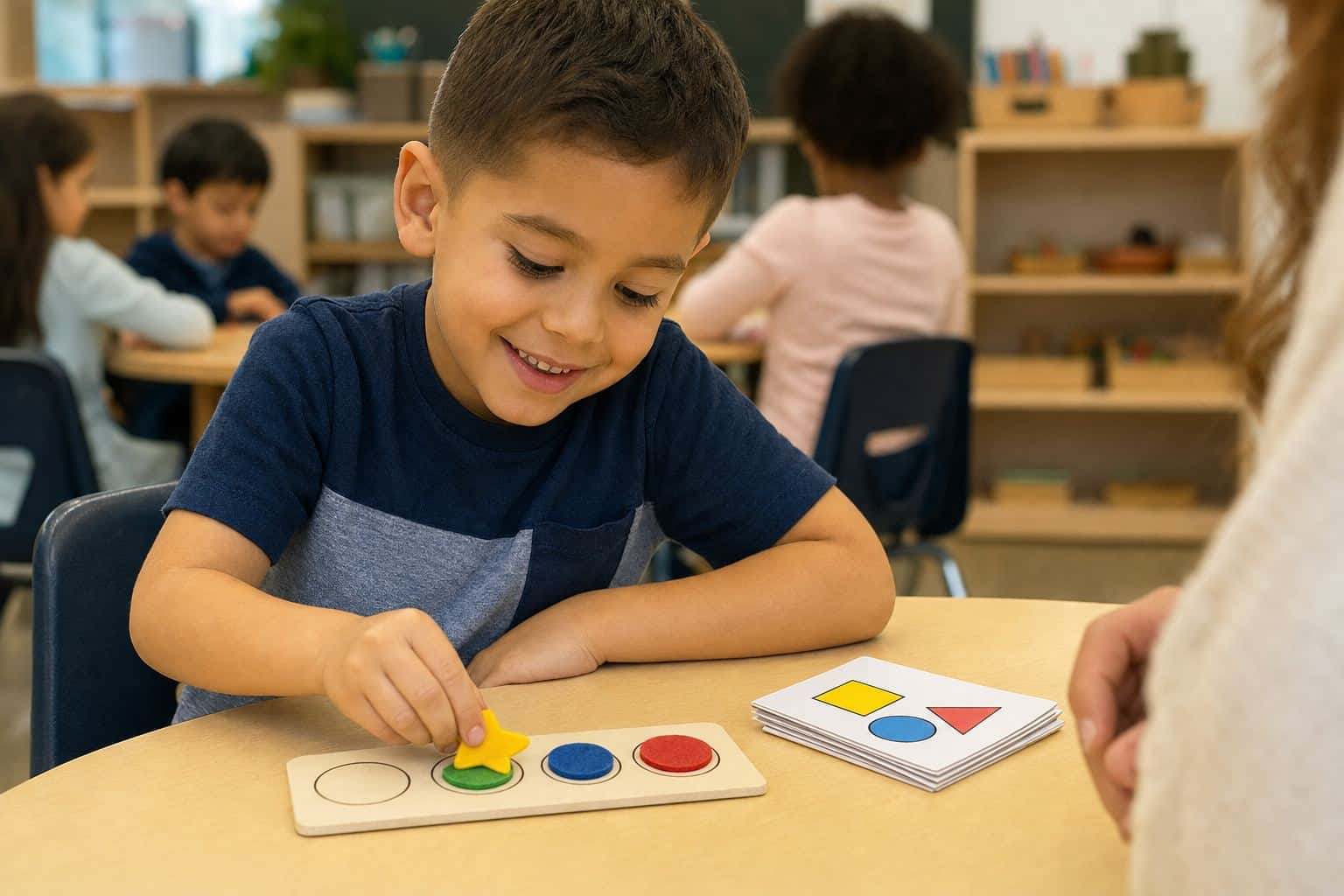
A 5-Space Token Board for a First Grader
| Element | Hugo, grade 1 |
|---|---|
| Target behavior | Finishes each task card at the teacher table and puts it in the “finished” bin |
| Board | Five spaces in a row, with a “working for” square where Hugo places the picture he chose |
| Token | A felt star, given with “You finished the card, here is your star” |
| Backup reinforcers | A menu of three pictures: blocks, drawing, a song with the aide |
| Exchange | Five stars earn three minutes of his choice; then the board resets |
| Fading | After two weeks with no more than one prompt per session: one star per two cards, then an eight-space board |
The “working for” square makes this a first-then token board: first five stars, then the picture, a layout familiar to students who use first-then boards (see visual schedules).
A Points Card for a Middle Schooler
Kiara, a seventh grader, carries a points card that each teacher marks at the end of class. A point is earned for each behavior met.
| Period | Ready at the bell (desk, materials out) | Starts work within 2 minutes | Teacher initials |
|---|---|---|---|
| 1. Science | 1 | 1 | JR |
| 2. Math | 1 | 0 | AL |
| 3. English | 1 | 1 | MT |
| 4. Social studies | 0 | 1 | DB |
| 5. Study skills | 1 | 1 | KS |
| 6. Art | 1 | 1 | PW |
Ten of 12 points makes a successful day; four successful days buy a choice from a menu Kiara helped write, such as lunch in the library with a friend. To fade the card, Kiara later rates herself and earns a bonus point when her rating matches the teacher’s, a step toward self-management, in which learners monitor and record their own behavior (NCAEP).
A Classwide Token System and Its Limits
A third-grade teacher adds a marble to a jar each time the class finishes a transition in under a minute; when the marbles reach a line, the class votes on a 15-minute outdoor game. The Kim meta-analysis found large effects in general education classrooms, and the Center on PBIS lists practices to avoid:
- Public corrections, such as clip charts.
- A goal students cannot reach, such as perfect behavior all year.
- A reward the teacher cannot deliver.
A classwide system rewards the group; a student who needs individual reinforcement still needs an individual plan.
Delivering Tokens and Running the Exchange
Tokens should arrive right after the behavior, every time at first, with a short statement of why; AFIRM’s example is “You completed your assignment, now you get a token.” IRIS advises pairing reinforcement with behavior-specific praise, and the Center on PBIS recommends at least five positive statements for every correction, more for students at risk.
- Exchange at a set time and place, with a “bank” to track tokens (AFIRM).
- Reset the board after each exchange (IRIS).
- Rotate the menu so rewards keep their value; AFIRM calls loss of interest satiation.
- When the problem behavior occurs, keep reinforcement for it low and redirect the student to the replacement behavior (IRIS).
Thinning and Fading a Token Board
Fading a token board means requiring more behavior for each token and each reward until praise and natural payoffs maintain the behavior. AFIRM suggests giving a token every other time the behavior occurs, then every third time; IRIS suggests lengthening intervals for time-based schedules and raising the number of tokens required, and says reinforcement should be faded slowly. Long-term maintenance and transfer of gains were identified early as obstacles for token economies (Kazdin, 1982), so plan the steps early. One possible sequence:
- Thin the earning rate: one token per two behaviors, then three.
- Raise the price: more spaces before an exchange.
- Lengthen the wait: exchange at the end of the morning, then the day.
- Shift to self-monitoring, as with Kiara’s self-rating.
- Keep the praise after the tokens are gone.
Use the same system in every setting (AFIRM), and step back if the data drop.
Response Cost: Should a Token Board Take Tokens Away?
Removing earned tokens is response cost, and teams should decide in the BIP, before the board starts, whether it is ever used. NCAEP lists punishment, with response cost as an example, among practices with insufficient evidence, and says its use “should be limited or at least carefully monitored.” The 2016 Soares meta-analysis found no difference in effect with or without response cost. The Center on PBIS also warns against making corrections public. As a safeguard, a team that adopts response cost can write when tokens can be removed, by whom, and how the student can still reach the reward.
Token Board Data
Token board data compare the target behavior with baseline. Record the behavior itself, not just tokens: tokens measure adult delivery, the behavior measures learning. In this original sample for Hugo:
| Session | Cards finished | Prompts | Stars earned | Exchanges |
|---|---|---|---|---|
| Baseline (no board) | 2 | 6 | none | none |
| Week 1, Monday | 5 | 3 | 5 | 1 |
| Week 1, Friday | 10 | 1 | 10 | 2 |
| Week 3, Friday | 10 | 0 | 5 (one per two cards) | 1 |
If the behavior does not change, check fidelity, the value of the rewards, the earning rate and the prompt hierarchy in use before dropping the board. More layouts are in IEP data collection sheets.
Writing a Token Board Into a BIP or IEP
A token board belongs in a BIP’s reinforcement section or the IEP’s supports; the IEP goal names the behavior the student will learn. When behavior impedes learning, the IEP team must consider positive behavioral interventions and supports (34 CFR 300.324(a)(2)(i)), and the IEP states supplementary aids and services and supports for school personnel (34 CFR 300.320(a)(4)). Write the six components, fading steps and response cost decision into the plan. “Staff will provide a token board” is a support, not a goal; see behavior IEP goals. These goals are original examples:
- Task completion: By the annual review, during teacher-table work, Hugo will finish and turn in 8 of 10 task cards with no more than one prompt per session, on 4 of 5 consecutive days, as measured by session data.
- Class readiness: By the annual review, Kiara will be ready at the bell and start work within 2 minutes in at least 5 of 6 periods on 4 of 5 days, as measured by her points card, with self-ratings matching the teacher’s in 80% of periods.
Common Mistakes to Avoid
- No defined behavior, so tokens follow adult mood.
- Rewards the adult chose alone, which the student does not want.
- Too many spaces at the start, so the student never fills the board.
- Tokens without praise, leaving nothing to maintain the behavior later.
- Taking tokens away on the spot without a plan.
- No fading plan, so the board follows the student for years.
- Using a board instead of teaching the skill or request the student lacks.
Recommended Actions
- Use one token plan template that lists all six components and the fading steps.
- Build token boards into paraprofessional training, with the free AFIRM reinforcement module.
- Require baseline and weekly data for every individual board.
- Set a district position on response cost and record each team decision in the BIP.
- Review classwide systems against the Center on PBIS practices to avoid.
- Check fading at every BIP review.
Frequently Asked Questions
What is a token board used for?
A token board is used to reinforce a target behavior or skill, such as finishing work, waiting or asking for help, by giving a token each time it occurs and a chosen reward when the board is full. It shows the student how close the reward is. Schools use it in special and general education classrooms and often write it into a behavior intervention plan.
Are token boards effective?
Often, but not for every student. NCAEP includes token economy in Reinforcement, an evidence-based practice for autistic learners, and classroom meta-analyses in 2016 and 2022 reported positive effects, large in the 2022 review. A 2011 review judged the evidence insufficient under What Works Clearinghouse standards, and in a 2020 study a token system produced less responding than primary reinforcers for two of four learners, so check each board with data.
Are token boards bad?
Not when they are planned well. Planning problems include rewards picked by adults alone, which IRIS warns students may not value, boards that never fade, and tokens taken away without a plan. Choose rewards with the student, pair tokens with praise, fade on a schedule and decide response cost in advance.
How many tokens should a token board have?
There is no fixed number. Start with as many spaces as the student can fill quickly, for example three to five within one activity, so the first exchanges come soon. IRIS suggests basing the earning rate on how often the behavior happens at baseline. Add spaces or require more behavior per token once the data show steady success.
Is a token board an antecedent strategy?
Mainly no. A token board is a consequence strategy: the token follows the behavior and reinforces it, and NCAEP classifies token economy under Reinforcement, a consequence that increases future use of a skill. Showing the board and the chosen reward before a task can also remind the student what to do, and a plan can pair it with antecedent strategies such as a visual schedule.
What is a token economy in ABA?
In applied behavior analysis (ABA), a token economy is a reinforcement system with six parts: the target behavior, a token that becomes a conditioned reinforcer, backup reinforcers and three schedules for earning tokens, opening an exchange and pricing rewards. Schools use the same system in classrooms and BIPs; the IEP team, with a behavior specialist or BCBA where one supports the student, designs it.
Related Resources
- Behavior Intervention Plan
- Behavior IEP Goals
- Visual Schedules
- Functional Communication Training
- Functional Behavior Assessment
- IEP Data Collection Sheets
Conclusion
A token board works when every part is decided in advance: a clear behavior, rewards the student chose, an earning rate the student can meet, praise with every token, a fading plan and a recorded decision on response cost. Track the behavior, not just the stars, and retire the board once the skill holds.
Sources: Steinbrenner et al., Evidence-Based Practices for Children, Youth, and Young Adults with Autism, NCAEP (2020); Sam and AFIRM Team, Reinforcement Brief Packet (updated 2024); IRIS Center, Behavioral Intervention Plans (Elementary): Reinforcement-Based Interventions; Center on PBIS, Supporting and Responding to Students’ Social, Emotional, and Behavioral Needs (Version 2, April 2025); Ivy et al., Token Economy: A Systematic Review of Procedural Descriptions (2017); Hackenberg, Token Reinforcement: A Review and Analysis (2009); Soares et al., Effect Size for Token Economy Use in Contemporary Classroom Settings (2016); Kim et al., Systematic Review and Meta-Analysis of Token Economy Practices in K-5 Educational Settings (2022); Maggin et al., A Systematic Evaluation of Token Economies as a Classroom Management Tool for Students with Challenging Behavior (2011); DeLeon et al., Distributed and Accumulated Reinforcement Arrangements (2014); Fiske et al., An Analysis of the Value of Token Reinforcement Using a Multiple-Schedule Assessment (2020). Other sources and sections of 34 CFR Part 300 are linked where they are cited.
Join the 2027 Special Education Pilot
A token board rewards a skill, but the skill itself grows through many repetitions of practice with an adult, and adult 1-on-1 time is scarce. Telo AI is being adapted for students with IEPs: patient, 1-on-1 practice aligned to each student’s IEP goals and pace, including social-emotional learning, with teachers setting the goals, topics and rules. We are inviting districts to shape it with us in a 2027 pilot.
Apply to pilot Telo AI in your Special Education program
Found this guide useful?
Preferred sources show up more often in your Google results, including AI Overviews.