

Last updated:
Estimated reading time: 7 minutes
The WIDA writing rubric is how teachers judge where an English Learner’s writing sits on the path to proficiency, from single words to grade-level academic prose. Scoring writing against it by hand is slow, and consistency across a class is hard. This guide explains the rubric level by level and shows how to score EL writing quickly and consistently with AI, using a ready prompt builder.
Table of contents
Score EL Writing with AI in 20 Seconds
Pick the standard and level, paste the student’s writing into the prompt, and let the AI return a level with evidence and next steps. Always review its judgment yourself and never paste student names or identifying data.
What Is the WIDA Writing Rubric?
Quick answer: the WIDA writing rubric is a set of proficiency-level descriptors that describe what English Learners can do in writing at each of six levels, from Level 1 (Entering) to Level 6 (Reaching). WIDA looks at three dimensions of language: discourse (how ideas are organized), sentence structure (grammatical complexity), and word or phrase use (vocabulary). Teachers use it to place writing on the proficiency scale, plan next steps, and interpret ACCESS results. For how the score itself is produced on the ACCESS test and what it weighs in the composites, see the WIDA ACCESS writing score.
The Six WIDA Writing Levels (Plain-Language Summary)
These are short summaries in plain language. For the official descriptors, use the WIDA link in the sources.
| Level | What the writing looks like |
|---|---|
| 1 Entering | Single words, set phrases, and copied chunks; relies heavily on models and support. |
| 2 Emerging | Short, simple sentences; everyday vocabulary with some general academic words; frequent support. |
| 3 Developing | Expanded sentences and connected ideas; general and some specific academic vocabulary; developing organization. |
| 4 Expanding | A variety of sentence types and connected paragraphs; specific and some technical vocabulary; growing cohesion. |
| 5 Bridging | Complex, cohesive writing approaching grade level; technical vocabulary; minimal support. |
| 6 Reaching | Writing comparable to that of proficient grade-level English-speaking peers. |
How to Score EL Writing with AI
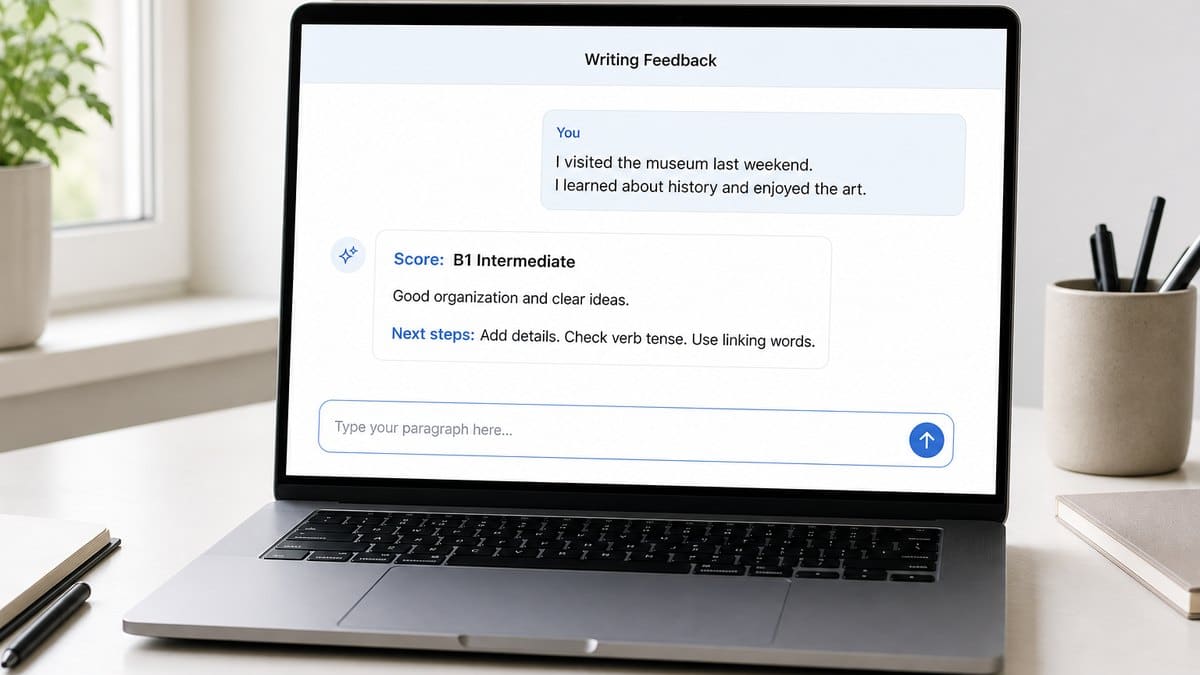
AI does not replace your professional judgment, but it gives you a fast, consistent first read against the WIDA writing rubric and specific next steps. The method:
- Tell the AI the rubric and level. Name WIDA and the level you are checking, and include the plain-language descriptor so it scores against the right expectations.
- Paste the writing sample (no student names or identifying data).
- Ask for a level, evidence, and next steps, not just a score. The builder above does this for you.
- Review the judgment. Treat the AI level as a second opinion, and trust your own read when they differ.
Refine with one line if needed: “explain why it is not Level 3,” “quote the evidence,” or “give two sentence frames to move the student up a level.”
TELPAS and ELPAC Writing Rubrics
The same method works for other standards. TELPAS (Texas) rates writing as Beginning, Intermediate, Advanced, or Advanced High. ELPAC (California) uses Emerging, Expanding, and Bridging. In the builder above, choose your standard and level and it writes the scoring prompt to match. See how ELPAC and WIDA differ for the California context.
Best Practices and Cautions
- Keep it a second opinion. AI is consistent but can miss nuance; your judgment is the final word.
- Protect privacy. Never paste student names, IEP details, or scores into a public tool. Follow your district’s AI policy.
- Use it for growth, not just a grade. The value is in the specific next steps and sentence frames, which you can turn into instruction.
- Calibrate. Occasionally score a sample yourself and compare, so you trust the tool and catch drift.
Turning a Score Into Next Steps by Level
A level is only useful if it points to a next move, and the WIDA dimensions, discourse, sentence structure, and vocabulary, tell you where to push. The targets differ by level band. For writers at Levels 1 and 2, the priority is producing complete sentences: sentence frames, word banks, and models give beginners a structure to fill, and the goal is moving from single words and copied chunks to short, original sentences of their own. For writers at Levels 3 and 4, the work shifts to expansion and connection: combining short sentences into longer ones, using transition words to link ideas, and reaching for more specific academic vocabulary in place of everyday words. For writers at Levels 5 and 6, the focus narrows to cohesion, precision, and the technical vocabulary of the discipline, the fine differences that separate strong writing from grade-level proficient writing.
Reading a score through these bands keeps feedback actionable. Instead of telling a Level 2 writer to add complexity they are not ready for, or a Level 5 writer to work on basics they have mastered, you match the instructional move to where the student actually is. When you ask AI for next steps, request them in these terms, such as two sentence frames for a Level 2 writer or a transition-word bank for a Level 3 writer, so the feedback converts directly into your next mini-lesson.
Common Scoring Errors and How to Avoid Them
Scoring writing against the WIDA rubric is a skill, and a few errors are common enough to name. The most frequent is confusing content quality with language proficiency: a student may have a brilliant idea expressed in simple language, or a shallow idea expressed in complex language, and the rubric measures the language, not the strength of the argument. Score what the writing shows about the student’s command of English, not how interesting the topic is. A second error is judging on a single sample; a student’s proficiency is better captured across several pieces than from one on-day or off-day draft. A third is scoring an edited or heavily supported piece as if it were independent work, which inflates the level, so note how much scaffolding a sample received. Finally, remember that the rubric is holistic across the three dimensions; a writer can show stronger vocabulary than sentence structure, and the overall level reflects the balance. Naming these traps, and calibrating occasionally with a colleague or against your own second read, keeps scoring honest whether you do it by hand or with AI as a first pass.
Frequently Asked Questions
What is the WIDA writing rubric?
A set of proficiency-level descriptors that describe what English Learners can do in writing at each of six WIDA levels, across discourse, sentence structure, and vocabulary. Teachers use it to place writing on the proficiency scale and plan next steps.
How many levels does the WIDA writing rubric have?
Six: Level 1 Entering, Level 2 Emerging, Level 3 Developing, Level 4 Expanding, Level 5 Bridging, and Level 6 Reaching.
Can AI score EL writing to the WIDA rubric?
Yes, as a fast, consistent first read. Give it the level and descriptor, paste the sample, and ask for a level with evidence and next steps. Review the result yourself and never enter student data into a public tool.
Is AI scoring reliable?
It is consistent and useful for a first pass and for generating next steps, but it can miss nuance. Treat it as a second opinion and calibrate against your own scoring.
How do I turn a WIDA level into next steps?
Match the move to the level band. At Levels 1 to 2, build complete sentences with frames and models. At Levels 3 to 4, expand and connect sentences and add specific academic vocabulary. At Levels 5 to 6, focus on cohesion, precision, and technical vocabulary. Ask AI for next steps in these terms.
Should a strong idea raise the writing score?
No. The rubric measures language proficiency, not the quality of the idea. A brilliant idea in simple language is still simple language, and a weak idea in complex language still shows command of English. Score what the writing reveals about the student’s English, not how interesting the topic is.
Is one writing sample enough to assign a level?
One sample gives a snapshot, but proficiency is better captured across several pieces, since students have on-days and off-days. Also note how much scaffolding a piece received, because scoring heavily supported work as independent inflates the level.
Related Resources
- WIDA ACCESS Writing Score: How ACCESS Scores Writing
- TELPAS Writing Rubric (Texas)
- ELL Writing Prompts
- AI Prompts for ELL Teachers
- ELPAC vs WIDA
- ChatGPT for Teachers
Conclusion
The WIDA writing rubric turns a vague sense of “getting better” into a clear proficiency level and a next step. AI makes applying it fast and consistent: give it the level, paste the sample, and get evidence-based feedback in seconds. Keep your judgment in charge, protect student privacy, and use the next steps to drive instruction, especially the speaking practice that makes writing grow.
Sources: WIDA ELD Standards Framework; WIDA ACCESS; TELPAS Proficiency Level Descriptors.
Scoring Names the Gap; Talk Closes It
A rubric score is a precise diagnosis. It tells a teacher that a student is writing at Level 2, that sentences stay short, that academic vocabulary is thin. What it does not tell you is how to move the writer forward, and that is where the real work sits.
English Learners write better when they have first said the idea aloud, argued it, and heard it questioned. Oral rehearsal is what supplies the sentences a student later commits to paper. Yet in a full class, individual talk time is scarce; one teacher cannot rehearse ideas one-to-one with every writer before every task. The bottleneck is capacity for conversation, not the accuracy of the score.
Increasingly, teachers pair their assessment with something that builds that oral foundation. Telo AI is one example, giving each student individualized speaking practice aligned to WIDA, in English plus Spanish and French for bilingual programs, so learners reach the writing task with language already activated.
See how oral rehearsal feeds stronger student writing: https://mytelo.ai/how-telo-works/
The rubric is excellent at telling you where a writer stands; it says nothing about the talking that gets them to the next level. The teachers who move scores fastest treat speaking as the groundwork of writing, not a separate subject.
Found this guide useful?
Preferred sources show up more often in your Google results, including AI Overviews.