

Last updated:
Estimated reading time: 6 minutes
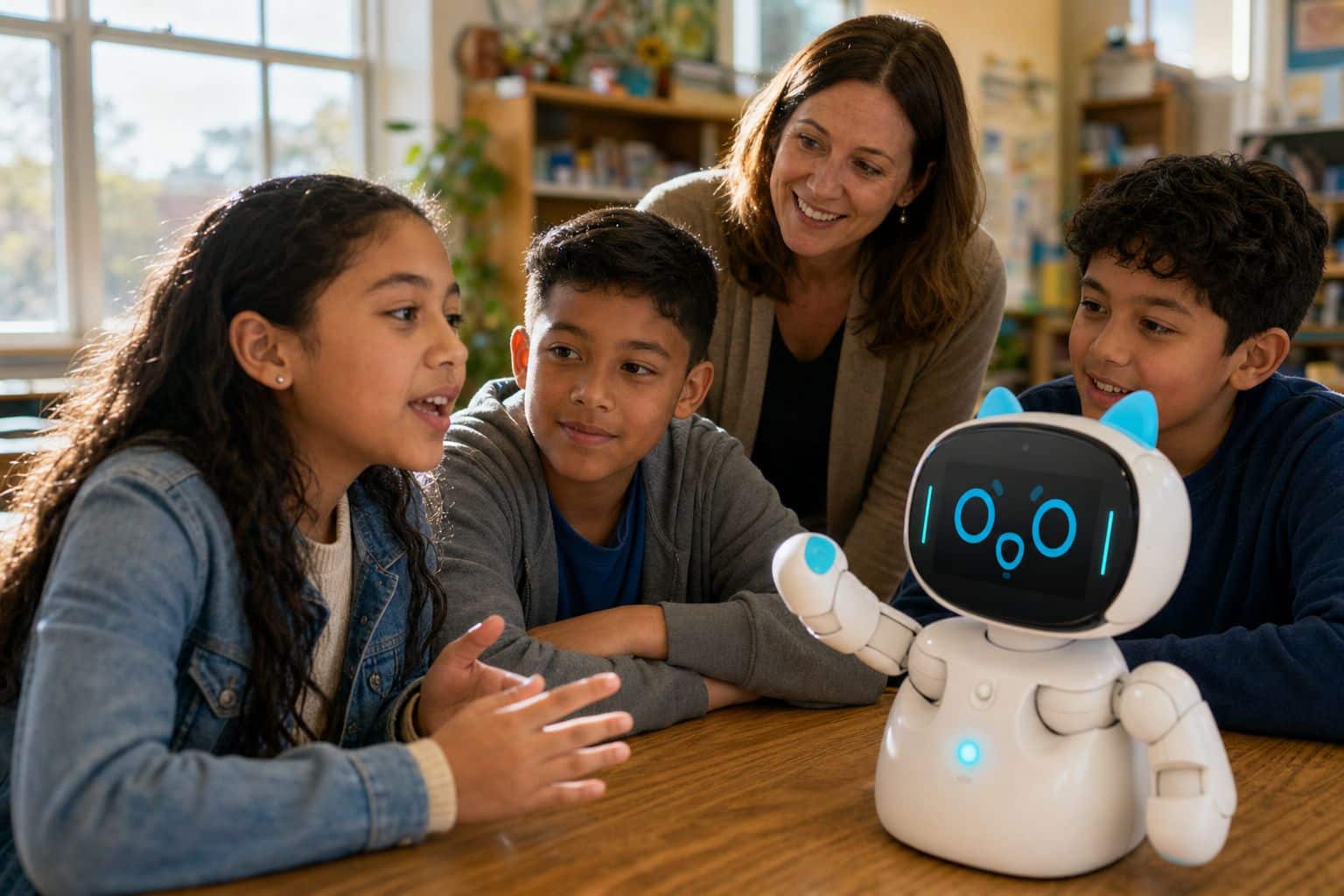
DeKalb County Schools, in northeast Alabama, has purchased a Telo AI robot to give English learners at Crossville Middle School more individual speaking practice during the school day. It is the second Alabama district to work with Telo AI, after Alabaster City Schools. The robot went into service at the end of September for the 2026-27 school year. In a rural district where roughly one student in five is learning English, the reason is not hard to find: there are far more children who need to talk than adults free to listen.
At a glance
| Element | Detail |
|---|---|
| District | DeKalb County Schools, Rainsville, Alabama |
| Size | 8,769 students in 15 schools (NCES, 2024-25) |
| English learners | About 22% of students, third-highest share in Alabama |
| School | Crossville Middle School, grades 4 to 8 |
| Equipment | One embodied AI robot |
| Timeline | Ordered in September 2026, in service by the end of the month |
| Next step | Teacher onboarding in early October, then monthly check-ins |
Disclosure: Telo AI is the vendor in this deployment and publishes this blog. District facts come from DeKalb County Schools and from local reporting; every state and national figure below is linked to its primary source so you can check it independently.
Table of contents
Why speaking time is a division problem in Crossville
Take a class of 24 with an English learner share close to the reported 22%. That means about five children. Ten minutes of real back-and-forth with each would require roughly 50 minutes of the teacher’s day. Finding that time alongside whole-class instruction and the needs of every other student is a serious scheduling challenge. The constraint is the number of children sharing one adult.
That is why oral language development lags reading and writing in so many programs, and why a district in this position ends up buying conversation time rather than more material.
One robot, built into an EL teacher’s routine
DeKalb chose to place the robot with one EL teacher at Crossville Middle School, inside her existing schedule rather than in a block of its own. That choice settles practical questions early:
- Where the ten-minute sessions fit, typically as one station in a rotation the teacher already runs.
- How the teacher uses the dashboard to decide who needs her next.
The district and Telo AI will hold monthly check-ins with the teacher throughout the year. DeKalb also follows Alabaster City Schools, which uses four Telo AI robots for its English learners in 2026-27.
What students at Crossville will actually do
The teacher sets the learning objective in seconds, the student talks with the robot for five to ten minutes, and the teacher’s dashboard updates after each conversation. With three sessions a week, each student gets roughly one to two extra hours of speaking practice per month. Open conversation is one of five practice modes, not the default:
- Conversation, for fluency, confidence and volume of talk.
- Lesson Practice, rehearsing the day’s vocabulary right after instruction.
- Role Play, for functional and academic language.
- Skill Training, aimed at one gap at a time, such as complete sentences or academic vocabulary.
- Ask and Learn, where a student asks in English for help with the work in front of them.
During a session the AI adjusts to the student’s level, refuses one-word answers and pushes for the extended responses that state assessments measure, and corrects naturally in the flow of conversation rather than with red marks. The robot is voice-first: students interact through conversation, without having to click or tap buttons as they would in an app on a tablet or Chromebook.
Telo’s teacher-facing insights are WIDA-aligned, helping teachers track participation, vocabulary development, and speaking progress over time. Speaking is a foundation of language learning: young children develop their first language through everyday exchanges with parents and caregivers, listening, responding, and trying out new words. Students learning English also need regular opportunities to use the language in meaningful conversations. Telo gives them more of that practice in the classroom.
On privacy, the commitments are contractual: conversations are not retained (no audio, no transcripts) and student data is never used to train AI models
Sources: Alabama Reflector, “In DeKalb County, English Language Learner instructors teach, translate and calm fears,” February 16, 2026 · NCES Common Core of Data, DeKalb County district detail · NCES, English Learners in Public Schools · IES, REL Southeast and Region 7 Comprehensive Center on Alabama’s English learners · WIDA Consortium, Alabama
Found this guide useful?
Preferred sources show up more often in your Google results, including AI Overviews.