

Estimated reading time: 12 minutes
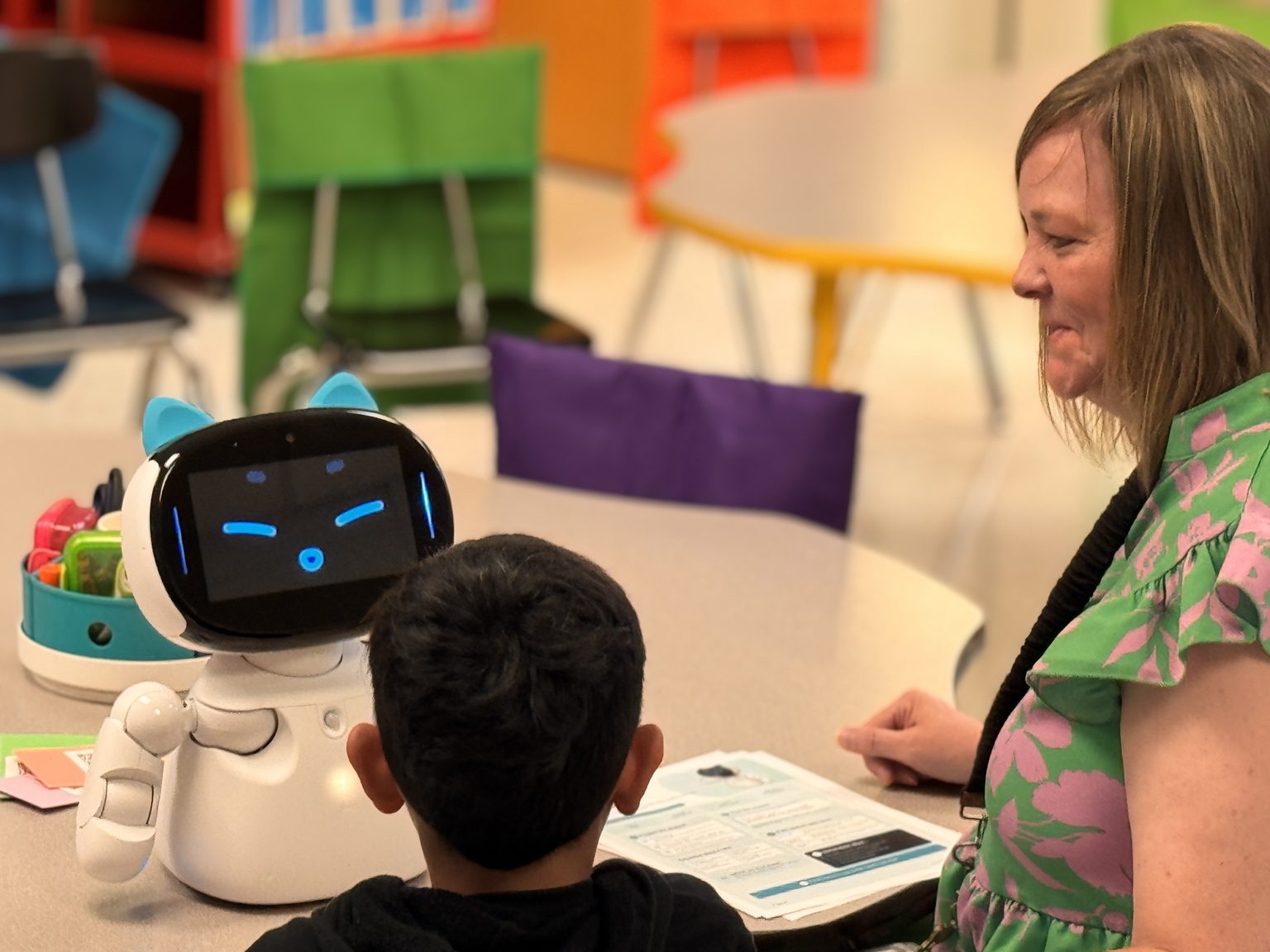
After a pilot year, Alabaster City Schools is adding four Telo AI robots for the 2026-27 school year, to give its English learners individual speaking practice during the school day. The district’s own framing is three short clauses: more speaking time, less screen time, teachers in control. That order matters. The expansion is not a bet on a device. It is a decision about where a small district’s scarcest resource, adult conversation time, is going to come from.
The story in 20 seconds
| Element | What it means |
|---|---|
| Pilot | Ran first, and proved the model before any expansion |
| Four robots | Added for the 2026-27 school year |
| 1:1 practice | Individual speaking practice for English learners |
| 1 extra hour | Five minutes, three times a week, adds up to about an hour more speaking time per month, at a fraction of the cost of adding staff |
| Teacher-led | The AI adapts to the teacher’s lesson, not the reverse |
| Privacy-first | Student data is never used to train AI models |
Disclosure: Telo AI is the vendor in this deployment and publishes this blog. District figures come from Alabaster City Schools and from local reporting; every state and national figure below is linked to its primary source so you can check it independently.
Table of contents
Why the district expanded to four more robots
The sequence is the interesting part. Alabaster piloted first, then expanded. Superintendent Dr. Wayne Vickers put the reasoning this way:
“We want to be thoughtful about how we bring AI into our schools. For us, technology should support our teachers and create meaningful opportunities for students. What we saw during the Telo pilot gave us the confidence to expand its use.”
Dr. Wayne Vickers, Superintendent, Alabaster City Schools
Three words in that sentence do the work: support our teachers. Not replace, not supplement, not transform. A district that describes an AI purchase in terms of teacher capacity has already answered the question most procurement committees spend a semester arguing about.
The problem Alabaster City Schools is actually solving
Alabaster is a five-school district of 6,316 students, according to the NCES district directory, and nearly 15 percent of its students are English learners. Set that against its state and its country.
| Population | English learner share | Source year |
|---|---|---|
| Alabaster City Schools | Nearly 15% | 2026 |
| United States, public schools | 10.6% (5.3 million students) | Fall 2021 |
| Alabama, statewide | 4.6% (32,630 students) | 2020 |
Alabaster carries an English learner density more than three times its state average, and above the national average. And Alabama’s English learner enrollment grew 61 percent between 2015 and 2020, which means the staffing model, the endorsement pipeline and the state guidance were all built for a smaller problem than the one districts now have.
This is the situation across much of the Southeast: not a large English learner population, but a fast-growing one, in systems that never had deep English learner infrastructure to begin with.
Why this is a division problem, not an effort problem
A teacher cannot give every English learner extended one-on-one conversation. That is not a failing of teachers. It is division.
At nearly 15 percent, English learners in Alabaster are not a pull-out group of a few children in one building. They are roughly 900 students across five schools, which puts two or three of them in most classrooms. Ten minutes of real back-and-forth with each costs a teacher half an hour a day, out of a day that is already committed. No master timetable produces that half hour, because the constraint is not the length of the lesson. It is the number of children sharing the one adult in the room.
That is what the district is buying against, and it is the structural reason oral language development lags reading and writing in nearly every program. Telo AI’s Alexis Jamin told ABC 33/40 that students average an extra hour of conversation a month, at a fraction of the cost of adding staff. Read that as a claim about cost per conversation-hour rather than about instruction, and treat it as the unit to compare vendors on.
Why speaking is the domain that hides
Alabama is a WIDA Consortium member state, so its English learners take ACCESS for ELLs each year, scored in four domains. Speaking is the weakest of the four at Alabaster, and that is the ordinary case rather than a local anomaly. The domains students struggle with are the two that require them to produce language, speaking and writing. The two where they only have to understand it, listening and reading, come along faster. These children are not short of exposure to English. They are short of occasions to produce it.
The way the test reports keeps that hidden. In the Overall composite, reading and writing carry 35 percent each while listening and speaking carry 15 percent each, so literacy is 70 percent of the headline number. A district can watch its Overall composite climb for two years while spoken production stays flat, because the metric it is watching barely registers speaking. The Oral Language composite, where speaking counts for half, tells a different story. The mechanics are in how WIDA scores are calculated. Districts that track only the Overall number tend to find the speaking gap late, usually at a reclassification meeting.
Why speaking time is the lever
A language is learned by speaking it. Speaking is the one domain where a learner cannot get by on context, which is what makes it both the slowest to move and the most productive to work on.
Oral language is the ground the rest is built on. The words and sentence patterns a child can say are the ones they go on to recognise in a text and reach for in writing. Adding speaking time is not only working on the domain that scores lowest, it is working on the foundation under the other three.
The mechanism behind that is ordinary enough. Reading and listening let a child skip what they do not know and still follow the meaning, which is why those two scores rise first. Speaking allows no such thing: the child has to commit to a word order, a tense, an ending, in real time, and lands on the precise point where they cannot yet say what they mean. Repairing it while somebody waits is where new language settles, and it is the part that never arrives if there is nobody free to have the conversation.
Which is why a district in this position ends up buying conversation time rather than more material.
What makes this different from a chatbot
Three design choices separate this from the AI tools most districts are being pitched, and each one is checkable.
- The AI asks the student to do more, not less. Students speak, listen, explain and practice. They are not asking a model to do the work for them. It refuses one-word answers and pushes for the extended speaking a state assessment actually measures. That inverts the usual classroom AI failure mode, where the tool produces the output and the student supervises.
- Embodied means screen-free. The practice is voice-first with a physical robot, with no screen in front of the child. For a district working under a screen time policy, that is a scheduling fact rather than a marketing line: these minutes do not come out of the same budget as everything else on a device.
- Teacher-directed, not curriculum-driven. The teacher chooses the activity and the objective, and the tool adapts to the materials already in use. It does not arrive with a scope and sequence that has to be reconciled with the district’s own.
The screen time point lands at a useful moment. The U.S. Department of Education’s August 2026 education technology guidance sets no screen time cap, but plenty of states and districts have set their own. A voice-first tool sits differently against those policies.
Responsible AI by design, in plain contract terms
These are the commitments a district signs, stated the way they should appear in a contract rather than a brochure.
- Conversations are not retained. Images, audio and transcripts of student conversations are not kept.
- Student data never trains the models. Student or user data is never used to train Telo AI’s models.
- Safeguards are built in. Guardrails are designed to keep student interactions age-appropriate and on task.
- Teachers stay in control. The adult sets the activity, and the tool works inside it.
Asked about privacy by ABC 33/40, Vickers went straight to the paperwork: “There are lots of protections in place. We have an agreement with Telo. They don’t use any of the data.” That is the right order of operations. A training-data clause is not boilerplate for a conversational tool, it is the clause.
What teachers actually see
Because conversations are not retained, the teacher-facing output is not a transcript to read. It is a set of signals about practice:
- Participation, meaning who is actually talking and who is not
- Session length, meaning how long a student sustains a conversation
- Vocabulary used in practice
- Language-skill performance over time
Those insights are WIDA-aligned, which is the framework Alabama already runs on. That matters more than it sounds. A speaking tool that reports in its own private units hands a district a number it cannot put next to anything else it holds. One that reports against the state’s own framework produces something an EL director can take into a reclassification meeting.
The trade-off is worth stating plainly. A district that expects to audit individual conversations after the fact will not get that, by design. What it gets instead is the one measure that speaking programs almost never have: evidence that a specific child spoke, for how long, and with what range.
See it in a classroom
ABC 33/40 filmed a session at Meadow View Elementary. Principal Amanda Harvey described the addition in staffing terms rather than technology terms: “Our staff has been super excited to have an extra set of listening ears and a mind for students to talk to.” She noted that the robot’s movements hold young children’s attention, and that students “love to talk to it about hobbies.”
The hobbies detail is easy to misread, so it is worth being precise. Interests are how the practice gets personalised, not what the session is about. A child who mentions football gets football turning up in later prompts, at whatever level and objective they are working on.
The session itself begins with a teacher setting an objective, and open conversation is one of five modes rather than the default:
- Conversation, for fluency and volume of talk, typically a warm-up.
- Lesson practice, rehearsing the day’s vocabulary, grammar or reading straight after instruction.
- Role play, for functional language: ordering food, a job interview, a doctor’s visit.
- Skill training, aimed at one gap at a time, such as complete sentences, transitions or academic vocabulary.
- Ask and learn, where a student asks in English for help with the work in front of them.
Sessions run five minutes, three times a week, which is exactly where the extra hour a month comes from. It is a routine that fits a station rotation rather than a block of its own. How Telo works sets out the five modes and what the teacher controls in each.
Note also what nobody claimed on camera: nobody said the robot teaches English.
Questions district leaders should ask before buying conversational AI
- Is student data used to train the vendor’s models, and are conversations retained? Two separate questions. Get both answered in the contract, not the deck.
- Who directs the activity? If the tool arrives with its own scope and sequence, you are buying a curriculum, and you should evaluate it as one.
- What is the measured output per student? Ask for conversation minutes per child per month, and how they are counted.
- What does the teacher receive, and when? Ask to see the actual teacher view before signing, not a screenshot of it.
- What safeguards are built in? Ask what keeps a conversation age-appropriate and on task, whether those guardrails sit in the product or only in a policy document, and how they were tested before the tool met a child.
- Which composite will you judge it on? If it is the WIDA Overall composite, you have chosen a metric that is 70 percent literacy.
- Which funding stream, and does it survive an audit? See how districts buy ed-tech.
What an extra conversation partner changes in a schedule
Districts rarely arrive at conversational AI out of enthusiasm for robots. They arrive because the speaking shortfall is an arithmetic problem with no staffing answer, and the other levers have already been pulled. Once a leader accepts that the divisor is the number of children rather than the length of the block, the shortlist is short: hire adults, shrink groups, or add a conversation partner per child that does not require a salary line.
What matters then is narrow. Does the child do the talking, or does the tool. Does the teacher set the task, or does the vendor. Does the district get evidence that a specific student spoke, for how long, with what range, without keeping a recording of a child’s voice on a server somewhere. Most tools do not clear all three. If you want to see how one implementation handles them, how Telo works covers the practice modes and what reaches the teacher. Judge it on those three questions, and on the contract language, before anything else.
Sources: Telo AI media brief, Alabaster City Schools expansion, August 2026 · ABC 33/40, “Alabaster schools add AI robots to help students learn English,” August 28, 2026 · NCES, English Learners in Public Schools · NCES Common Core of Data, Alabaster City district detail · IES, REL Southeast and Region 7 Comprehensive Center on Alabama’s English learners · WIDA Consortium, Alabama · Alabama State Department of Education, English Learners
Found this guide useful?
Preferred sources show up more often in your Google results, including AI Overviews.