

Last updated:
Estimated reading time: 7 minutes
Two-way immersion is the dual language model where native English speakers and native speakers of another language learn together, each becoming bilingual. It is one of the most effective and equitable program designs in the country. This guide explains what two-way immersion is, how it works, the common language splits, the research behind it, the benefits, and what it requires.
Table of contents
What Is Two-Way Immersion?
Quick answer: two-way immersion (also called two-way dual language) is a program that brings together two groups of students, native English speakers and native speakers of a partner language such as Spanish, and teaches them academic content in both languages. Each group serves as language models for the other, and both graduate bilingual and biliterate. It is a subtype of dual language.
How It Works
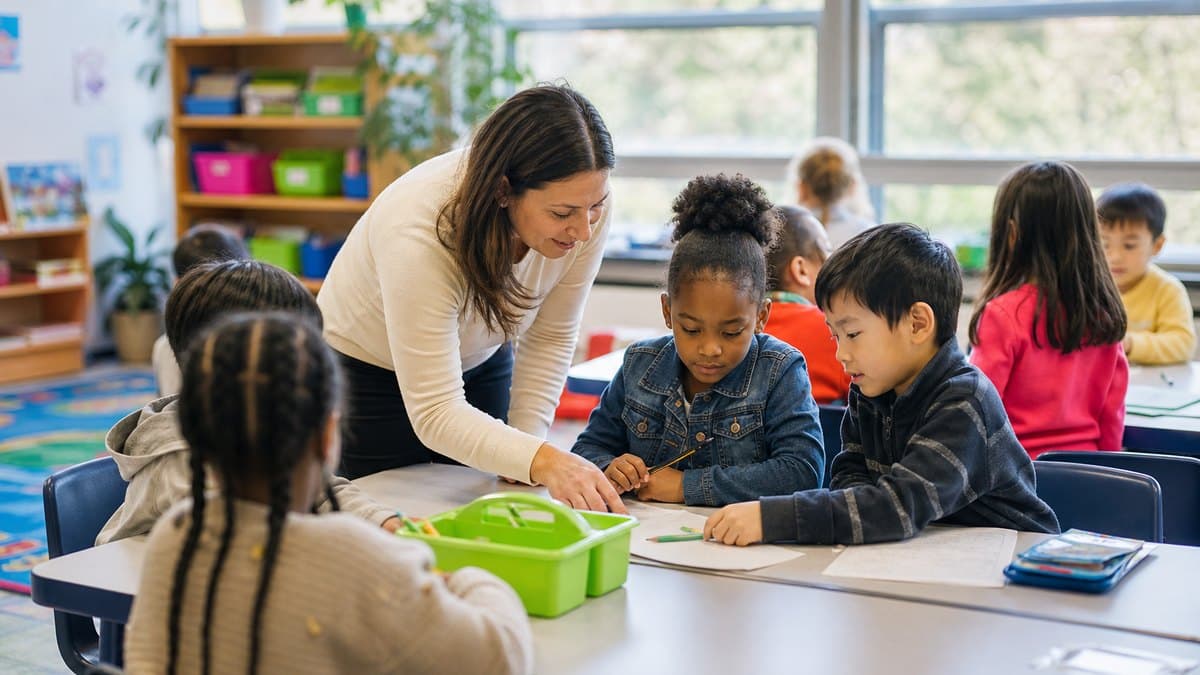
Students learn side by side, with instruction divided between the two languages. Because roughly half the class are native speakers of each language, students hear authentic models and support each other’s acquisition. Programs typically start in the early elementary grades and continue upward, ideally through at least grade 5 and often into middle and high school, for the model to reach its full effect. The goal is not just to “cover” both languages but to develop grade-level academic proficiency and literacy in each.
| Language split | How it works |
|---|---|
| 90/10 | Begins with about 90 percent of instruction in the partner language, moving toward balance by the upper grades. |
| 50/50 | Splits the two languages evenly from the start. |
The 90/10 model front-loads the minority language (which has less support in the wider society) and tends to produce stronger biliteracy; the 50/50 model is simpler to staff and schedule. Both converge toward balanced bilingualism by the upper grades.
What the Research Shows
Two-way immersion has some of the strongest evidence in the field. Long-term studies, most notably the large longitudinal work of Thomas and Collier, found that English Learners in well-implemented dual language and two-way programs ultimately reach and often surpass the achievement of their peers in English-only programs, while also becoming bilingual. The catch is time: the advantages appear over many years, not in the first year or two, which is why program consistency across grades matters so much. Two-way immersion is also notable for being additive: it builds a second language for everyone without subtracting the first.
Benefits and Requirements
Two-way immersion produces strong long-term academic outcomes, full bilingualism, and cross-cultural understanding, and it positions students for the Seal of Biliteracy. It requires a balanced enrollment of both language groups, certified bilingual teachers, aligned materials in both languages, and consistency across grades, which is why planning matters. The most common failure mode is starting strong in kindergarten but losing the program in the upper grades, before the long-term benefits can materialize.
Common Challenges
- Balanced enrollment: the model needs roughly equal numbers of each language group, which can be hard to maintain over time.
- Teacher supply: certified bilingual teachers are scarce, and the program depends on them.
- Materials: high-quality, grade-level materials in the partner language are not always available.
- Program continuity: the payoff requires sustaining the program through the upper grades, which takes district commitment.
Language Separation or Translanguaging?
One of the liveliest questions in two-way immersion is how strictly the two languages should be kept apart. The traditional approach is strict language separation: each language has its own dedicated time, subject, or space, and teachers avoid mixing them, on the theory that clear boundaries protect the minority language and push students to use each one fully. Many well-regarded programs are built this way, and separation remains a common and defensible design.
A newer approach, translanguaging, argues that bilingual students naturally draw on their whole linguistic repertoire and that allowing flexible, purposeful use of both languages can deepen understanding, for example letting a student brainstorm in one language before writing in the other. Proponents see it as more authentic to how bilinguals actually think and as an asset-based stance that values students’ full language resources. Critics worry that without careful structure it can let the dominant language, usually English, crowd out the partner language. In practice, many programs land somewhere in between: they maintain strong dedicated spaces for each language while allowing intentional bridging at specific moments. For a district, the point is not to pick a side dogmatically but to decide deliberately how the two languages will be managed, and to protect the partner language either way, since it is the one the surrounding environment does not reinforce.
Building Family and Community Support
Two-way immersion depends on two communities choosing to participate, and sustaining that partnership is as important as the instructional design. Both the English-speaking and the partner-language families need to understand and value the model, including the reality that academic benefits build over years, so that they stay committed through the early grades when progress can look slow. Clear, ongoing communication with families in their own languages is essential, and it models the two-way respect the program is built on.
Equity deserves particular attention. Two-way immersion is at its best when it genuinely serves the minority-language community that the partner language comes from, rather than becoming a program that primarily benefits English-speaking families seeking a second language. District leaders should watch enrollment and access to ensure that the families whose home language anchors the program are well represented and supported, and that the program affirms their language as an asset rather than treating it as a resource for others. Programs that attend to this, keeping balanced enrollment, communicating with all families, and centering the community whose language is being learned, build the broad, durable support that carries a two-way program through the years of continuity its outcomes require.
Frequently Asked Questions
What is two-way immersion?
A dual language program where native English speakers and native partner-language speakers learn together in both languages, with both groups becoming bilingual.
How is it different from one-way dual language?
One-way serves mostly one language group; two-way deliberately mixes native speakers of each language so they model the languages for each other.
What are 90/10 and 50/50?
They describe the instructional time split between the two languages: 90/10 starts mostly in the partner language; 50/50 is even from the start.
Is two-way immersion effective?
Yes. Long-term research associates it with strong academic outcomes and full bilingualism for both groups, though the benefits appear over many years, not immediately.
What does a district need to run it?
Balanced enrollment of both language groups, certified bilingual teachers, materials in both languages, and a commitment to continue the program through the upper grades.
Should the two languages be kept strictly separate?
There are two views. Strict language separation gives each language its own time or space to protect the minority language. Translanguaging allows flexible, purposeful use of both to deepen understanding. Many programs blend the two, keeping strong dedicated spaces while allowing intentional bridging. Either way, protect the partner language.
What is translanguaging?
An approach that lets bilingual students draw on their whole linguistic repertoire, for example brainstorming in one language before writing in the other. Supporters see it as authentic and asset-based; critics worry it can let the dominant language crowd out the partner language without careful structure.
How does two-way immersion stay equitable?
By genuinely serving the minority-language community the partner language comes from, not becoming a program mainly for English-speaking families. Leaders should watch enrollment and access so the families whose home language anchors the program are well represented and their language is affirmed as an asset.
What role do families play in a two-way program?
A central one. Both language communities must value the model and stay committed through the early grades when progress looks slow. Clear, ongoing communication with families in their own languages sustains the partnership and models the two-way respect the program is built on.
Related Resources
- Dual Language Programs
- What Is Bilingual Education?
- Bilingual Education Programs
- Transitional Bilingual Education
- What Is the Seal of Biliteracy?
Conclusion
Two-way immersion is dual language at its most collaborative: two groups of students building each other’s languages toward full bilingualism. It asks for balanced enrollment, strong bilingual teachers, and years of consistency, and it rewards them with some of the best outcomes in the field, powered by daily speaking practice in both languages.
Sources: Center for Applied Linguistics; Thomas, W. and Collier, V. (2002), A National Study of School Effectiveness for Language Minority Students; U.S. Department of Education, NCELA.
When Peer Language Models Are Not Enough on Their Own
The elegance of two-way immersion is that students teach each other, half the class modeling one language and half the other. In practice, though, a quiet student can sit beside a fluent peer all year and still speak very little, because proximity is not the same as participation.
That is the model’s hidden fragility. The design assumes rich two-way talk, but a single teacher cannot guarantee that every child in both language groups gets enough active output in each language to keep the exchange balanced.
Districts running strong programs add practice that supplements the peer models rather than replacing them, in both languages. Telo AI is one example, with separate English, Spanish, and French apps that give each student individual conversation while the teacher tracks who is actually talking.
See how programs keep both language groups actively speaking: https://mytelo.ai/how-telo-works/
With that support, the peer-modeling design delivers the balanced bilingualism it promises instead of leaving quieter students behind. The two-way programs that reach their long-term payoff are the ones where every student, not just the outgoing ones, kept speaking both languages year after year.
Found this guide useful?
Preferred sources show up more often in your Google results, including AI Overviews.