

Last updated:
Estimated reading time: 7 minutes
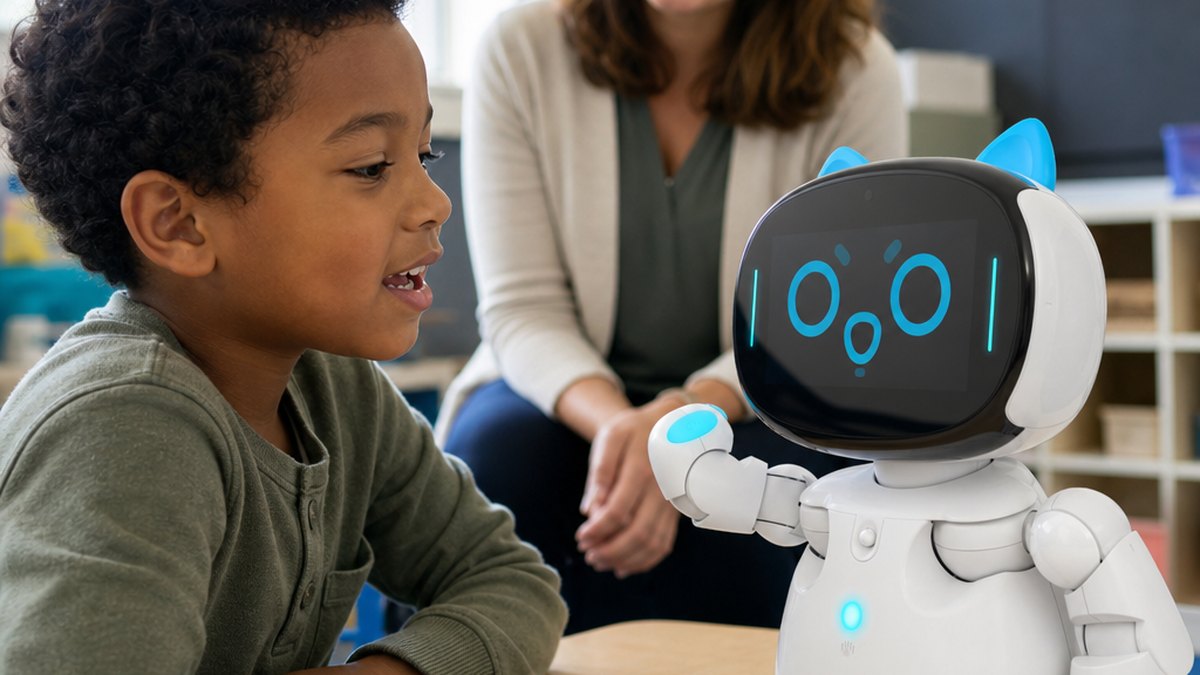
Conversational AI in education is technology that students learn with by talking or chatting, rather than by clicking through fixed content. It is the engine behind AI tutors and speaking-practice tools, and it is what makes individualized interaction possible at classroom scale. This guide explains what conversational AI in education is, how it differs from a basic chatbot, where it helps in K-12, and how districts adopt it responsibly.
Table of contents
Executive Summary
Conversational AI lets students interact with a system through natural dialogue, spoken or typed, and the system responds adaptively. The difference from a generic chatbot is purpose: educational conversational AI is built around a learning goal, adapts to the student, and gives instructionally useful feedback. Its highest-value K-12 use is interactive practice, especially speaking practice for English Learners, where the bottleneck is one-to-one conversation time a single teacher cannot supply. Adoption should follow district and state AI guidance and protect student data.
Key Takeaways
- Conversational AI in education teaches through dialogue, not fixed clicks.
- It differs from a basic chatbot by being goal-driven, adaptive, and instructional.
- Its top K-12 use is interactive practice, above all EL speaking practice.
- It powers AI tutors and speaking companions.
- Adoption should follow state/district AI policies and protect data.
What Conversational AI in Education Is
Quick answer: conversational AI in education is software that students learn with by speaking or chatting, and that adapts its responses to each student in real time. It uses natural-language understanding to interpret what a student says and generate a relevant, level-appropriate reply, turning learning into a back-and-forth instead of a one-way feed of content.
Conversational AI vs a Basic Chatbot
| Basic chatbot | Educational conversational AI |
|---|---|
| Answers questions | Pursues a learning goal |
| Same for everyone | Adapts to the student |
| No instructional feedback | Gives feedback that builds skills |
| General-purpose | Built for the classroom and standards |
Where It Helps in K-12
- Speaking practice for English Learners, the strongest fit.
- Tutoring dialogue that walks a student through a concept.
- Reading and comprehension through discussion.
- Practice and review in a question-and-answer format.
Why It Fits English Learners Best
Language is learned through use. English Learners need to speak, but the Speaking Time Gap, the shortfall between needed and available speaking practice, means one teacher cannot give 25 students daily conversation. Conversational AI gives each EL a patient partner for unlimited speaking practice at their level, the single clearest payoff of the technology in K-12.
Adopting It Responsibly
Conversational AI handles student input, so adoption should follow your state’s K-12 AI guidance (most states now publish it) and your district’s AI acceptable-use policy, and the tool must protect student data under FERPA and COPPA. See AI Safety in Schools for the full checklist.
Common Mistakes District Leaders Make
- Treating any chatbot as educational. Purpose and adaptivity matter.
- Buying conversation tools without a learning goal.
- Overlooking data privacy and district policy.
- Missing the clearest use case, EL speaking practice.
Recommended Actions
Immediate (this month): Identify a concrete learning goal conversational AI could serve, often EL speaking.
Medium-term (this year): Pilot a purpose-built tool that adapts and protects data, checked against district policy.
Long-term (strategy): Use conversational AI to scale interactive practice while teachers lead instruction.
Questions District Leaders Should Ask
- Is the tool built for a learning goal, or just general chat?
- Does it adapt to each student and give instructional feedback?
- Does it meet our state/district AI policy and protect data?
- Is our strongest use case, EL speaking practice, covered?
How Conversational AI Works Under the Hood
Understanding what happens in an exchange helps a district evaluate tools. When a student types or speaks, the system uses natural-language understanding to interpret the meaning, and for spoken practice it first uses speech recognition to turn the student’s speech into text. It then generates a relevant reply. What separates an educational tool from a general chatbot is the layer around that exchange: an educational conversational AI tracks the student’s proficiency level and the learning goal, so its responses stay level-appropriate, it steers the dialogue toward the objective, and its feedback targets the specific skill being built rather than simply answering. For language practice, this is also why the quality of the speech recognition and the feedback matters as much as the conversation itself: a tool that mishears a learner or gives vague feedback teaches less than one calibrated to the proficiency levels a district actually uses.
Guardrails That Matter in the Classroom
Because conversational AI generates its responses rather than selecting from a fixed bank, it needs guardrails a district should verify before adopting. The first is content safety: the tool should be age-appropriate and filter unsuitable content, especially for younger students. The second is teacher visibility: educators need a record of what students practiced and how they did, both to guide instruction and to keep oversight of an automated interaction. The third is task focus: an educational tool should keep the dialogue on the assigned learning goal rather than drifting into open-ended chat, which is part of what distinguishes it from a consumer chatbot. Underlying all of these are the data-privacy basics, FERPA and COPPA compliance and a clear data agreement. A tool that offers rich conversation but weak guardrails is not classroom-ready, however impressive the dialogue looks in a demo.
Frequently Asked Questions
What is conversational AI in education?
It is software students learn with by speaking or chatting, which adapts its responses to each student in real time around a learning goal. It powers AI tutors and speaking-practice tools and enables individualized interaction at scale.
How is it different from a chatbot like ChatGPT?
A general chatbot answers questions the same way for everyone. Educational conversational AI is built around a learning goal, adapts to the student, gives instructional feedback, and is designed for the classroom and student-data protection.
Why is it especially good for English Learners?
ELs learn language by using it, but one teacher cannot give every student daily conversation. Conversational AI provides each student a patient partner for unlimited, level-appropriate speaking practice, its clearest K-12 benefit.
Is conversational AI safe for schools?
It can be, when the tool protects student data under FERPA and COPPA and is adopted under your state and district AI policies. Vet vendors for data practices and age-appropriate design before deployment.
How does conversational AI understand a student?
It uses natural-language understanding to interpret what a student types, and for spoken practice, speech recognition to convert speech to text, then generates a reply. Educational tools add a layer that tracks proficiency and the learning goal so responses stay level-appropriate and feedback targets the skill.
What guardrails should a conversational AI tool have?
Age-appropriate content filtering, teacher visibility into what students practiced, task focus that keeps the dialogue on the learning goal, human oversight of outputs, and FERPA and COPPA compliance with a data agreement. Weak guardrails make a tool unsuitable for classrooms regardless of how good the conversation looks.
Why does speech recognition quality matter for language practice?
Because a tool that mishears a learner or gives vague feedback teaches less. For speaking practice, accurate recognition and feedback calibrated to the proficiency levels a district uses are what make the practice count toward measured growth.
Related Resources
- AI in Education: Complete Guide
- AI Tutors Explained
- AI Safety in Schools
- AI for English Learners
- Why English Learners Need More Speaking Time
Conclusion
Conversational AI in education turns learning into an adaptive dialogue, and that is what makes individualized practice possible for a whole class at once. Its clearest K-12 payoff is giving every English Learner the speaking practice a single teacher cannot. Adopt it around a real learning goal, under your state and district AI policies, with student data protected, and it becomes a genuine multiplier of teacher capacity.
Sources: U.S. Department of Education, Title III, Part A; National Center for Education Statistics.
When Dialogue Is the Lesson, Not the Feature
In a newcomer classroom, a teacher can plan a rich discussion and still watch it fall flat, because a real conversation needs a responsive partner and there is only one of her for two dozen students who each need to talk.
The obstacle is not the technology being unavailable; it is that genuine dialogue does not scale on human attention alone. A worksheet reaches everyone at once, but a back-and-forth exchange, the thing that actually builds language, has always been limited to whoever the teacher can reach in the moment.
Districts address this by choosing conversation tools tied to a clear learning goal rather than open-ended chatbots. Telo AI is one example built for K-12, giving each student adaptive, feedback-rich dialogue in English plus Spanish and French for dual-language and immersion programs.
See how goal-driven dialogue works for language practice: https://mytelo.ai/how-telo-works/
Interaction is where language lives, and it has always been the scarcest thing a classroom can offer. When every student can hold a real exchange at their own level, conversation shifts from an occasional event to something they get every day.
Found this guide useful?
Preferred sources show up more often in your Google results, including AI Overviews.