

Last updated:
Estimated reading time: 6 minutes
This fall, the Salamanca City Central School District in Western New York will place a life-sized humanoid robot named Sally in front of high school students, and the story made national headlines. It is easy to fixate on the machine. That is the wrong focus. Classroom robots are no longer science fiction, and the real question for district leaders is not whether they belong in schools, but which ones actually help every student learn. In just a few years the conversation has shifted from “Should we use robots?” to “How should we use them, and which ones can we afford to scale?”
Table of contents
The Real Story Behind the Headlines
Only a few years ago, classroom robots were treated as futuristic experiments or research demos. Today, superintendents and curriculum directors are actively asking how AI can personalize instruction, raise engagement, and create more learning opportunities for students who need them.
That is the real story. School districts are becoming comfortable with the idea that AI-powered robots have a legitimate place in K-12 education. Once that assumption takes hold, the important decisions become practical ones: cost, access, and measurable results.
What Actually Happened in Salamanca
The headline that sparked this conversation involves the Salamanca City Central School District in Western New York, a roughly 1,300-student district on the Seneca Nation reservation where about 79% of students are economically disadvantaged. This fall, the district plans to introduce a life-sized humanoid robot named Sally into high school AI and robotics courses.
The specifics matter for any leader weighing a similar move:
- The robot reportedly cost the district about $57,590, discounted from a roughly $95,000 list price.
- It will start in elective AI and robotics classes, using a curriculum associated with Apple co-founder Steve Wozniak.
- It is stationary, with upper-body and facial movement, and can provide real-time translation in more than 100 languages.
The district’s rationale is sound. As leaders there have framed it, schools should teach students to use technology responsibly rather than pretend it does not exist. That is a defensible instinct. The open question is what this model means for the thousands of districts that do not have a spare $58,000 for a single unit.
The Rise of AI Teaching Assistants
Teachers face a structural challenge that no amount of effort fully solves. Every classroom holds students with different strengths, needs, and speeds. English Learners, in particular, need far more speaking practice than a single class period can provide. Shy students rarely volunteer. Others need a concept explained three times before it lands.
The United States enrolls roughly 5 million English Learners, about 10% of public school students. No teacher can give each of them unlimited one-on-one attention, and this is where AI can make a real difference: not by replacing teachers, but by extending their reach with individualized practice, immediate feedback, and additional learning time.
This gap is not a teaching flaw. It is arithmetic. A teacher with 25 students in a 45-minute block has 1,125 student-minutes to distribute. Even if half of that were pure one-on-one speaking, which it never is, that is about 22 minutes per student per week, under 5 minutes a day. We call this the Speaking Time Gap, and closing it is exactly where AI teaching assistants earn their place.
Bigger Isn’t Always Better
Recent announcements have centered on life-sized humanoids designed to resemble adults. They are impressive engineering. But for K-12 schools, the decisive questions are practical: Can districts afford them? Can they be deployed across many classrooms? Can every student benefit, or only a handful?
Cost forces the issue. If a robot costs tens of thousands of dollars, a district can buy one or two units, which means most students never touch it. The table below shows why the design choice matters at the district level.
| Consideration | Life-sized humanoid | Compact classroom robot |
|---|---|---|
| Approximate cost | $50,000 or more per unit | Under $2,000 per unit |
| Units per $50K budget | 1 | 25 or more |
| Best fit | Single demonstration or elective | Classrooms, libraries, small groups |
| Students reached | A small cohort | Every student in the building |
We believe AI should reach every classroom, not only schools with the largest innovation budgets. When one robot costs as much as a teacher’s aide for a year, access becomes the whole ballgame.
A Different Design Philosophy
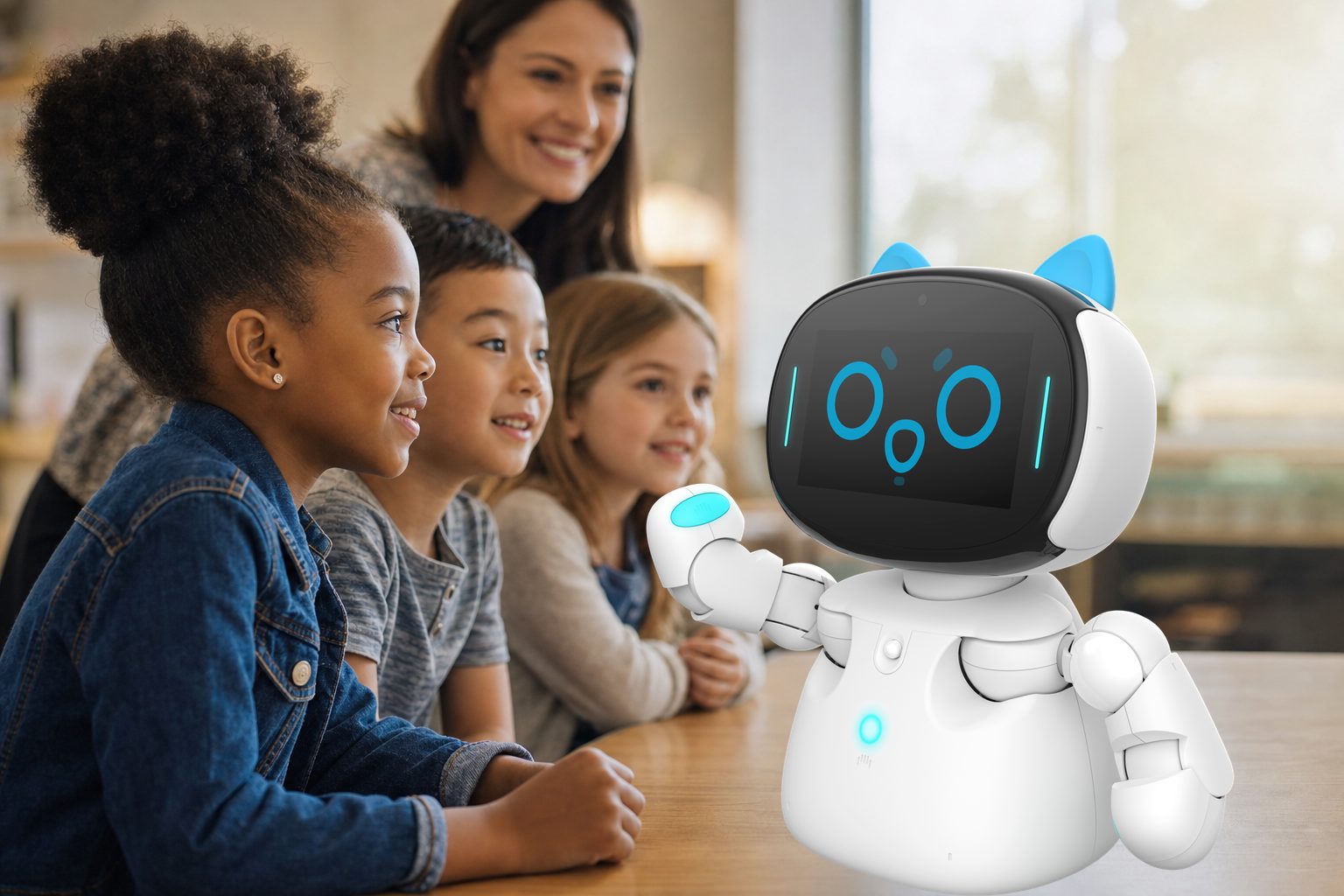
At Telo AI, we deliberately chose a different path. Instead of building a life-sized humanoid, we built a compact, approachable robot designed for elementary and middle school students, and a web version that runs on any Chromebook or tablet.
There are three reasons behind that decision. First, younger learners respond more naturally to friendly, expressive characters than to machines imitating adults. Second, a smaller robot is easy to deploy across classrooms, libraries, intervention rooms, and small-group instruction. Third, and most important, affordability changes the math: keeping hardware under $2,000 lets a district move past a single demonstration unit and start scaling AI support across many rooms. The goal is not to own one impressive robot. It is to help as many students as possible.
Teachers Stay at the Center
Whenever new classroom technology appears, one question follows immediately: will it replace teachers? Our answer is no. Teachers remain the most important part of every classroom. They motivate students, build relationships, read emotions, manage the room, and make instructional judgments no AI can replicate.
Robots should not try to become teachers. They should become teacher assistants. An AI assistant can provide extra speaking practice, answer routine questions, encourage hesitant learners, and collect learning data that helps teachers make better decisions. That frees teachers to do what only humans can do.
From Vision to Reality
This future is no longer theoretical. Districts across the United States are already exploring how AI can support multilingual learners. At Telo AI, we are proud to work with districts including Alabaster City Schools in Alabama, Franklin Square UFSD and Maine-Endwell CSD in New York, and Ysleta ISD in Texas.
Each has different goals. Some want more speaking opportunities for English Learners. Others want more personalized instruction or additional support for teachers. What they share is a belief that AI becomes a practical classroom tool when it is designed around educators’ needs. You can see how it works with your own students before committing to anything.
Questions District Leaders Should Ask
Before signing a purchase order for any classroom robot, a leadership team can pressure-test the decision with a few questions:
- How many students will actually interact with this device each week, and for how many minutes each?
- What is the cost per student reached, not the cost per unit?
- Can we deploy it across multiple classrooms, or only in one showcase room?
- What measurable learning outcome are we trying to move, and how will we track it?
- Does it reduce teacher workload, or add to it?
The Future of Classroom Robotics
The arrival of classroom robots should not be read as a contest between hardware designs. It marks the start of a broader shift in how schools deliver instruction. Over the coming years, districts will keep experimenting: some robots will focus on social interaction, others on STEM, tutoring, or language learning.
The winners will not be the most human-looking machines. They will be the solutions that produce measurable learning outcomes, fit naturally into classroom routines, earn teachers’ trust, and stay financially accessible for districts. The future of education is not about replacing teachers with robots. It is about giving every teacher an intelligent assistant so every student receives more personalized learning. That is a future worth building.
Frequently Asked Questions
What is Sally, the classroom robot in the news?
Sally is a life-sized humanoid robot built by Realbotix that the Salamanca City Central School District in New York plans to use in high school AI and robotics courses starting in fall 2026. The district reportedly paid about $57,590 for the unit.
How much do classroom robots cost?
Costs range widely. Life-sized humanoid robots can run $50,000 or more per unit, while compact classroom robots designed for everyday instruction can cost under $2,000, which allows districts to deploy many units instead of one.
Will AI robots replace teachers?
No. AI robots work best as teacher assistants, not replacements. They can provide extra speaking practice, answer routine questions, and collect learning data, freeing teachers to focus on relationships, judgment, and instruction that only humans can provide.
Are classroom robots useful for English Learners?
They can be, when they deliver individualized speaking practice. English Learners need far more conversation time than a single class period allows, and AI assistants can close that Speaking Time Gap with unlimited, low-pressure practice and immediate feedback.
What should schools look for in a classroom robot?
Prioritize cost per student reached, ease of deployment across many classrooms, measurable learning outcomes, teacher trust, and reduced teacher workload, rather than how closely the robot resembles a human.
Related Resources
- The Complete Guide to Educational Robots in K-12 Schools
- Best Strategies for EL Speaking Practice
- AI for Education: What District Leaders Need to Know
- Book a Demo: See Telo AI in Action
Sources: NY Focus, NewsNation, National Center for Education Statistics.
Found this guide useful?
Preferred sources show up more often in your Google results, including AI Overviews.